
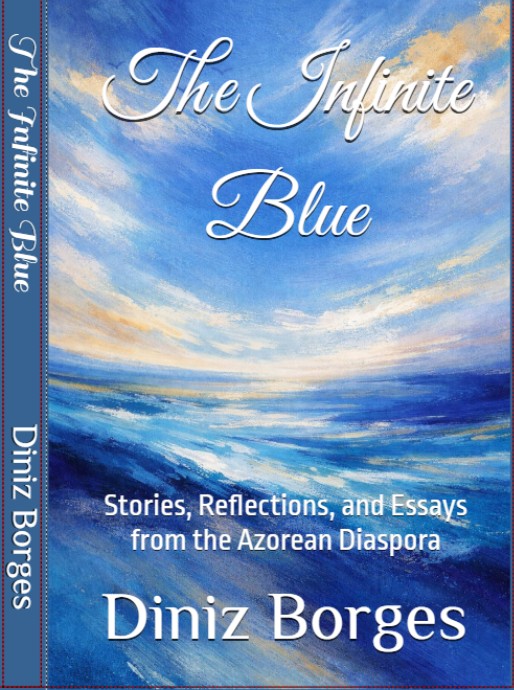
There are books written at a desk. And there are books written across water. This one has been written across a lifetime.
At dusk, when the Atlantic settles into that deep, interior blue, I often think of the cagarro circling above the basalt cliffs of Terceira. Its flight has never seemed to me like departure. It traces an invisible line between worlds — between what we leave and what we carry, between island and continent, between language and memory.
For most of my life, I have written in Portuguese.
I have lived inside that language — its cadences, its ironies, its Atlantic breath. I have translated it, defended it, argued for it, trusted it. I have carried it into classrooms, into radio studios, into archives, into conversations across generations.
But there comes a moment when reflection must cross its own ocean.
This book is that crossing.
It gathers decades of thought — about the Azores, about autonomy, about literature, about a people whose sense of place does not diminish with distance. Our islands do not fade once we leave them. They take root elsewhere. They speak in new accents. They are studied, debated, translated, questioned, and renewed. What began in basalt and salt wind continues in valley light and city streets — not as a relic carefully preserved, but as a living inheritance actively shaped.
The diaspora has never felt far to me. It has always been near — in Fresno and Fall River, in Toronto and Tulare, in the quiet labor of teachers, students, writers, and families who refuse to let their history shrink into folklore. The Azores are not a seasonal memory. They are a presence that breathes through institutions, scholarship, and the daily work of cultural responsibility.
And so, after a lifetime of writing in Portuguese and translating others into English, I felt it was time to bring this experience — this ongoing Atlantic meditation — into English myself.
Not to step away from one language.
But to let the tide move differently.
A lighthouse beam crosses the page.
It does not replace what came before.
It widens the field of vision.
This new work has just been published.
I release it the way one releases a message in a bottle —
not into emptiness,
but into a sea already alive with crossings.
If the Atlantic has taught me anything,
it is that it does not divide us.
It carries us.
Its waters move between islands and continents
the way memory moves between generations.
May these pages travel as our people have traveled —
not away from home,
but with it.
Abraços
Diniz Borges
A special thanks to Avelina da Silveira — poet, novelist, essayist, editor, and friend — for the wind behind these pages, and for joining Bruma Publications and MoonWater Editions in this crossing of waters, lands, and words.
You can order the book on Amazon
 Filamentos (artes e letras)