World Radio Day has never been just another date to me. It is not a ceremonial nod to technology or media history. It is something closer to a private anniversary — a reckoning with the invisible current that has moved quietly through my life, shaping it in ways I only understood much later. Radio was never simply sound. It was breath, belonging, argument, solace, vocation.
On Terceira Island, in Canada dos Pastos, before we left in 1968, we owned a small radio — unremarkable, almost fragile. It sat in our home like a modest altar. Every day we gathered around it. Through that little box came the voices of the Rádio Clube de Angra — news, music, announcements, laughter, the tonal rhythm of a community speaking to itself. I did not know it then, but I was already apprenticed to the spoken word. The radio taught me that language carries temperature, that a voice can warm a room, that even silence between phrases has meaning.
Then we crossed the ocean.
In the ranches and farm fields of California’s southern San Joaquin Valley, radio became my refuge. More than television, more than any screen, it was radio that steadied me. I was ten years old, but I understood that when I heard Portuguese on the airwaves, I was not entirely displaced. Those programs in our language stitched the Valley back to the Atlantic. Through them came fado and folk songs, news from Portugal, advertisements for bakeries and festas, and the cadence of a people refusing to dissolve. Radio was not entertainment; it was continuity.
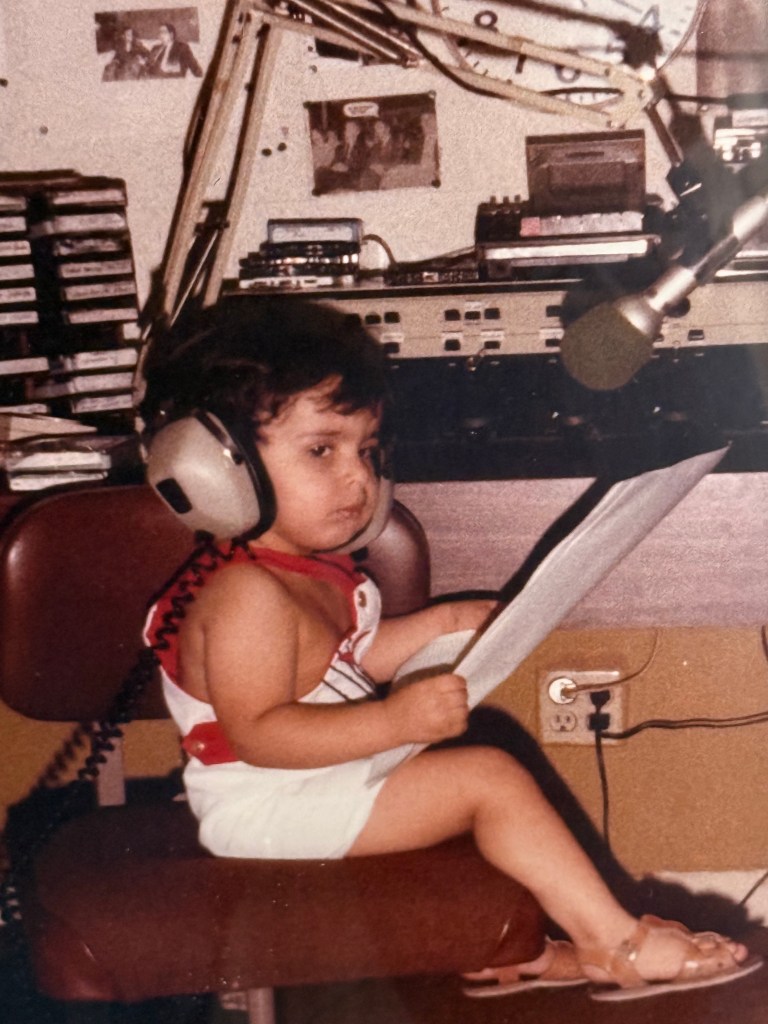
At seventeen, I stepped timidly into that world. A family friend, Manuel Simões, invited me into his program — later joined by Pedro Miranda — and for the first time I felt the nervous electricity of speaking into a microphone. Two years later, at eighteen, I launched my first program: The Voice of the Portuguese Emigrant. The title was naïve, utopian, perhaps too grand for a teenager driving forty minutes each way to KOAD in Lemoore for a Saturday morning broadcast. But it was sincere.
The first show was blessed by Father Dinis da Costa — and then came the moment I still carry like a talisman. A phone call from Joaquim Morisson, an iconic figure in Portuguese-language radio. He congratulated me. I floated. That one hour on the air required three or four hours of preparation: selecting each song, writing each live commercial, crafting each line of text, arranging the flow so that nothing felt accidental. It was unpaid, but sacred labor.
In 1980, I ended that first program and joined Joe Silva and Aires Madruga da Silva to create Rádio Aliança 80, broadcasting weeknights from eight to ten on an American station. It was more structured, more ambitious — local news, news from Portugal, careful musical curation. And it was there, at twenty-two, that I learned radio’s harder lessons. When I reported the arrest of a young Portuguese man accused of drug offenses, the backlash was swift and fierce. “We do not speak of our own crimes,” some said. I was accused of betrayal. But radio, if it is honest, cannot be only celebration. It must also bear witness.
In 1982, we launched Rádio Clube Comunidade, broadcasting twelve hours a day through a closed-circuit FM subfrequency. Listeners paid four dollars a month to rent a special receiver. We aired everything — music, commentary, even costly live soccer broadcasts from Portugal. It was audacious, improbable. I left in 1983, but continued in journalism, co-founding the newspaper Novidades. Later came collaborations, community programming, more hours given freely to a public that often did not see the sacrifice behind the sound.
In 1988, we created KTPB — Kings Tulare Portuguese Broadcasting — again through a closed system, but this time listeners purchased adapted radios outright. By 1990, I was news director and program director. The utopia lasted until 1993, when I stepped away to devote myself fully to another calling: teaching.
Yet radio had already done its quiet work on me. It sharpened my love of reading. It deepened my commitment to culture. It disciplined my ear to nuance and responsibility. Through radio, I came to understand exile not only as loss but as a condition that demands articulation. The microphone became a bridge between the community I thought I knew and the one I was discovering daily.
In 1989, I began a long career in television, hosting The Portuguese in the Valley for nearly three decades. But even under studio lights, I knew something essential: radio remained my truest medium. There is an intimacy in disembodied voice that television cannot replicate. Radio trusts the listener’s imagination. It demands attention without spectacle.
In 2019, I returned to radio once more with The Portuguese-American Hour, a project of the institute I direct at the university. This time in English — an effort to create space for reflection on our diaspora in a language the younger generations inhabit more comfortably. The station later changed formats; the experiment lasted just over two years. But the old pulse returned.
Today, in the southern San Joaquin Valley — as in so many immigrant communities — there is no longer a community radio presence, neither in Portuguese nor in English. Something vital has been lost. If Portuguese is still spoken in homes across California’s diaspora, we owe that persistence to grandparents — and to decades of Portuguese-language radio that kept the language alive in kitchens, garages, and pickup trucks before dawn.
I do not recall these years with nostalgia. I recall them with clarity. Radio formed me. It taught me that community is an act of listening as much as speaking. Yesterday it was a small transistor radio in a Terceira kitchen; today it may be a digital stream crossing continents. The technology evolves. The human need does not.
Radio is an unseen current. It moves through walls, across oceans, through generations. It is a voice entering the dark and trusting that someone, somewhere, is awake. And even now, long after the red “On Air” light has dimmed in so many studios, I still feel that frequency inside me — steady, persistent — a reminder that as long as someone speaks with care and someone listens with intention, a community endures.
Diniz Borges
 Filamentos (artes e letras)