
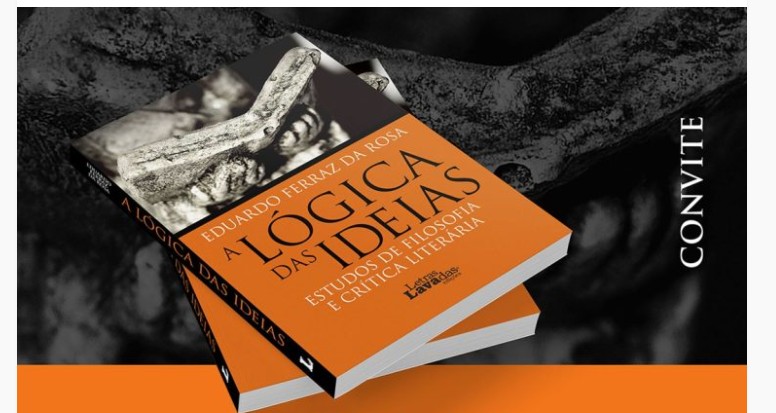
The Public Library and Regional Archive of Ponta Delgada will host, on the 26th at 6:00 p.m., the launch and presentation of the latest book by Eduardo Ferraz da Rosa.
Titled The Logic of Ideas – Studies in Philosophy and Literary Criticism, the 600-page volume will be introduced by Brandão da Luz and Urbano Bettencourt in the Library’s Projection Room.
Organized into two major thematic sections—each subdivided into three units—the book traverses a wide intellectual terrain. The first part is devoted to “pure” Philosophy and related disciplines such as Theology, Psychology, Ethics, and Religion. Here, Ferraz da Rosa enters into dialogue with thinkers including José Enes, Karl Rahner, Bernard Lonergan, Joseph Ratzinger, Emmanuel Lévinas, Martin Heidegger, Immanuel Kant, and Aristotle, alongside Portuguese figures such as Antero de Quental and Leonardo Coimbra, among others.
The second part turns to Literary Criticism, assembling a wide range of critical approaches to writers from global, national, and Azorean contexts. Among those examined are Álamo Oliveira, Fernando Aires, Sidónio Bettencourt, Rui Rodrigues, Daniel de Sá, Emanuel Félix, Eça de Queirós, Fernando Pessoa, Sophia de Mello Breyner Andresen, Álvaro Cunhal, Ruy Belo, Luís de Camões, J.M.G. Iturbe, J.M.G. Le Clézio, Alberto Manguel, and Albert Camus.
In his preface, Mendo Castro Henriques, professor at the Portuguese Catholic University, describes Ferraz da Rosa as “one of the most singular voices in contemporary Portuguese philosophy and culture.” He emphasizes that the author’s intellectual path—spanning literature, theology, anthropology, aesthetics, ethics, and history—reveals “a thinker who does not separate the act of thinking from the experience of living, and who sees philosophy not merely as a discipline but as a way of being present before the world.”
Henriques further underscores the “hermeneutic and luminous, symbolic and affective” character of Ferraz da Rosa’s prose, rooted in the Atlantic insular world yet open to the universality of culture. As noted on the back cover, with commentary by Carlos Reis, José Enes, Adriano Moreira, and Mendo Henriques, the work traces a “trajectory that unites Ontology, Ethics, Language, Literature, and Hope under a single hermeneutic horizon.” It develops an ongoing dialogue with Scholasticism, Theology, and Phenomenology, invoking—both implicitly and explicitly—figures such as Augustine, Thomas Aquinas, Lonergan, Johann Baptist Metz, Jean-Luc Marion, and Emmanuel Falque, among other contemporary thinkers. The effort is one of reconciliation: between philosophical reflection and theological inquiry, between mystical sensibility and poetic creation.

Eduardo Ferraz da Rosa—university professor, writer, researcher, and essayist—was born in Praia da Vitória, on the island of Terceira. He earned his degree in Philosophy from the Portuguese Catholic University, completing a thesis on Vitorino Nemésio, later published in Ponta Delgada with a preface by José Enes. His academic and professional trajectory includes appointments at the University of Coimbra, the New University of Lisbon, and the University of the Azores. He has served as a member of several cultural and scientific institutions, as a consultant to the Regional Government and various Azorean municipalities, and as coordinator of the Bicentennial Commemorations of Almeida Garrett and the Centennial of Vitorino Nemésio.
The evening promises not merely a book launch, but an encounter with a body of work that seeks to braid philosophy and literature into a single, sustained meditation—one anchored in the Atlantic yet addressed to the wider human conversation.
In Correio dos Açores-Natalino Viveiros-director.
 Filamentos (artes e letras)