

The Other Supreme Luso-American Poetry
Vamberto Freitas
I have read and written before about the poetry of Millicent Borges Accardi. I make it a rule never to revisit what I have already said. To return too often to the same author is to risk the unconscious repetition of one’s own enthusiasms, the dulling of a first astonishment. Let it suffice here to affirm what has long been evident: Millicent is not only one of the most compelling voices of our Luso-American diaspora in North America; she is also an indefatigable convener of literary communities, bringing poets together from the Eastern seaboard and Chicago to California.
Of mixed ancestry—her name itself a crossing—she is moved most deeply by her Portuguese inheritance. To read Through a Grainy Landscape is, for me, an act of humility and gratitude. The book arrives already framed by two distinguished figures of American letters, Katherine Vaz and Frank X. Gaspar, whose prefatory reflections might well render any further commentary superfluous. Gaspar, born and raised in Provincetown, understands this terrain intimately; he recognizes what Accardi has achieved: a seamless alloying of her poems with seminal lines from Portuguese and Portuguese-American poets, writing from their own cultures and in their own languages. This is no decorative gesture, no convenient “hook.” It is a transatlantic braid—history and lyric fused.
What I can add is born of long engagement with this evolving body of Luso-American writing, particularly since the 1990s. With Through a Grainy Landscape, something has ripened further. Through the vast, hyper-productive fields of California—the very soil that enriched and dignified generations of predominantly Azorean laborers—Accardi fashions a poetic chronicle of triumph and sorrow. Out of manual labor and restless intelligence arose what may be called the most prosperous of all Azorean territories: California itself, tilled by immigrant hands and sustained by memory.
Yet the poetry does not romanticize this inheritance. The human cost is everywhere present. There is the pain of having been, the too-human ache of labor, the intimate griefs carried behind closed doors, the endless saudade for a homeland left behind in decades of lead and lament. Accardi’s book reads almost as a novel in fragments, a sequential narrative whose lyric force draws the reader into both triumph and tragedy. Each word, each line, is weighted with lived experience.
The “grainy landscape” of the title is fertile ground, yes—a promised land—but it is also the terrain of disillusionment and longing. Irony is constant in Accardi’s vision. Alongside the heroism of immigrant endurance, we encounter the glitter of department stores, the seductions of new clothes and endless commodities, the mother anchored in the kitchen, the father returning home weary yet tender. These domestic worlds, seemingly enclosed, are never cut off from the larger America that surrounds them. The poetry does not retreat into insular nostalgia. It looks outward, attentive to the vastness of the Great Society.
If the grandparents scarcely lifted their eyes from the fields, their descendants inhabit the larger republic—studying, loving, marrying—without severing the thread of origin. Accardi underscores this continuity by invoking lines from Portuguese poets such as Renata Correia Botelho, Carolina Matos, João Miguel Fernandes, and others, weaving them into her own text. The gesture is both homage and declaration: we are not separate literatures but one unfolding conversation across languages.
For those who still imagine that our Portuguese and Luso-American letters stand at a provincial remove from the so-called centers of culture, let them reconsider. Recently, a friend suggested that I devote myself only to “great foreign writers.” But the masters of distant orthographies are not the sole custodians of literary greatness. Our Portuguese tradition—whether written in Lisbon, the Azores, or California—owes nothing to those canonical names, past or present. The critic’s duty is first to account for his own, to place them beside others in equality, and at times in superiority.
To neglect Luso-American writers would be an act of intellectual smallness. To have among us a poet such as Millicent Borges Accardi is to affirm, without apology, the enduring “pleasure of the text,” and the dignity of a people who have helped build other great societies with thought, labor, and artistic sensibility. Her presence at major literary events in Portugal and the United States over recent years is no accident; it is the natural recognition of literary and intellectual stature.
In this other supreme Luso-American poetry, the Atlantic is not a divide but a resonance. Boats become fleets; widows become choruses; the grain of California holds within it the salt of the Azorean sea. And through that braided inheritance, the lyric persists—fertile, grainy, and luminous.
Millicent Borges Accardi, Through a Grainy Landscape. New Meridian, part of the nonprofit New Meridian Arts, 2021.
“BorderCrossings: Transatlantic Readings,” published in Açoriano Oriental, December 24, 2021.
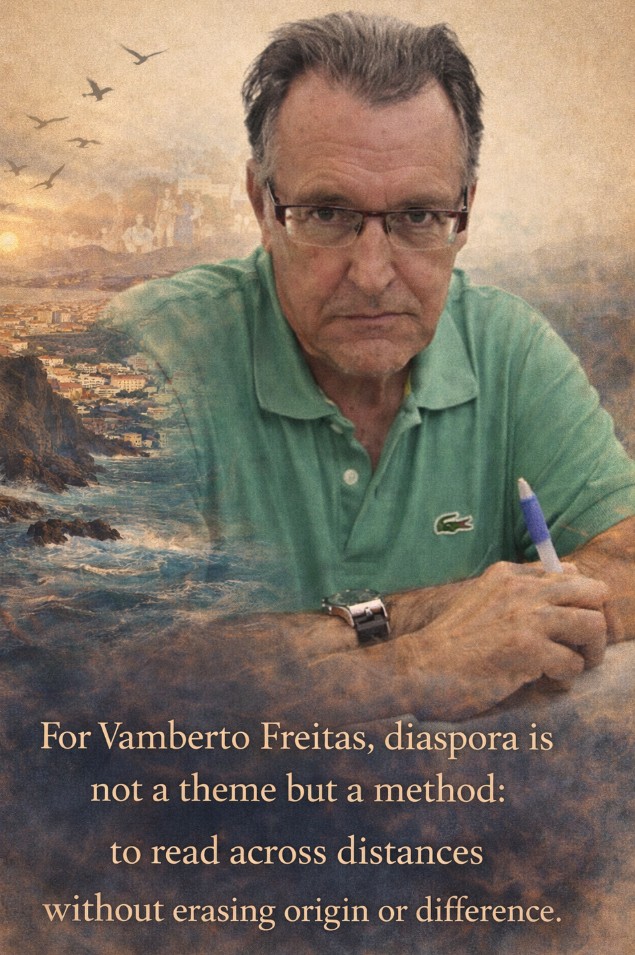
Vamberto Freitas at Seventy-Five
The Long Work of Critically Listening to and writing about Dispersed Voices
Filamentos – arts and letters
Bruma Publications | Portuguese Beyond Borders Institute (PBBI),
California State University, Fresno
Introduction
For more than three decades, Vamberto Freitas has practiced literary criticism as a form of sustained attention—patient, rigorous, and ethically alert. His work has traced the quiet, often overlooked trajectories of writers shaped by migration, insularity, and memory, especially those of American and Canadian authors with roots in the Azores. At seventy-five, his critical legacy stands not as a monument but as an ongoing conversation: a life of letters placed in the service of literature itself, where reading becomes an act of responsibility and criticism as a way of listening deeply to voices dispersed across geographies, languages, and generations.
Throughout the month of February, Filamentos – arts and letters, an initiative of Bruma Publications at the Portuguese Beyond Borders Institute (PBBI), California State University, Fresno, will honor this legacy with daily segments published from February 1 through February 28. Each entry will revisit, reflect upon, and extend the critical pathways opened by Vamberto Freitas, reaffirming the enduring relevance of his work within Atlantic, diasporic, and transnational literary studies.
Vision
To honor literary criticism as a form of cultural stewardship—one that listens across distance, preserves intellectual memory, and affirms the centrality of diasporic voices within the broader landscape of contemporary literature.
Mission
Through this February series, Filamentos – arts and letters seeks to celebrate the life and work of Vamberto Freitas by foregrounding criticism as a practice of care, rigor, and continuity. By publishing daily reflections, excerpts, and critical engagements, this initiative reaffirms Filamentos’ commitment to literature that crosses borders, sustains dialogue between islands and continents, and recognizes reading as an ethical act—one capable of holding dispersed voices in thoughtful, enduring relation.
 Filamentos (artes e letras)