
“The Rise of New Media and the Crisis in the Printed Press Do Not Mean the Death of Conventional Journalism…”
Osvaldo Cabral, The Azores and the New Media
By Vamberto Freitas
When one reads a first book by a journalist who is also a writer, the initial reaction is often one of suspicion—or, at the very least, an expectation of restraint. The Azores and the New Media, by Osvaldo Cabral, shattered that prejudice for me within its opening pages. Amid extensive references to regional, national, and international theorists of traditional media—print, radio, and television—as well as new communication technologies, and supported by detailed data on the reality of the islands in relation to the wider world, the reader encounters an engaging, elegant prose that never accuses gratuitously. When it does adopt a sharper tone, it is directed—justifiably—at centralized powers in Lisbon, both within and beyond the so-called national public broadcaster, which have historically failed to recognize the importance of RTP/Açores as a vital link between the islands themselves, mainland Portugal, and the Azorean diaspora.
What the book primarily does, however, is observe. It captures what enters our living rooms and workplaces every single day, compelling the reader to move line by line, page by page. That was certainly my experience. As I have written elsewhere, reading this book attentively is akin to attending a seminar on the contemporary media landscape—the many forms of media that “assault” us second by second.
I will not attempt to list all the national and international figures cited throughout the book, many of them central to debates on ethics and professional standards. What matters is that Cabral does not neglect the most important Azorean voices, whether they wrote from the islands or built their careers on the mainland. From José Lourenço, director of Diário Insular in Angra do Heroísmo, to Daniel de Sá, Jorge do Nascimento Cabral, and Ermelindo Ávila, among others; from Mário Mesquita and Mário Bettencourt Resendes—both former directors of Diário de Notícias in Lisbon—to José Medeiros Ferreira and José Lopes de Araújo, the references are wide-ranging and historically grounded. Nor are the great masters of nineteenth-century Azorean journalism forgotten; they are contextualized within their time and circumstances, many of them fierce defenders of political autonomy well before it became institutionalized.
All these invocations of the past serve a purpose: to offer a critical yet solidaristic analysis of the present. Osvaldo Cabral has one of the longest and most productive careers in Azorean journalism—from his early years at Correio dos Açores in the 1980s, to his roles as journalist and later director of RTP/Açores, and today as executive director of the historic Diário dos Açores. It has been a long journey, and his knowledge is unmatched—arguably even within the university system. More than anything else, this book stands as a brilliant history of the written press in the archipelago, tracing its evolution into the age of computers, smartphones, and other ubiquitous devices through which entire families now forgo face-to-face conversation in favor of mediated communication, whether with friends or strangers.
I do not believe there is another book in the Azores that comes close to this one in terms of scope, analytical depth, and, above all, concrete information about the journalistic history that brought us to this point—supported by island-by-island data that illuminate the current media landscape. The analysis moves outward, from the islands to the rest of the country and the world, but always returns to the Azores as the central axis of investigation.
As the title suggests, Cabral offers a sustained examination of the influence and consequences of new technologies on traditional journalism. At times he adopts a skeptical, critical stance toward the distortions produced by an obsession with speed and novelty—even in television—at the expense of serious, thoughtful public discourse. Yet he does not believe the printed press will disappear, even if its influence has become increasingly diluted, to the point where political leaders now invoke “fake news” or “alternative facts” whenever coverage displeases them. Resistance to mindless immediacy, he argues, will persist—perhaps only among a responsible elite committed to institutional integrity.
In other words, The Azores and the New Media traces the long trajectory of credible journalism in the islands, while issuing a clear warning to both larger and smaller islands alike: newspapers do not need to abandon print editions, but they must migrate to other, more immediate and constantly updated platforms. The rest depends on professional conscience and capacity: telling the truth and making room for informed opinion, as a former professor of mine in California used to say.
Cabral is also sharply critical of those who now rely almost exclusively on official press offices and public relations machinery that disseminate political narratives at various levels of power. As he writes in the chapter “Journalism and Citizenship,” citing the late sociologist Paquete de Oliveira:
“The power to inform, like political power itself, is in today’s complex society a diluted power. Centers of power are dispersed, each equipped with the means to disseminate information. The information machine has reorganized itself professionally. There are agencies, refined new techniques, the famous ‘spin doctors,’ professionally tasked with making messages function in the public sphere. And so it would be unthinkable for governments, parties, movements, or companies not to organize themselves within this framework. It seems to me that many journalists, still enclosed in a model that overvalues mission and carries a strong corporatist burden, have not yet fully grasped this ‘new communicational order.’”
I will repeat myself once more: there is no other book in the Azores that rivals this one in its breadth, analytical rigor, and historical grounding. Reading academic jargon is often a painful exercise. Reading someone who understands the problem from the inside, after a lifetime of service and still actively engaged, is an entirely different experience. Add to that the ability to write with clarity, precision, and elegance, and you have what this book offers. With The Azores and the New Media, Osvaldo Cabral makes a major contribution not only to his colleagues in the islands and beyond, but also to Azorean readers who wish to be informed—providing them with a vital starting point for thinking about how we listen to, watch, and read both our own media and that of the wider world.
I expected nothing less from a journalist like Osvaldo Cabral, yet he surpassed all my expectations. The book includes a characteristically modest preface by Onésimo T. Almeida of Brown University, which nonetheless guides the reader along a path that further enriches and clarifies the experience.
Finally, recalling a line I once read from an American journalist nearing the end of his career—though I can no longer locate the book in my overgrown library—the most perfect summation seems apt here: “I know that my greatest prize was finishing my career with my credibility intact.”
Osvaldo Cabral, The Azores and the New Media. Ponta Delgada: Gráfica Açoreana, 2018.
Originally published in Açoriano Oriental, December 11, 2019.
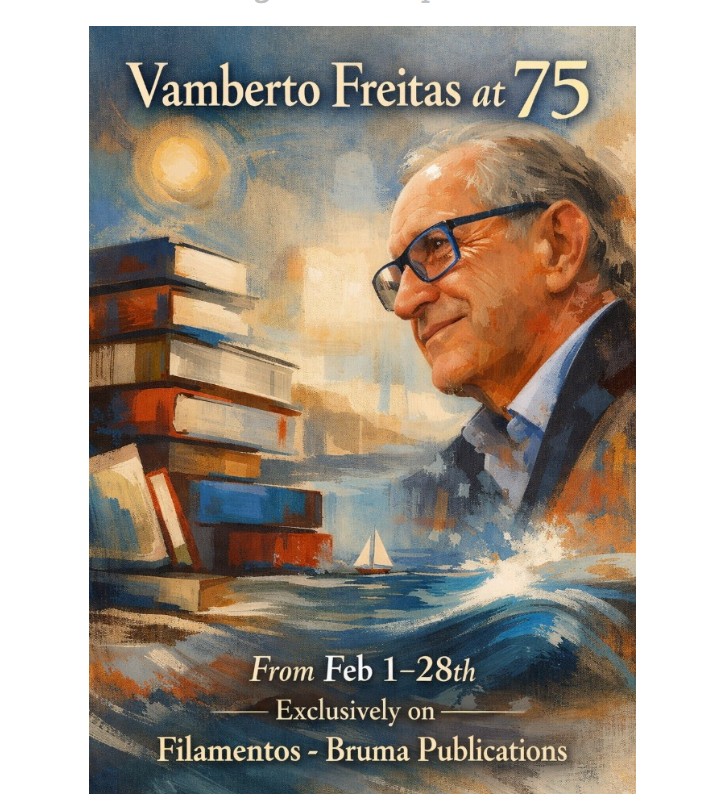
Vamberto Freitas at Seventy-Five
The Long Work of Critically Listening to and writing about Dispersed Voices
Filamentos – arts and letters
Bruma Publications | Portuguese Beyond Borders Institute (PBBI),
California State University, Fresno
Introduction
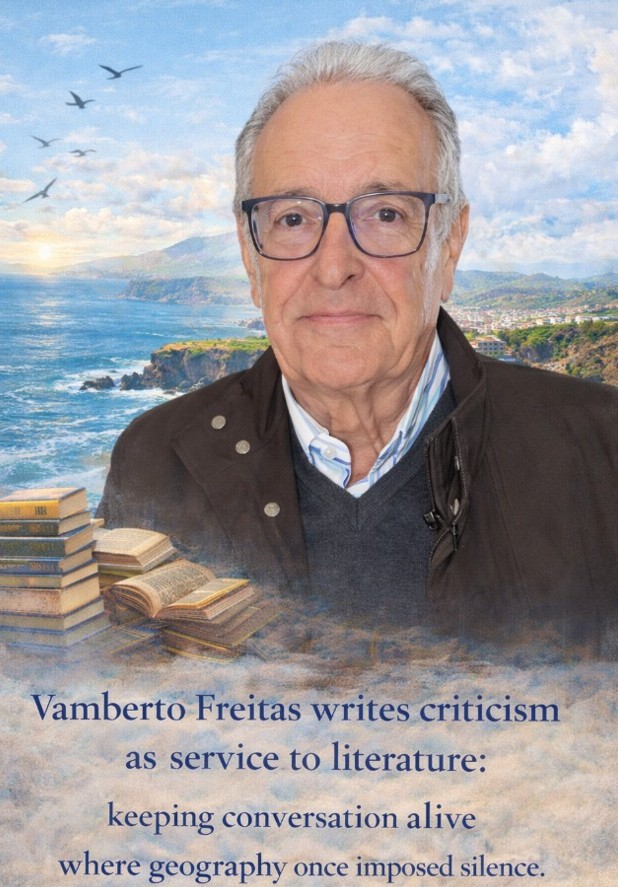
For more than three decades, Vamberto Freitas has practiced literary criticism as a form of sustained attention—patient, rigorous, and ethically alert. His work has traced the quiet, often overlooked trajectories of writers shaped by migration, insularity, and memory, especially those of American and Canadian authors with roots in the Azores. At seventy-five, his critical legacy stands not as a monument but as an ongoing conversation: a life of letters placed in the service of literature itself, where reading becomes an act of responsibility and criticism as a way of listening deeply to voices dispersed across geographies, languages, and generations.
Throughout the month of February, Filamentos – arts and letters, an initiative of Bruma Publications at the Portuguese Beyond Borders Institute (PBBI), California State University, Fresno, will honor this legacy with daily segments published from February 1 through February 28. Each entry will revisit, reflect upon, and extend the critical pathways opened by Vamberto Freitas, reaffirming the enduring relevance of his work within Atlantic, diasporic, and transnational literary studies.
Vision
To honor literary criticism as a form of cultural stewardship—one that listens across distance, preserves intellectual memory, and affirms the centrality of diasporic voices within the broader landscape of contemporary literature.
Mission
Through this February series, Filamentos – arts and letters seeks to celebrate the life and work of Vamberto Freitas by foregrounding criticism as a practice of care, rigor, and continuity. By publishing daily reflections, excerpts, and critical engagements, this initiative reaffirms Filamentos’ commitment to literature that crosses borders, sustains dialogue between islands and continents, and recognizes reading as an ethical act—one capable of holding dispersed voices in thoughtful, enduring relation.
 Filamentos (artes e letras)