

Many moments have shaped the history of the Autonomous Region of the Azores, and recording them has long been—and continues to be—the mission of Diário dos Açores. For 156 years, the newspaper has provided Azoreans with daily, regionally grounded reporting of events of deep historical and civic relevance.
For decades, the paper served as one of the principal links between the populations of São Miguel and the more remote islands of the archipelago, helping to connect Azoreans not only among themselves, but also with mainland Portugal. Geography made the Azores both central and distant, and Diário dos Açores functioned as a vital bridge in that fragmented Atlantic space.
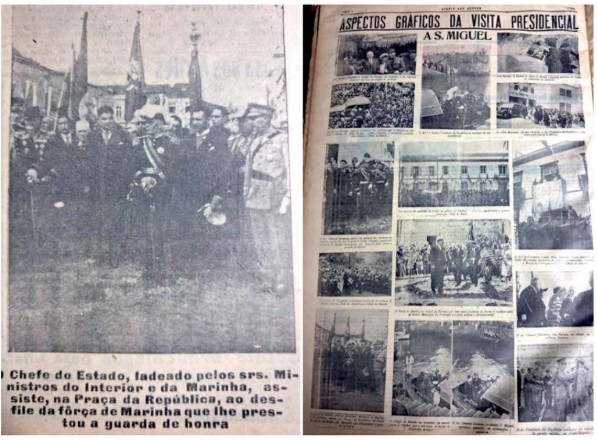
The Visit of President Óscar Carmona, 1941
Because of its geographic location, the Azores experienced certain historical events with particular intensity—especially those that were rare yet symbolically powerful. Among them were official visits by heads of state, which took on extraordinary significance in an island context.
One such moment occurred in 1901 with the royal visit of King Carlos I and Queen Amélia of Portugal, an event widely regarded as one of the most consequential in Azorean history. But this was not the only defining visit of the twentieth century.
In 1941, the official visit of the President of the Republic, General António Óscar de Fragoso Carmona, marked another historic milestone. Appointed president on November 16, 1926, and often described as lacking charisma, Carmona nonetheless ensured the stability of the military dictatorship and played a decisive role in the transition toward the Estado Novo regime, which would last until the Carnation Revolution of April 25, 1974.
On June 26, 1941, Diário dos Açores reported on a trip to Lisbon by the governors of the Azorean districts, whose principal goal was to renew their invitation for the head of state to visit the archipelago. Confirmation came two days later in the paper’s “Latest News” column:
“General Carmona has accepted the invitation extended by the governors of the autonomous districts of Ponta Delgada, Angra do Heroísmo, and Horta to visit the Azorean archipelago.”
Shortly thereafter, the newspaper announced the dates of the presidential stay, noting that Carmona would embark on July 23 aboard the ship Carvalho Araújo, escorted by a naval division. He would visit all the islands of the archipelago and spend seven days resting in the Furnas Valley on São Miguel, before returning to Lisbon on August 20.
The public response was marked by intense enthusiasm. In its July 17 edition, the newspaper described the atmosphere as unprecedented:
“The demonstrations of joy and respect toward the President of the Republic are assuming a grandeur never before seen, an admirable and elevated expression of Azorean unity. One feels that it is the soul of the Fatherland commanding this action… bringing men closer together and sealing an indissoluble pact directed simply and solely toward the love we all owe Portugal.”
On July 26, Diário dos Açores published a special edition almost entirely dedicated to the presidential visit. Under the headline “Honor and Glory of the Azores to the President of the Republic,” the paper detailed the itinerary and the official entourage, which included the Minister of the Interior, Dr. Pais de Sousa; the Minister of the Navy, Commander Ortis de Bettencourt; and the president’s wife, Maria do Carmo de Fragoso Carmona. The edition also highlighted São Miguel’s agricultural, political, and intellectual contributions, referencing prominent Azorean figures such as Antero de Quental, Hintze Ribeiro, and Father Sena Freitas.
The arrival of Carmona in Ponta Delgada on July 27 was described as one of the most emotionally charged moments in the island’s history. The newspaper’s vivid account captured the scale of the reception:
“The people of São Miguel lived through unforgettable hours of intense patriotic emotion… fireworks, salutes, cheers, applause, and patriotic hymns in an apotheosis our generation had never seen—nor even imagined.”
The detailed narration continued in subsequent editions, as did the description of the president’s departure, marked by collective emotion and symbolic closure:
“Handkerchiefs still waved as the ship disappeared from sight… and only then did the crowd disperse, the people of São Miguel—fulfilled in their duty—returning to the struggle of daily life, to work so that Portugal may increasingly become a perfect unity, eternally belonging to all Portuguese.”
Although many heads of state would later visit the Azores, this visit held special prominence as the first official presidential visit following the establishment of the Republic.
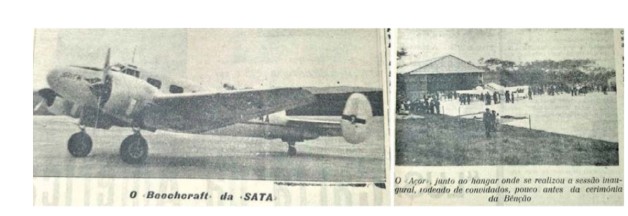
The First Official SATA Flight, 1947
For decades, maritime transport of people and goods was the primary link between the Azores and the outside world. It is therefore unsurprising that one of the region’s most transformative moments was the founding of SATA, the Azorean airline, which shifted isolation into connectivity and brought the archipelago closer to the world.
On August 21, 1941, the Sociedade Açoriana de Estudos Aéreos was founded by a group of prominent Azorean entrepreneurs, laying the groundwork for what would become SATA Air Açores. Six years later, on February 17, 1947, the company was renamed Sociedade Açoriana de Transportes Aéreos, and on June 15 of that year it officially launched operations with a Beechcraft D18S aircraft—registered as CS-TAA and named Açor.
The newspaper chronicled the excitement surrounding the inaugural flights. On June 6, 1947, it reported that the Açor had completed its test flight over Ponta Delgada, drawing widespread public attention. On June 9, the aircraft carried its first six passengers to Santa Maria, marking the beginning of a new era in inter-island travel.
The formal inauguration, described in detail in the June 16 edition, drew thousands to the Sant’Ana airfield. The newspaper declared the moment a turning point, quoting an aviator who summarized its significance succinctly:
“São Miguel now has its arms open to the north and to the south, touching the world.”
SATA, the paper wrote, had finally given the island the means to overcome distance and claim its place in the modern world.
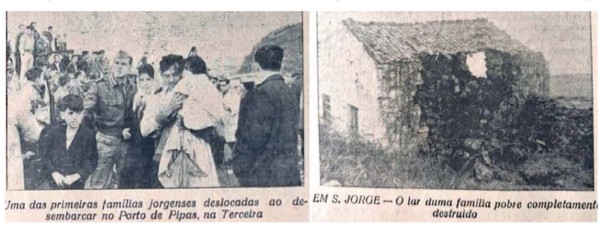
The Rosais Seismic Crisis, 1964
Not all defining moments in Azorean history were celebratory. In February 1964, the island of São Jorge was shaken by a seismic crisis that would profoundly alter the lives of thousands. Between February 15 and 21, repeated earthquakes devastated the western part of the island and forced the evacuation of nearly 5,000 people.
Diário dos Açores reported extensively on the unfolding disaster, detailing evacuations, infrastructure damage, and mounting fears. As tremors intensified, hospitals were evacuated and entire communities displaced. Solidarity efforts quickly followed, including the shipment of food supplies and assistance from U.S. military forces stationed at Lajes Air Base, which offered communications equipment, machinery, and personnel for debris removal and reconstruction.
By late February, the scale of destruction was undeniable. Officials reported that in Rosais, nearly all buildings would need to be rebuilt. Volcanologist Frederico Machado later explained that the seismic activity was likely linked to a submarine volcanic eruption southwest of Ponta dos Rosais.
The crisis officially ended in early March, but its consequences lingered. The scale of destruction, combined with limited resources, led many affected families to choose emigration as a path forward—seeking renewal and the chance to rebuild their lives elsewhere.
For 156 years, Diário dos Açores has not merely reported history—it has helped shape the collective memory of the Azores, documenting moments of triumph and tragedy alike, and standing as a vital witness to the region’s evolving story.
 Filamentos (artes e letras)