
Gávea-Brown and Luso-American Culture
May 8, 2011
Vamberto Freitas
“Let us set pornography aside and speak of immigrants. On this matter, there are misconceptions of many kinds.”
— Jorge de Sena, in the first issue of Gávea-Brown, 1980
The “pornography” Jorge de Sena invoked in his essay “Being an Immigrant—and How”, which opened the inaugural issue of Gávea-Brown back in 1980—two years after his death in California and likely among his final writings—did not refer to pornography in the literal sense. It was, rather, a metaphorical declaration, a way of describing Portuguese historicity and certain institutional relationships within parts of the academy. The concept can easily be extended to much of what was happening then—and what continues to happen around us now. Had the author of Peregrinatio ad Loca Infecta still been among us, that same verbal fury—perhaps even more violent—would fully apply to the times we are living through.
But the point here is another. What was then a “small” university journal, opening its pages with Jorge de Sena addressing our historical status as immigrants in North America—naturally alongside intellectuals and other writers—would have been more than a wake-up call anywhere. It was the missing proof that everything among us was undergoing evolutionary change, much as had happened in our country of origin a few years earlier. That first issue ran to just 53 pages, yet its formal quality had no precedent in “hyphenated” Luso studies abroad. The creative lives of our immigrants were not only undervalued; in some quarters they were flatly denied. We were supposedly nothing more than manual labor and faithful senders of remittances to save the motherland—speaking loudly and badly in every language, bursting onto the scene here from time to time in flamboyant fashion.
Following Jorge de Sena’s essay came unpublished short stories (and an interview) by José Rodrigues Miguéis and George Monteiro, along with poetry by both known and unknown voices (Luís Amorim de Sousa, Alberto de Lacerda, Urbino de San-Payo), and the artwork of the late Azorean painter Rogério Silva, who—after Faial and later Terceira—had shared the maritime fate of so many of his countrymen.
The most recent volume (XXX–XXXI, 2009–2010) of Gávea-Brown: A Bilingual Journal of Luso-American Letters and Studies has just been released. Its contents are increasingly diverse, in two languages, yet always anchored by the writing, art, and historical journey of our North American communities—articulated through a rich literature in all its forms, embodying another theme deeply our own: the seeming destiny of being perpetual navigators on turbulent seas. I will return shortly to this unique literary and cultural content, but it is long past time we grant this publication the attention it fully deserves.
It is true that Portuguese studies—perennially precarious within the world’s major academies—experienced a certain flowering in the decades following April 25, especially in countries with which Portugal has long maintained political ties or to which history has permanently bound us, including through the massive emigration of the past two centuries. Thirty-one issues in just over thirty years—many now exceeding 240 pages—divided between academic-scientific and creative sections. For a journal of this kind, one can speak of admirable persistence and of an ongoing project of projection and excavation of our literary, academic, and intellectual production within communities whose outward lifestyles and appearances might never suggest so rich a public legacy.
The truth is that our immigration—even our presence in America during the nation’s founding years—has always recorded its lived experience or passage through distant and unfamiliar lands. From the second half of the twentieth century onward, this literature flourished abundantly. Today, Gávea-Brown documents a considerable and prestigious cohort of Luso-descendants within the North American literary world who have written—and continue to write—brilliantly in English. Lusophony is multilingual, and all the richer and more consequential for it.
Gávea-Brown was founded—and remains directed—by Onésimo T. Almeida and George Monteiro at what was then the Center for Portuguese and Brazilian Studies, now a department, at Brown University—a private institution, democratically elitist, from which have emerged some of the most prominent figures in American political, scientific, and intellectual life. The journal could never exist below the standards of its institution; it would not have survived without offering the university clear added value, prestige, and above all a recognized contribution to a deeper understanding of the Lusophone world in its immigrant and Luso-American dimensions. Before or since, there has been no project like it—one born in the humility of the truly “great,” and unwavering in its original aims.
“Initially intended to convey, in Portuguese, the literary and artistic expression of the Portuguese immigrant experience in the United States,” wrote Onésimo T. Almeida in the first editorial of 1980, “it quickly became evident, even in the conception phase, that only a bilingual publication would make sense. First, because it would be meaningless to confine ourselves to a single language when the reality under examination unfolds in Portuguese and English—or simultaneously in both; second, because the journal’s potential would be significantly expanded (contributors and readers alike), with direct consequences for the quality of its contents, given the broader range from which to select.”
Once again, alongside figures such as Jorge de Sena and José Rodrigues Miguéis—two major Portuguese authors who lived in the United States for much of their lives and reflected the tensions of diasporic existence in their work—other writers and poets, in both Portuguese and English, long relegated to community silence and obscurity, were introduced to the public through their poetry, fiction, essays, or chronicles. With an Editorial Board and an Advisory Board that have evolved over the years according to specialization and merit, Gávea-Brown has consistently distinguished itself by rejecting the pretensions of so-called canonical culture (without ever neglecting it), redefining literary values, readings, and reinterpretations of the immigrant experience in America through literature.
A university journal may at times appear hermetic, aimed at a narrow circle of specialists. Yet the dynamism it generates among contributors and readers inevitably radiates outward, shaping the literary, artistic, and intellectual production of an entire society. I believe it was publications like this that ultimately awakened advanced academic interest in Portugal itself—where scholars today, across universities from north to south and throughout the islands, reaffirm the value of Portuguese immigrant writing everywhere, with particular attention to English-language Luso-descendants. Some of their books have already been translated and published in Portugal by both small and major presses.
“What has been happening over the past seven years here in California,” wrote Jorge de Sena in the inaugural essay of Gávea-Brown, “in terms of Luso and Luso-American awakening, seems unbelievable. And I am among those who have done the least—though persistently—to bring it about: without others, nothing.” With his full authority and intellectual dignity, the great poet acknowledged the growing immigrant and Luso-American ferment around him. His words endure among us—and should endure—especially in relation to projects like these.
Gávea-Brown: A Bilingual Journal of Luso-American Letters and Studies,
Volume XXX–XXXI, 2009–2010.
Department of Portuguese and Brazilian Studies, Brown University, Providence, Rhode Island.
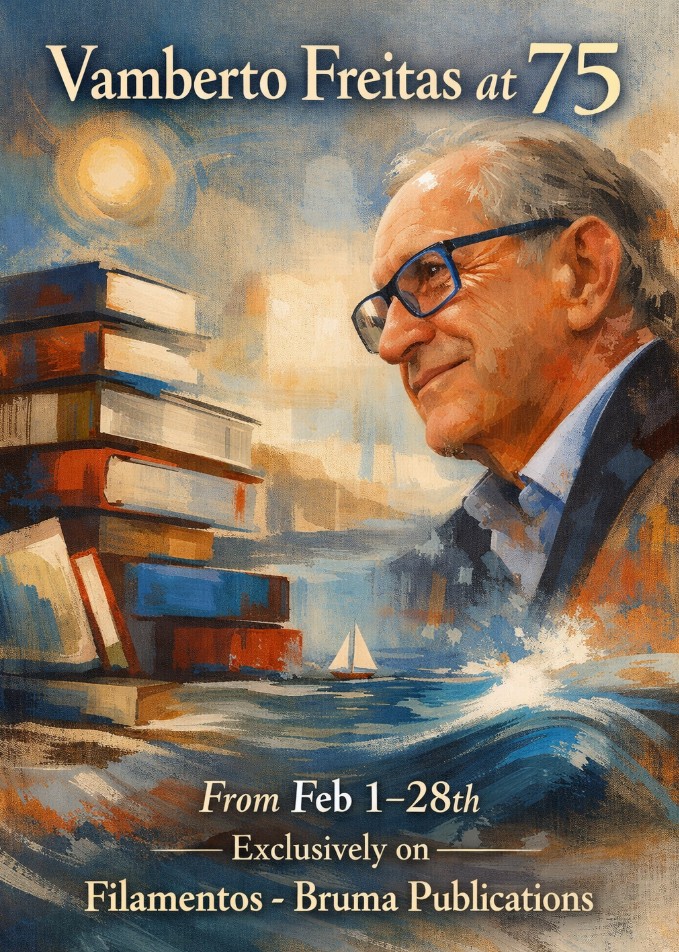
Vamberto Freitas at Seventy-Five
The Long Work of Critically Listening to and writing about Dispersed Voices
Filamentos – arts and letters
Bruma Publications | Portuguese Beyond Borders Institute (PBBI),
California State University, Fresno
Introduction
For more than three decades, Vamberto Freitas has practiced literary criticism as a form of sustained attention—patient, rigorous, and ethically alert. His work has traced the quiet, often overlooked trajectories of writers shaped by migration, insularity, and memory, especially those of American and Canadian authors with roots in the Azores. At seventy-five, his critical legacy stands not as a monument but as an ongoing conversation: a life of letters placed in the service of literature itself, where reading becomes an act of responsibility and criticism as a way of listening deeply to voices dispersed across geographies, languages, and generations.
Throughout the month of February, Filamentos – arts and letters, an initiative of Bruma Publications at the Portuguese Beyond Borders Institute (PBBI), California State University, Fresno, will honor this legacy with daily segments published from February 1 through February 28. Each entry will revisit, reflect upon, and extend the critical pathways opened by Vamberto Freitas, reaffirming the enduring relevance of his work within Atlantic, diasporic, and transnational literary studies.
Vision
To honor literary criticism as a form of cultural stewardship—one that listens across distance, preserves intellectual memory, and affirms the centrality of diasporic voices within the broader landscape of contemporary literature.
Mission
Through this February series, Filamentos – arts and letters seeks to celebrate the life and work of Vamberto Freitas by foregrounding criticism as a practice of care, rigor, and continuity. By publishing daily reflections, excerpts, and critical engagements, this initiative reaffirms Filamentos’ commitment to literature that crosses borders, sustains dialogue between islands and continents, and recognizes reading as an ethical act—one capable of holding dispersed voices in thoughtful, enduring relation.
 Filamentos (artes e letras)