
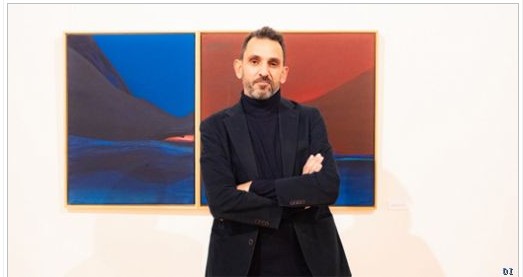
Photographs by António Araújo and Rui Melo (continuation from 2026.01.31 in Diário Insular)
Where does your connection to Álamo Oliveira come from?
My connection to Álamo goes back long before the professional relationship that later linked us until the end of his life—right up to his final days. Álamo was a frequent presence in my grandparents’ home, and later in my parents’ home. I have photographs of us as children standing next to him, with my brother in my arms. In fact, he was my brother’s godfather. Álamo used to come to our house regularly.
Before coming here today, I was remembering moments we shared. There’s something few people know: we used to call Álamo “the comrade.” My father was deeply connected to the political left in the 1970s, and they were close friends. I think it started partly as a way of teasing him, because Álamo didn’t quite fit into that rigid political camp. So whenever he arrived, we’d greet him as “comrade,” and he would go along with it. Only many years later did I fully understand why he truly was a comrade.
He was always someone who felt like family. My father died very young—I was only 12—and from that point on, Álamo became an especially present figure in our lives. He helped us immensely, on many levels. It was from that foundation that I began to shape what would become my professional path. He supported me unconditionally. When there were things he liked less, he told me so. As I grew professionally, whenever I needed him, he was there. And sometimes he was the one who took the initiative, checking in to see what I was working on. He was always—always—deeply present.
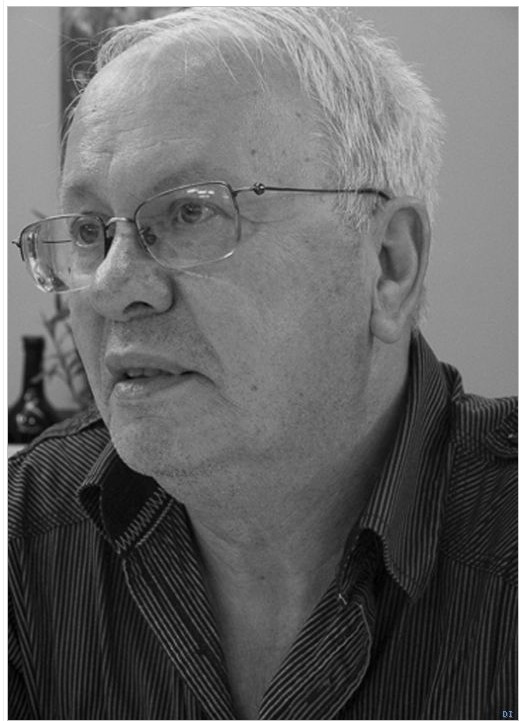
A testimonial in a documentary marking one of Álamo’s anniversaries refers to his ability to “address divisive themes without ever causing division.”
That was one of Álamo’s greatest virtues. He was completely integrated into his community—a conservative community, let’s not kid ourselves, as most Azorean parishes are. Yet in his work, and in everything he did, he managed to engage with themes that people found extremely difficult to address.
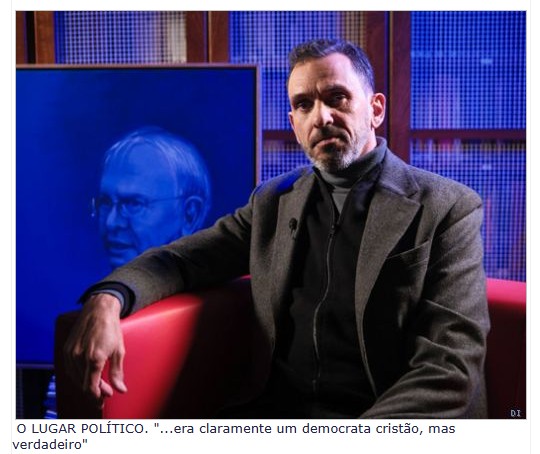
Homosexuality, for example, was a taboo—still is today, let alone back then. The colonial war was another. He was highly critical on many issues, but his criticism was always constructive. He was also deeply connected to the Church, which adds another layer of irony to the nickname “comrade”—something I understand much better now. He always found it amusing, as the intelligent man he was. He was clearly a Christian democrat, but a genuine one.
Even within the Church he knew so well—he had been a seminarian—he held a remarkably progressive vision of what the Church should be. Just look at the lyrics he wrote for Masses. They were completely outside the norm, sung in a peripheral parish on Terceira Island. As far as I know, this never caused problems—quite the opposite. It takes courage to confront a community with that kind of subject matter.
But the community trusted him.
Exactly. He built such deep trust within the community that it allowed him to do all of that. It’s interesting—just the other day, speaking with people here in Raminho, someone said to me, “We counted on Álamo for everything.” If something was needed—something aesthetic, an arrangement for the church—it was Álamo. He was a kind of aesthetic insurance policy.
That relationship developed naturally. It’s not easy for an intellectual to have that kind of flexibility. It requires great human strength. There are many great intellectuals who simply don’t have the patience for this kind of engagement. That wasn’t the case with him. He had this rare ability to connect all worlds. Álamo belonged to many worlds—and it all worked seamlessly. That is perhaps the dimension of Álamo I admire most.
In your personal selection of Álamo’s books, why Telas e Cores and Versos de Todas as Luas?
First of all, these are books he personally signed for me when they came back from the printer, as a way of thanking me for the artwork. In truth, I was the one who should have been thanking him—but he always thanked me. I have all of them signed, and I treasure them deeply.
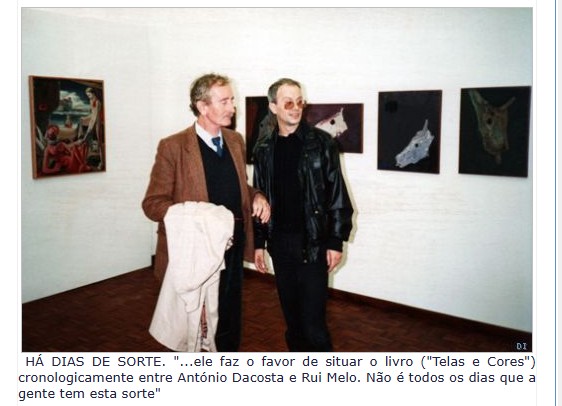
Telas e Cores was part of the reissue wave by Companhia das Ilhas and brings together his articles on the visual arts. Álamo also had a strong critical voice as an art critic. This book is particularly important to me because it includes five or six articles about my work, or where I’m mentioned, and I value that immensely. In a way, it’s the story of my life. He even situates the book chronologically between António Dacosta and Rui Melo. That doesn’t happen every day. It’s a vanity, I admit—but it was his gesture, and I’m deeply grateful for it.
The book is essentially an essay in art criticism. It opens with a substantial text on António Dacosta, a foundational figure in Azorean contemporary art, around whom subsequent generations gravitate. Many of the artists discussed are particularly tied to Terceira Island. These articles had been published in newspapers, but here they gained a different dignity.
Versos de Todas as Luas, his poetry collection, is another story. I haven’t reread all of it, but I laid out every single line with him. Unlike his other books, which followed professional, orderly graphic layouts, this one was pure Álamo—completely deconstructed. Each poem had to be assembled, sometimes line by line. He told me, “I’ve got a book here for us to do, and you’re the one who’s going to do it.” It’s a 500-page volume. We spent days working on it, almost engaging in reverse psychology with the layout software, constantly shifting lines back and forth. It was the last project in that long series, and I take great pride in having done it.
After that, I still designed the cover for the last book published before his death, Já Não Gosto de Chocolates (I No Longer Like Chocolates), translated by Diniz Borges and Katharine F. Baker. That cover was made according to the instructions Álamo himself gave me. He said, “I want cows, an American flag, and something that vaguely suggests chocolate.” I then mixed everything into a single visual composition. Sometimes he sent me these ideas by email.
The very last message he sent me contained instructions for a theater piece premiered by the group Pé de Milho, which he never lived to see. It included the program leaflet text and other notes. He wanted Camões on the cover. I came here to Raminho to photograph a Camões statue we discovered. That was, truly, the last work I did with him.
 Filamentos (artes e letras)