

How do you assess the state of conservation of religious heritage in the Azores? Are there churches in urgent need of intervention?
The state of conservation of religious heritage in the Azores is uneven. From the perspective of the built environment, there are churches in good condition, capable of welcoming both their sacred objects and the faithful in complete safety. However, there are other spaces that are more fragile and in need of interventions that range from moderate to highly structural. In many cases, most of the building is in good condition, but certain areas show progressive deterioration.
This degradation is driven by a wide range of factors: the climate (constant humidity, salinity, strong winds); traditional materials (basalt stonework and local woods), which require regular maintenance; and seismic activity, which necessitates costly and technically demanding structural reinforcements. The issue is not merely aesthetic. We are dealing with pathologies such as water infiltration, roof instability, deterioration of gilded woodcarving and tilework, among other forms of damage.
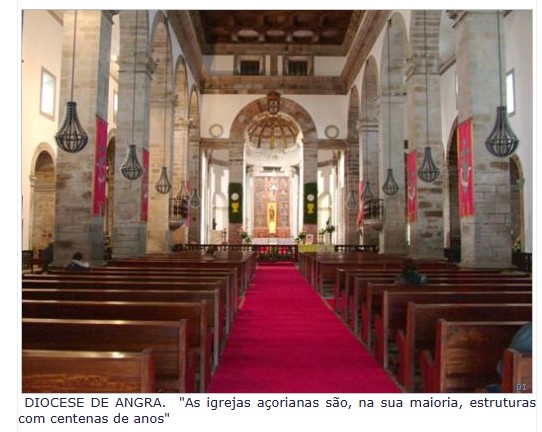
Taking all of this into account, the factor that most penalizes religious buildings is their age. Azorean churches are, for the most part, several centuries old. There are exceptions, such as some churches on Pico and Faial that were rebuilt following the agreement between the Regional Government of the Azores and the Diocese of Angra after the 1998 earthquake. Generally speaking, however, Azorean religious heritage is centuries old.
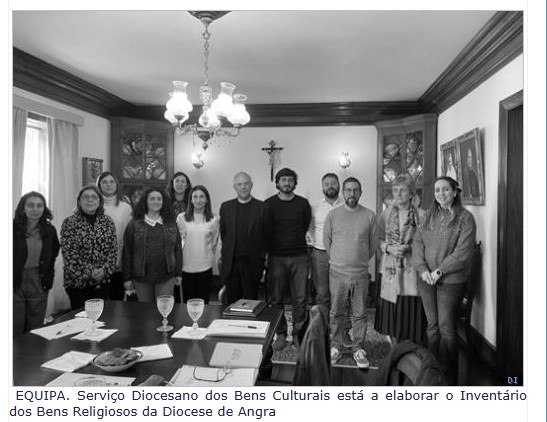
Beyond the buildings themselves, we must also care for the movable heritage inside churches: vestments, liturgical objects, paintings, sculptures, candlesticks, and many other works of art. While some pieces require restoration, the overall state of conservation of this movable heritage is generally very positive—especially when the objects are visible and in active liturgical use. When they are stored away and forgotten, the situation is far more problematic. For this reason, the Diocesan Office for Cultural Heritage is currently preparing the Inventory of Religious Assets of the Diocese of Angra, with the goal of identifying and protecting this heritage which, while belonging to the Church, is also a fundamental component of Azorean culture.
What are the most problematic cases? Are there churches closed due to safety concerns?
Yes, there are several problematic cases. The Church of Ribeirinha, in Ribeira Grande, has been closed since 2024. Recently, with the support of the Ribeira Grande City Council and the faithful, prospects have become more optimistic, and architectural and engineering projects are currently underway. It should be noted, however, that the estimated cost of the works is one million euros—a very high figure.
Still within the municipality of Ribeira Grande, the churches of Espírito Santo (in the city), as well as those in Rabo de Peixe and Lomba da Maia, are also facing structural problems, both at the level of roofing and exterior structures. In Velas, the hermitage of Jesus, Mary and Joseph shows weaknesses in its structure, particularly in the main altar. On São Jorge Island, in Urzelina, a project is underway to rehabilitate the church roof.
On São Miguel Island, the Parish Church of Ponta Delgada has suffered serious damage due to roof infiltration. In addition, this church faces the problem of termites, which, as is well known, is a widespread issue affecting many Azorean buildings and whose treatment is both complex and costly.
Maintaining this heritage is expensive. Are there support mechanisms from the Regional Government?
Yes. The Regional Government of the Azores has legislation in place that provides financial support for the recovery and conservation of privately owned immovable properties classified as being of Public Interest. This support covers 50% of the cost and, in exceptional cases, may reach up to 75%.
Currently, according to available data, there are 47 classified immovable properties, in addition to movable assets also protected by law, such as pipe organs and other liturgical objects. Beyond these, there are hundreds of chapels and churches that, while not officially classified, hold significant value and importance for local communities and therefore must also be protected and maintained. The collective effort required is therefore immense.
In this context, the role of municipal governments deserves special mention. Municipalities have been—and continue to be—essential partners in helping the Diocese care for parish religious heritage. This deep relationship with various sectors of Azorean society (government, municipalities, associations, parish communities) clearly reflects the importance of the religious phenomenon in the islands, which extends beyond the diocesan sphere and stands as a true pillar of identity and culture.
For this reason, the ideal approach must always be prevention rather than remediation. As with our own homes, it is crucial to take care of heritage on an ongoing basis and to prioritize preventive maintenance, which is far less costly than emergency restoration.

Does the community also have a responsibility to support the preservation of this heritage? Has this been happening? Is there a need to raise awareness among the faithful?
Yes, the community has played a central role in the defense of religious heritage. In fact, in many Azorean parishes, the faithful are already doing more than could reasonably be expected of them: they raise funds, organize festivals, carry out small repairs, and volunteer their time to support restoration efforts, among many other forms of assistance.
A clear example is the parish of São Mateus on Terceira Island, which has established a fundraising committee to support necessary church works. The role of parish priests is also fundamental and, fortunately, amid their many responsibilities, there is growing awareness of the needs of church buildings and increasing leadership in safeguarding this heritage.
There is, however, an issue that deserves particular attention. Today, religious communities are aging, and there is a noticeable decline in religious practice—even as parishes and churches remain. This scenario, already evident in other countries and now increasingly visible in the Azores, poses an urgent challenge: how can we ensure the conservation of these spaces and secure the resources needed for their future?
In 2025, the Pontifical Council for Culture drew attention to this issue by publishing a set of guidelines on the “Deconsecration and Ecclesial Reuse of Churches.” As this guiding document rightly argues, reflection on the preservation of religious heritage—both material and immaterial—is not solely the responsibility of the Church, but also of the State and the broader community, since these buildings continue to play an important role in public life.
For this reason, this is a discussion that calls for collective and collaborative commitment.
In Diário Insular, José Lourenço, director.
Translated by Diniz Borges
 Filamentos (artes e letras)