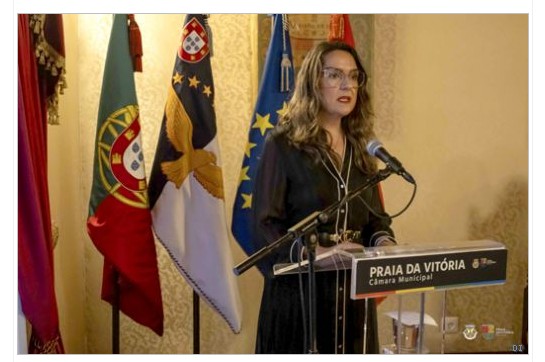
It is essential to prevent History from becoming an “instrument in the service of propaganda and disinformation.” To do so, “we must understand how narratives about the past are constructed—who produces them, for what purposes, and on the basis of which sources,” said historian Assunção Melo during a ceremony marking the 83rd anniversary of the IHIT – Instituto Histórico da Ilha Terceira.
“Contemporary society is immersed in competing narratives, fabricated discourses, and selective memories,” she noted in a lecture titled “The Meaning of History in the 21st Century: Ideology, Gender, Art, and the Urgency of Impartiality.” Asking, “Why do we keep returning to History?”, the speaker emphasized that “History is not merely the study of the past, but the ongoing construction of a critical dialogue between who we were, who we are, and who we aspire to become.”
“In the 21st century—marked by information crises, ideological polarization, media manipulation, and accelerated digital flows—studying History has ceased to be an academic luxury and has become a civic necessity,” she argued.
“In this lecture, I sought to reflect on why History continues to matter; how it relates to ideology, gender issues, and art history—my own field of specialization; the role of heritage professionals and researchers; and how historiographical rigor can (and must) function as a weapon against fake news and the manipulation of the past,” Assunção Melo explained.
She made clear that “the historical method—grounded in heuristics, external and internal criticism, comparison, contextualization, and synthesis—remains the guarantee of scientific reliability.” In her view, “History is cumulative: it is produced in dialogue with earlier works, theoretical debates, and critical revisions,” and “bibliography underpins and legitimizes research, ensuring transparency and scholarly continuity.”
“The historical profession carries social responsibility,” she added, because “those who manipulate the past can influence public policy, identities, and collective memory.”
The Dangers of the Past
For Assunção Melo, “the mass circulation of disinformation has transformed the public sphere,” as “extremist groups weaponize the past, producing simplified and emotionally charged narratives.” Yet the fight against disinformation finds in History its “most powerful tool,” because “only through historical literacy—critical source analysis, mastery of fact-checking methods, and above all a strong sense of pedagogical responsibility—can we understand the present and counter fake news, memory distortions, denialism, racialized discourse, and mythic nationalisms that often present themselves under the guise of identity and the defense of tradition.”
“Slavery, too, was once a tradition,” she reminded the audience, “and tradition cannot be invoked at any cost to preserve practices that serve the entrenched interests of a few. History, as a critical discipline, is one of the strongest barriers against these phenomena.”
In closing, Assunção Melo appealed to the need for historical knowledge among young people, for reading widely across subjects, and for critical thinking before speaking. “Placing issues in perspective and seeking to relate them to one another is far more important than mere access to fragmented information that appears in the reels on our mobile devices,” she said.
Books for Young Readers
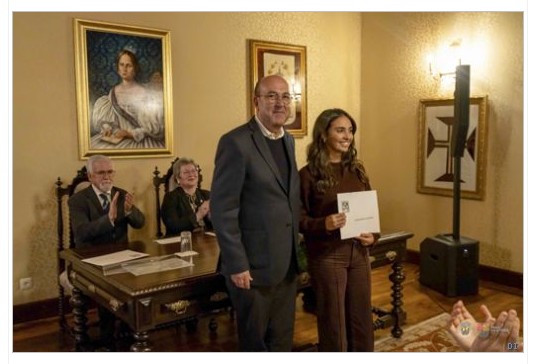
To mark its 83rd anniversary—celebrated this year in Praia da Vitória—the Instituto Histórico da Ilha Terceira awarded three high-school students (one from each secondary school on the island) a €150 voucher for books published by the institute.
The prize recognizes academic merit, interest in regional historical and literary themes, and participation in cultural activities; dedication and exemplary conduct are also considered. Following feedback from the inaugural edition held the previous year, the IHIT expanded eligibility to students from 10th through 12th grade, focusing on courses such as History of Culture and the Arts, History B, and History A.
This year’s recipients were Maria Amaral Leonardo (Escola Jerónimo Emiliano de Andrade), Caetana Pereira e Silva Malheiro (Escola Tomás de Borba), and Martim Coelho Mendonça (Escola Secundária Vitorino Nemésio).
A Vast Library
The IHIT maintains an extensive catalog of publications—not limited to History—that are particularly valuable for understanding Azorean themes. Over more than eight decades, many of the Azores’ leading scholars and thinkers, along with others from beyond the region, have published their work under the institute’s imprint.
Its annual journal serves as a repository of articles on a wide range of topics and will now be available to the award-winning students, who can select IHIT titles totaling €150. Although Azorean subjects have limited presence in school curricula, the institute argues that students’ individual initiative can help bridge that gap—provided they are given the tools. Through this program, the IHIT offers precisely that: access, choice, and a sustained invitation to think historically.
 Filamentos (artes e letras)