
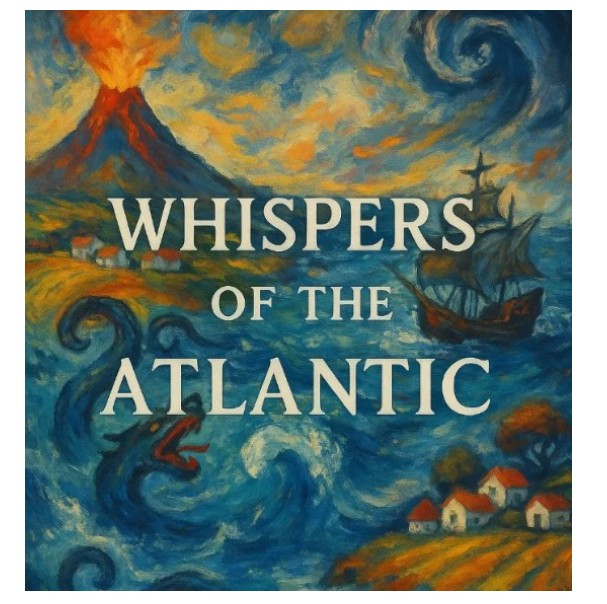
Where islands dream, and stories cross oceans.
Long ago, on a sunlit morning in the village of São João do Pico, just after dawn had broken, the sun rose over Lajes do Pico. The green of the vineyards and cornfields stood in sharp relief against the blackened stones scorched by ancient volcanoes.
Men were heading to their fields for the day’s labor—hoeing corn, threshing lupins, digging potatoes, tending the vines. In their kitchens, women prepared the midday meal, which in those days was almost always simple fare: bread soups, corn porridge, or potatoes with fish.
Suddenly, the whale alarm rang out. From one of the lookout posts placed along the coast, rockets were fired into the sky. The men dropped whatever they were doing. Hoes fell to the ground; picks were left stuck in the earth. Bundles of corn were abandoned, the stalks left untied. Animals were hastily tethered to nearby trees, and the men ran for the docks. At home, the women quickly prepared provisions and rushed after them, carrying food for their husbands in patchwork cloth sacks before the boats set out to sea.
Those who arrived first launched the whaling boats and pushed off as soon as the crews were complete. On the dock, the women remained behind, weeping, uncertain whether the struggle between man and the great beast would claim a life—as so often it did.
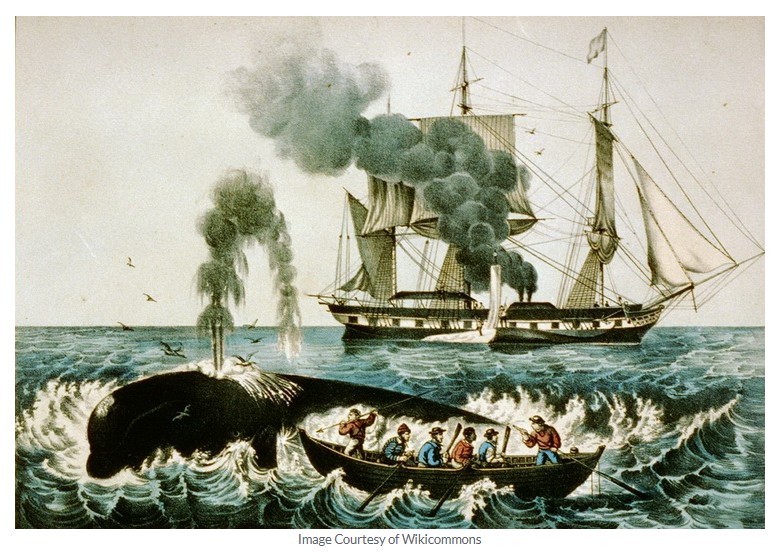
After sailing several miles with the wind at their backs, they sighted the whale nearby. It was a massive adult sperm whale, estimated to yield more than a hundred barrels of oil—a fortune. Excitement rippled through the boats; such a creature was not seen every day. It promised not only food for many days to come, but also the thrill of battle for men seasoned by the sea.
The sails were lowered, and the men took to the oars, drawing closer as the whale surfaced, spouting spray into the air, diving and reappearing yards ahead. In the boat that first found its position, the harpooner leaned forward, fixed his gaze, and struck true.
Wounded, the whale surged ahead, pulling away with the harpoon lodged in its back, a thick rope trailing behind, unwinding from a tub in the boat’s hold. When that rope ran out, it was tied to a second line, then a third—until no rope remained. The line tender seized what was left and, before it vanished, tied it around his waist. In an instant, he was torn from the boat and dragged into the sea, pulled by the whale toward the unknown, before anyone could react.
With only sails and oars, the boats were too slow to pursue the fleeing animal. They searched as best they could, though hope was slim. Night fell, and they were forced to turn back to shore, leaving the line tender behind. His family dressed in mourning, and the women wailed through the night in grief.
At dawn the next day, the boats set out again. Many believed the search futile, but it had to be done, if only to ease their consciences—to find the man’s body and give him a proper burial.
After traveling far from the coast, they spotted a dark shape on the low horizon. Curious, they steered toward it. There they found a great whale, dead and floating—and standing atop it, upright and calm, was the line tender himself, leaning against the harpoon shaft.
Perfectly unharmed, he called out, “So this is when you arrive? I’ve been waiting here all night!”
He was smoking a thick cigarette, wrapped in a corn husk, as casually as if he were seated at a table. Legend has it that he never explained what had happened, nor where he found the corn-husk cigarette, or the fire with which he lit it.
Note: The Legend of a Whaler from Pico Island is a traditional tale from the island of Pico in the Azores. It speaks of courage and of the dangers men once faced to earn their daily bread from the sea.
FURTADO-BRUM, Ângela. Açores, Lendas e Outras Histórias (2a. ed).. Ponta Delgada: Ribeiro & Caravana Editores, 1999. ISBN 972-97803-3-1 p. 224-225.
Whispers of the Atlantic: Legends from the Azores
Vision Statement
To preserve, translate, and reimagine the legendary heritage of the Azores as a cultural bridge across oceans—connecting generations, honoring the voices of the ancestors, and ensuring that these stories remain vibrant for the future of the diaspora and the world.
Mission Statement
Through the Whispers of the Atlantic series, Bruma Publications and Filamentos are committed to:
- Collecting and translating Azorean folktales, myths, and legends with literary fidelity and poetic resonance.
- Sharing these stories with English-speaking readers in North America and beyond fosters cultural pride and cross-cultural dialogue.
- Preserving centuries-old oral traditions as living cultural treasures, not museum relics.
- Inspiring new generations of writers, artists, and dreamers to draw from Azorean heritage in building bridges across languages, cultures, and oceans.
 Filamentos (artes e letras)