
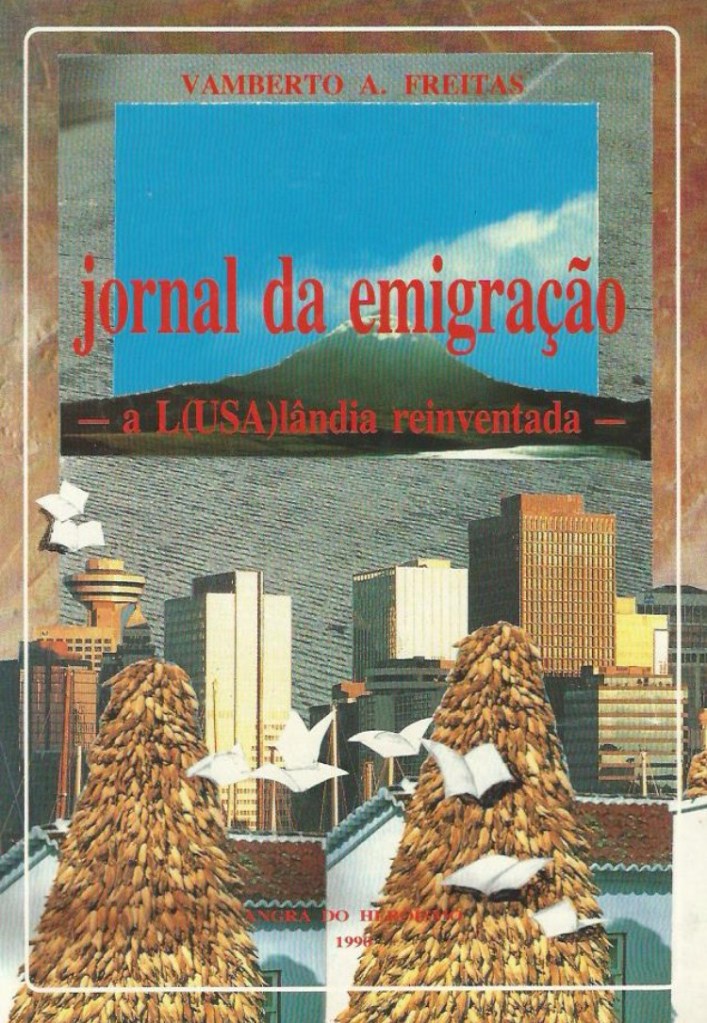
Jornal da Emigração and the L(USA)landia Reinventada by Vamberto Freitas
There are words that are not written—
they rise.
And once risen, they continue to illuminate generations.
Before a book enters the world, the world sometimes inclines itself to receive it.
There are works that seem to emerge from a primordial silence, as if a fissure opened in the firmament and allowed an ancient light to pass through. They do not announce themselves; they arrive—sudden and inevitable—tearing the fabric of literary time. They come from remote constellations: scattered memories, fractured geographies, subterranean voices that have waited decades for the precise moment to become language.
Jornal da Emigração by Vamberto Freitas, belongs to this rare category of telluric creations—books that function like seismographs, registering the hidden vibrations of a people in transit. When it appeared in 1990, it did not merely bring pages into the world; it delivered a tremor—a newly revealed emotional continent, a sudden reconfiguration of an identity in search of its own name. And as time passed, rather than dimming, the book intensified its radiance, like stars that shine more fiercely as they move farther from the point of origin that launched them.
For Jornal da Emigração is not simply a book. It is the first critical breath of a diaspora in the American West learning to recognize itself; an intimate map of an exodus; the overture to a body of work destined to illuminate the Portuguese Atlantic. To grasp the full reach of this eruption, one must return to its cradle: a life shaped by crossings, inner exiles, and the persistent call of the horizon.
We all know that some books do not arrive—they erupt. They are not merely published; they occur like a flare within the vast rhythm of language. They are born not of a single pen, but of a constellation: dispersed memories, broken geographies, voices that until then lived only in the subsoil of History. Jornal da Emigração is one of those rare seismic books, capable of recording the intimate tremor of a people in motion.
When it appeared in 1990, it did not bring only pages—it brought an emotional continent, a reimagining of diasporic identity itself. Thirty-five years have passed since that inaugural moment, and instead of losing intensity, the work has become more necessary, clearer, more luminous—like certain celestial bodies that burn brighter as they move farther from their point of origin.
That is because Jornal da Emigração is not merely a work; it is a first critical inhalation of what it means to be Azorean in a continent of successive reinventions; an emotional map of the closing chapter of the great exodus of the 1970s and 1980s; an announcement—long before its author could know it—of what would become one of the most influential critical careers in the Portuguese Atlantic.
But to understand the weight of this inaugural book, one must return to the author’s origins. Like all essential works, it is born of a life made of crossings.
Vamberto Freitas was born in Fontinhas, on Terceira Island, on February 27, 1951. From his insular childhood he carried with him the distant thunder of airplanes lifting off from Lajes Air Base, the scent of pastureland, and the first silent yet decisive intuition that the world did not end at the blue horizon. He studied at the National Lyceum of Angra until his family—like so many others—packed their lives, said hurried goodbyes, and leapt into the unknown: Porterville, in California’s San Joaquin Valley.
There, in the agricultural heart of California, he learned that to be an immigrant is to carry two geographies at once—the one you come from and the one that attempts to remake you.
He later moved to Los Angeles, completed his studies at Chino High School, and immersed himself in American language and literature. At California State University–Fullerton, he earned a degree in Latin American Studies, studying hybrid narratives, porous borders, and crossed identities. He pursued graduate work in American and Comparative Literature, completed pedagogical training at Chapman College, and taught at Cerritos High School.
What destiny could be more emblematic for a future writer of the diaspora than this pilgrimage through the heart of American literature—learning how to read, how to teach, how to observe, and how to bear witness from multiple margins? All of this—the islands, the California valley, the universities, the classrooms, the newspapers—was preparing the writer who would one day reinvent L(USA)land.
I met Vamberto when I was eighteen. It was a chance encounter—the way we meet many of the people who will mark us for life. There was a particular intensity in his presence: someone who saw far but spoke close. From those first conversations many others followed—some accompanied by the fraternal taste of shared drinks, others marked by the calm urgency of someone trying to understand a diaspora that was growing, expanding, searching for a voice.
I vividly remember the interviews I conducted with him for Portuguese-language radio in California’s Central Valley—first on a program I naively began at eighteen, The Voice of the Portuguese Emigrant; later on the station I founded, Rádio Clube Comunidade (1982, when I was twenty-four); and later still on KTPB – Kings-Tulare Portuguese Broadcasting, inaugurated in 1988.
Vamberto was always one of my favorite guests—not because he said what I expected to hear, but because he always said what no one else had yet articulated. Conversations flowed, ideas sparked like flint, and our intellectual, literary, and diasporic complicity was immediate and unmistakable. Those radio moments were more than interviews: they were improvised essays, affective maps, live affirmations of identity, with the breath of the San Joaquin Valley still present on the telephone line.
Our diaspora—vibrant with the recent wave of migration—recognized itself in those conversations. And I recognized a form of thought that would permanently change how we understood what it meant to be Azorean far from the islands. For margins are not borders; they are places where the world gains depth. In Jornal da Emigração, Vamberto Freitas showed us that true erudition is born precisely from the margins—from islands, diasporas, and voices nearly erased.
A large portion of the texts that make up Jornal da Emigração had been published in the Portuguese Tribune, founded in 1979 by João Bruma—a newspaper that, in its early years, served as the intellectual center of the California diaspora, a living laboratory for Azorean communities in the state. That space had a decisive name behind it: a discerning editor, a cultivator of talent, someone who recognized a voice before it became literature. During that singular period, Freitas wrote about festivals and wounds, about belonging and absence, about the geometries of memory and the tensions of integration. It was there that the critic was born—and there that the diaspora gained consciousness of its own worthiness as an object of thought.
To this must be added his work in East Coast Portuguese journalism and his long collaboration with major Portuguese newspapers, serving for more than a decade as a correspondent in California for the prestigious Diário de Notícias. He became a living bridge—between Los Angeles and Lisbon, between the Valley and the Azores.
The year 1990 was marked by a constellation of decisive events. It was the year Jornal da Emigração: The L(USA)land Reinvented was published—and also the year that the first major literary symposium uniting the Azores and the diaspora took place in Tulare, a sister city of Angra do Heroísmo. It was no coincidence that the book was launched at Filamentos da Herança Atlântica. The work entered the world at the precise location where California’s Azorean identity was gaining intellectual and cultural form.
What followed—the books, the travels, the supplements, the recognition—grew outward from that moment. But everything began with that book. With that reinvented L(USA)land. Because when written with truth, the word is always a form of return.
Few have understood this as deeply as Vamberto Freitas, who transformed distance into thought and exile into critical belonging. For him, literature was always the possible homeland.
To celebrate thirty-five years of Jornal da Emigração is to celebrate the voice that gave consciousness to a diaspora; the gaze that saw literature where others saw mere survival; the courage to transform life into criticism, memory into future. The L(USA)land he reinvented did not disappear—it spread. It now lives in books, universities, cultural institutes, and in the hearts of those who continue to navigate between margins.
Diaspora, as we knew even in our youthful conversations, is not the end of anything. It is always the beginning of something else.
The light of 1990 remains lit. More than that—it continues to grow.
One day, when others—younger, freer, more daring—open Jornal da Emigração, they will find not only testimony, but direction. A lighthouse belonging not only to the past, but to the future we are still building.
Diniz Borges (adopted from an essay published in Portuguese in the weekly Atlântico Expresso in Ponta Delgada, Azores.
 Filamentos (artes e letras)