
The Holy Spirit Festas as a Living Language of the Azores and the Diaspora
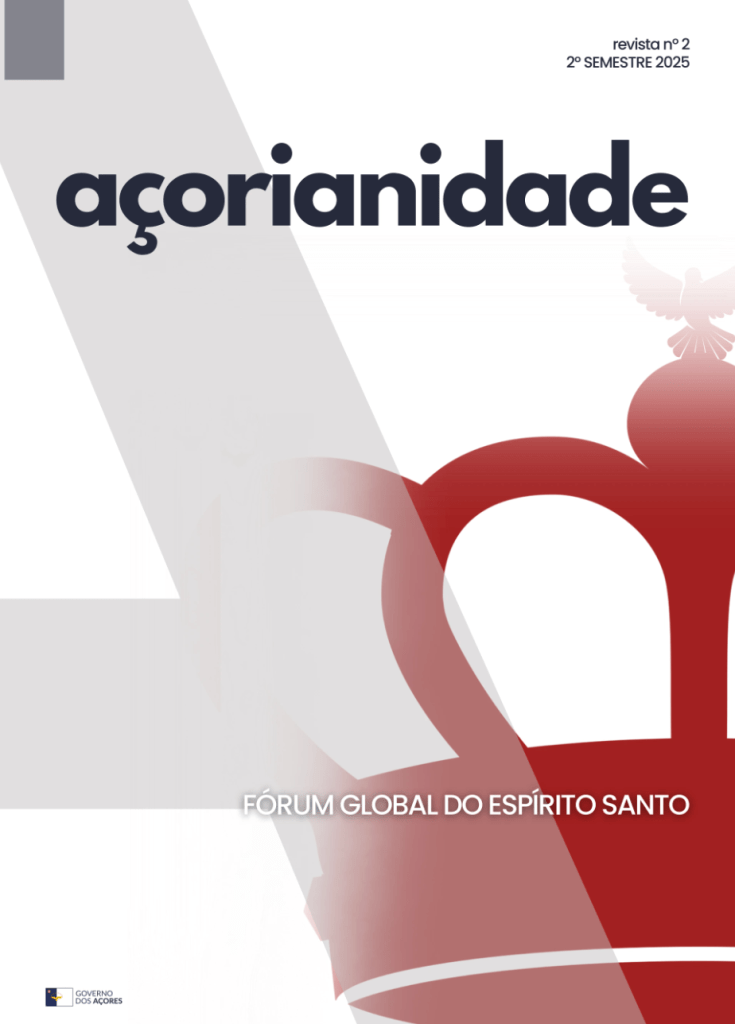
I read the second issue of Açorianidade, dedicated to the Holy Spirit, not as one reads a thematic dossier, but as one approaches an antique table — the kind that has survived generations, changes of house, departures, and returns. A table where objects carry memory, where gestures repeat themselves not out of mechanical habit, but because they still make sense.
This issue is not merely an editorial object. It is a civilizational gesture. One of those rare moments when a community pauses, looks at itself, and recognizes that its memory is not a static archive but an active principle of the future. By bringing together texts of public framing, academic reflection, and voices rooted in lived community experience, the magazine constructs a symbolic arc in which governance, faith, culture, and creation enter into dialogue without rigid hierarchies — like a table of the Divine: wide, shared, with no assigned seats.
There is something particularly significant in the way public and institutional language appears in these pages. Not as imposition, nor as closed discourse, but as an act of care. Public responsibility is understood here as an awareness of stewardship: the recognition that there exists a heritage that cannot be contained within a single physical territory or an administrative chronology. It is a heritage that spans oceans, crosses distant geographies, and is reinscribed in diverse contexts without losing its symbolic axis.
The azoreanness that emerges here is neither centripetal nor nostalgic. It is an identity in motion, polycentric, sustained by community structures that function as true infrastructures of memory. They are not merely associative spaces; they are sites of cultural translation, intergenerational transmission, and affective diplomacy. In this context, institutional presence does not capture or normalize the celebration. It legitimizes it. It protects it from oblivion and, above all, from the reductive temptation of harmless folklorization.
Yet it is when language descends from the plane of framing to the ground of lived experience that the magazine reaches its greatest human density. Grassroots communications — emerging from research, cultural practice, community mediation, and diaspora journalism — form a polyphonic chorus in which the Holy Spirit appears as a living, adaptable, and resilient practice.
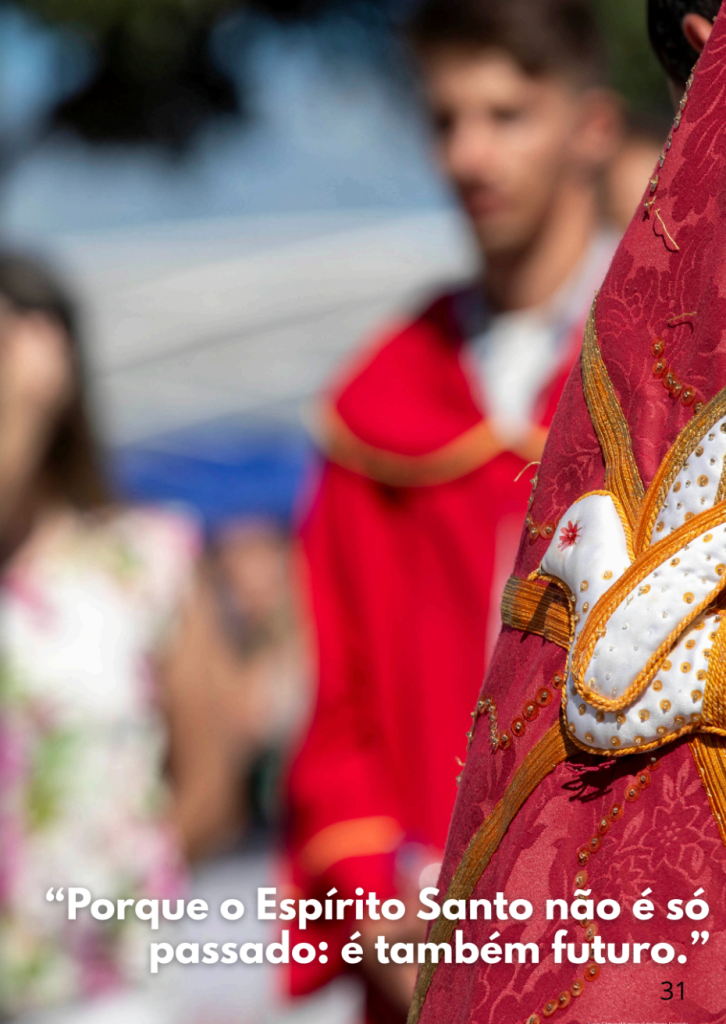
Here, the celebration ceases to be an object of description and becomes an ethical exercise. It becomes clear that the devotion cannot survive if it loses its moral center. It is not merely crown, banner, or repeated ritual: it is a commitment to equality, to dignity, to the shared table as a concrete utopia. This warning runs through the volume as a necessary line of tension.
We live in a time when traditions risk becoming spectacle, identity merchandise, or symbolic decoration. To foreground the celebrations — in the deepest sense of the word — does not mean isolating them from the contemporary world, but protecting them from impoverished readings. It means reaffirming their core: the refusal of exclusion, the provisional suspension of hierarchies, the celebration of community as an ethical, social, and spiritual value.
One of the most stimulating aspects of this issue of Açorianidade lies in what it suggests — and does not yet exhaust. The Holy Spirit is presented as a transversal cultural matrix, but this dimension opens more paths than those fully traveled here. And perhaps that is a virtue, not a flaw.
Throughout these pages, one senses that the Holy Spirit crosses multiple fields: collective music, where shared breath teaches an ethics of listening; literature and poetry, where ancient symbols are transfigured into metaphors of justice, exile, and belonging; visual arts, in contemporary reimaginings of the impérios; and the performing arts, where ritual becomes a dramaturgy of the common. Yet these readings largely remain to be done.
What is still missing is a systematic analysis of the Holy Spirit as an aesthetic language, as an artistic imaginary, as a formative force in contemporary creation. There remains much to think through regarding its impact on music, literature, poetry, visual and performing arts — not as illustration of ritual, but as a critical extension of its meaning. It will fall to future forums to deepen these readings, to cross tradition with critical thought, and to open new spaces for reflection and creation.
There is, however, another gesture of care that deserves particular emphasis: the magazine’s full bilingual presentation, in Portuguese and English. This is not a technical detail nor a circumstantial concession. It is a political and cultural choice in the noblest sense of the word. By writing itself in two languages, Açorianidade extends the table, brings generations closer together, and acknowledges the linguistic reality of Azorean communities beyond the islands.
In the United States, Canada, Bermuda, and many other places where heritage languages live alongside the language of daily life, this gesture opens doors. It allows children and grandchildren to approach tradition not as distant spectators, but as full readers, capable of understanding, questioning, and claiming as their own a heritage that has often reached them in fragments. Bilingualism does not dilute identity; it translates it. It does not replace the language of origin; it builds bridges so that it may continue to be heard.
For this, it must be said clearly and with gratitude: a heartfelt thank you for such care. Because caring for language is caring for the community’s future. A word of gratitude to all involved in the project, and the director ot this magazine, José Andrade.
Taken as a whole, this second issue of Açorianidade functions as what it describes: a table of the Holy Spirit on an expanded scale. Around it sit different experiences, diverse forms of knowledge, generations separated by oceans — not to crystallize an identity, but to keep it breathable.
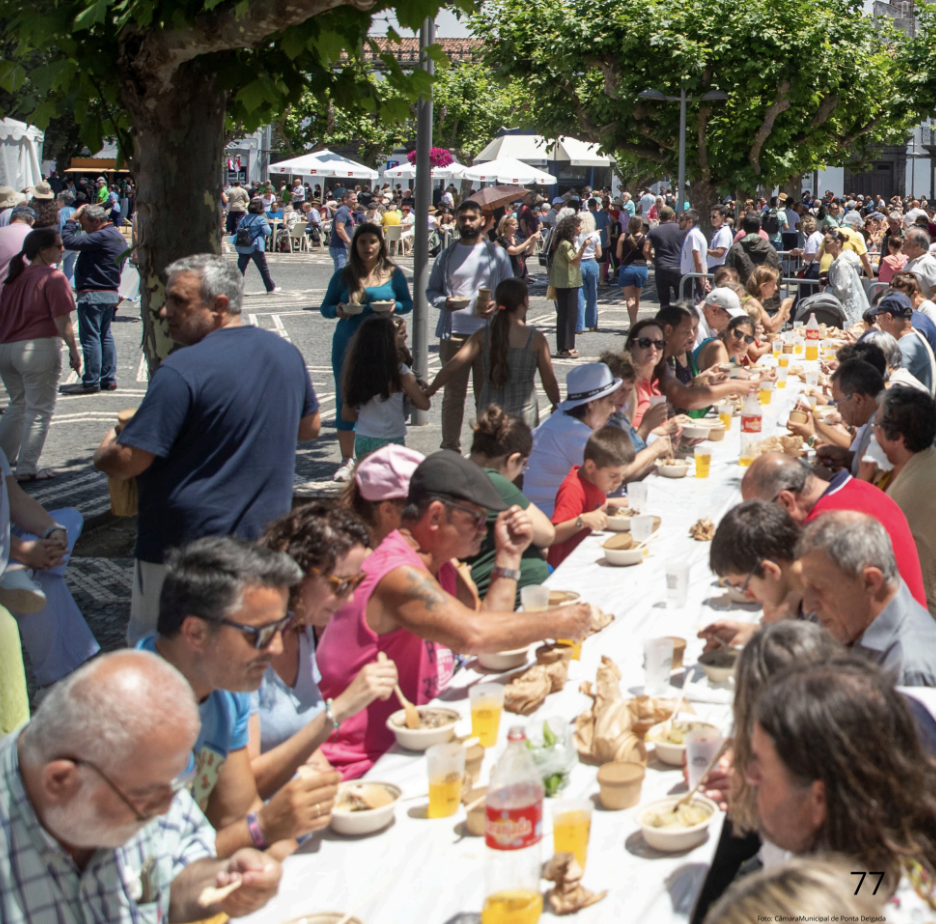
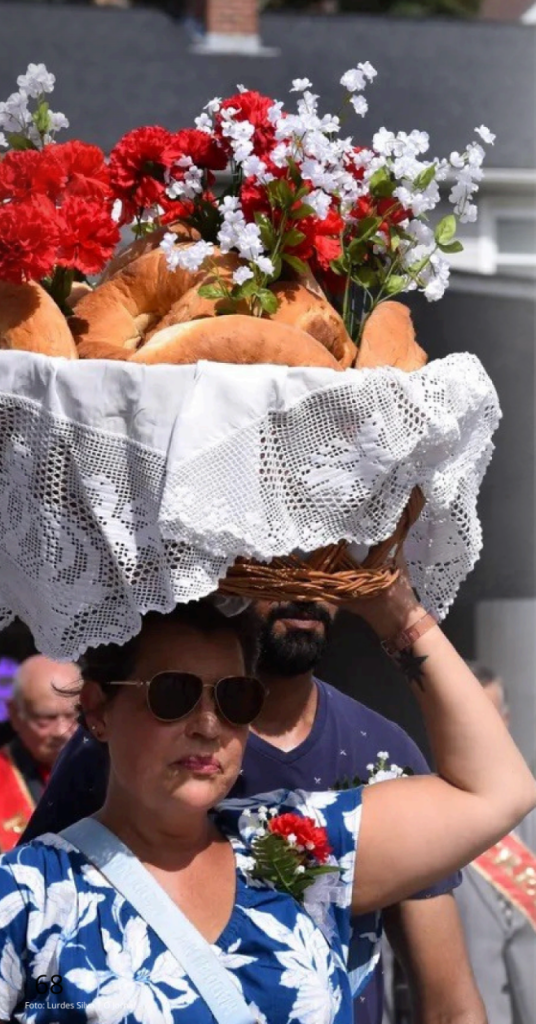
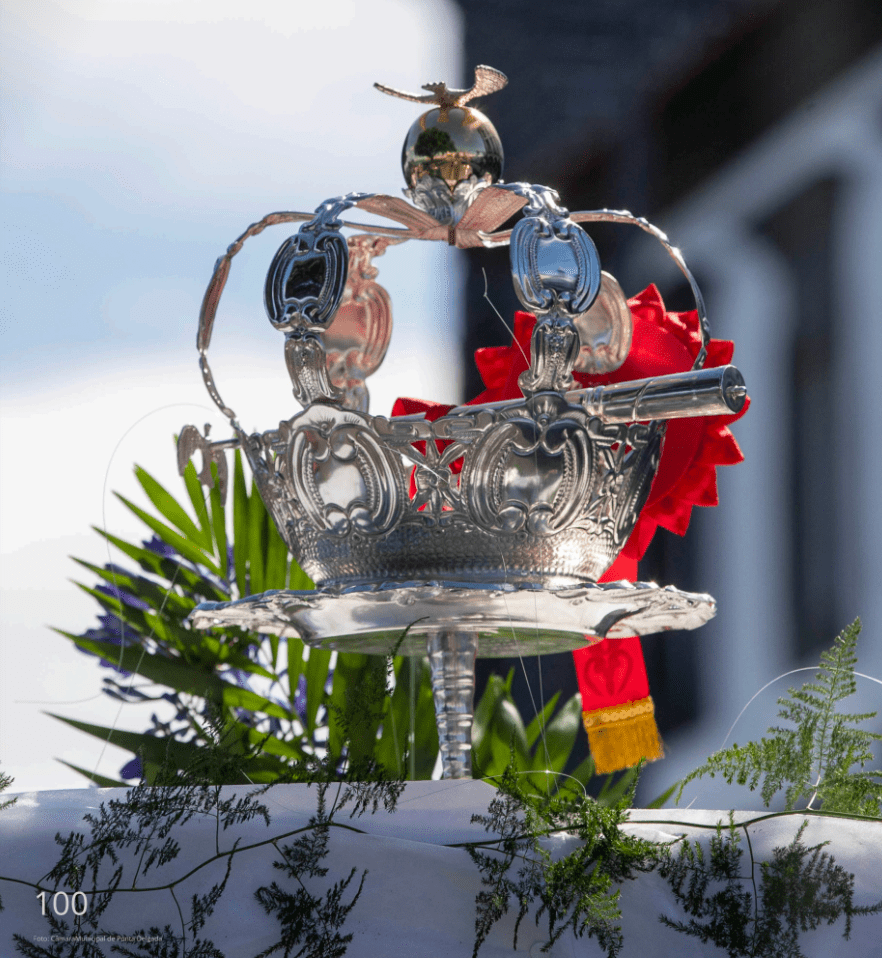
And perhaps it is here that this issue reveals its deepest lesson — and its most luminous achievement. Not only in what it thinks, but in how it cares. Because this magazine does not merely write about the Holy Spirit: it knows how to look. The rigor of the texts is echoed in an attentive visual sensibility; photography does not illustrate — it amplifies. It captures the light of the impérios, the anonymous gesture of sharing, the simple solemnity of crowns and open tables. Each image extends the thought; each frame restores the tradition’s sensory depth, reminding us that culture is also preserved through the gaze.
It is in this intertwining of word and image that the Festivals of the Divine reveal what they truly are: bridges in constant construction. Bridges that link the islands to the diaspora, the diaspora to itself, and all of them to a shared symbolic center that does not fix itself in one place, but moves with people. These are not distant echoes of a crystallized past; they are annual events of the present, lived, prepared, awaited, and carried across generations, each cycle renewing the meaning of what they have received.
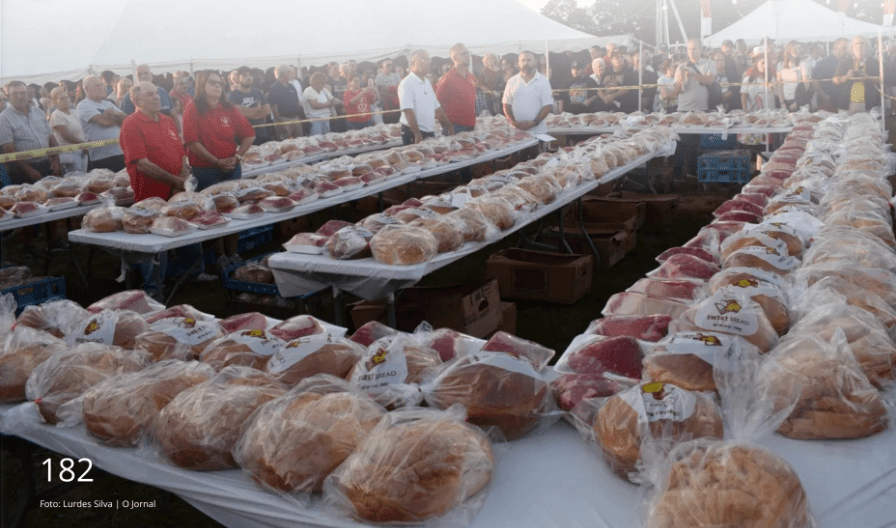
The Festivals of the Divine do not survive despite time — they survive through time. Each table set again, each breath of a philharmonic band, each repeated gesture with subtle variation affirms that this tradition is neither ruin nor relic. It is a body in motion. A community in action. Memory made flesh once a year — and, in that ritual return, a projection of the future.
As long as there are those who prepare the feast as one builds a bridge; as long as there are hands that open tables without asking who arrives; as long as there are images that know how to see and words that know how to listen; as long as there are different languages speaking the same inheritance; as long as there is a will to think tradition without emptying or domesticating it — the Holy Spirit will remain not a remnant of what we were, but a living experience of who we are and an active promise of who we may yet become.
Diniz Borges, Bruma Publications-PBBI, Fresno State.
Pictures from the magazine.
Here is a link to it:
 Filamentos (artes e letras)