
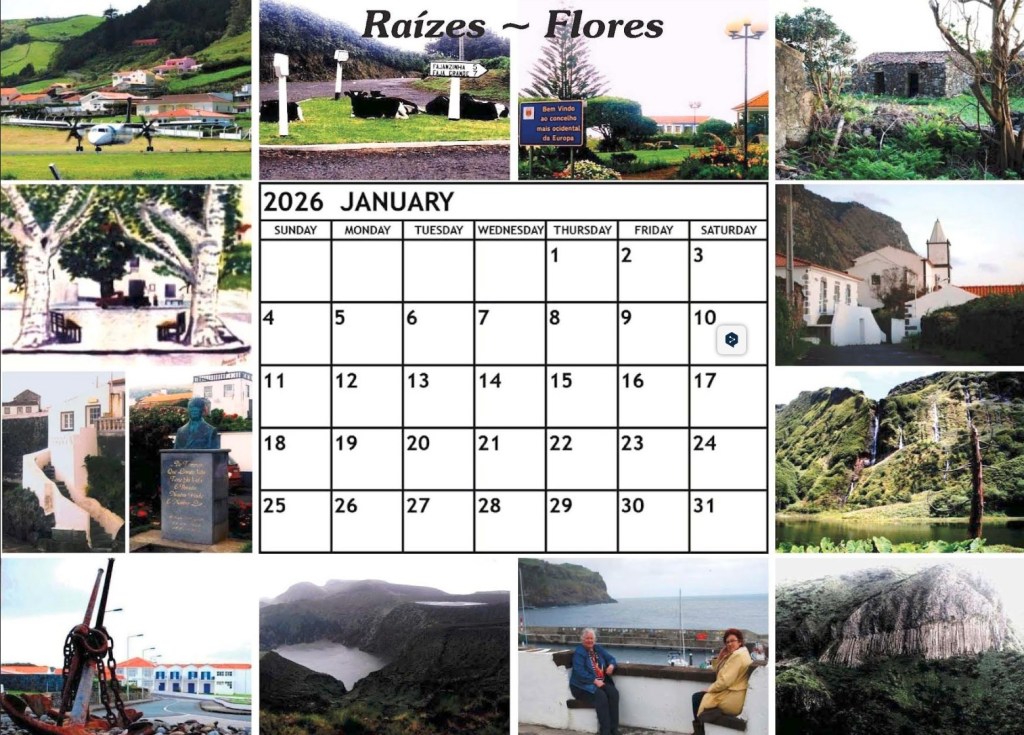
Three of my four Azores-born great-grandparents and both of my paternal grandparents were from Flores — from Fajãzinha, to which two great-grandparents returned after a couple years, leaving their young son behind in northern California; and a great-grandmother from the tiny settlement of Ponta da Fajã Grande (where the coastal road peters out, just north of Fajã Grande). This is the Azores’ westernmost jurisdiction — next landfall, North America!
Flores’ west coast is noted for two signature landmarks (or the Azoreanism ex libris, if you prefer): Rocha dos Bordões (walking-stick cliff) and Poço da Alagoinha (whose waterfalls tumble down into a pond). The island’s mountainous interior contains seven lakes, of which two neighboring ones at different elevations are unconnected underground. The main town is Santa Cruz, on the island’s east coast; once a whaling port, its factories processed the carcasses, now commemorated at a whaling museum. The island’s next largest town is Lajes on the southern tip, and the first possible port of call for transatlantic sailors needing to stop for repairs, reprovisioning or other emergency.
Flores has produced more than its share of poets, including Roberto Mesquita (1871-1923), who was born and died in Santa Cruz, and whose bust is on public display. Others include Alfred Lewis (1902-77) né Alfredo Luís from Fajãzinha, who immigrated to California as a young man; Pedro da Silveira (1922-2003), from Fajã Grande; and the still-active Gabriela Silva, of Fazenda das Lajes.
Katharine F. Baker, translator
 Filamentos (artes e letras)