
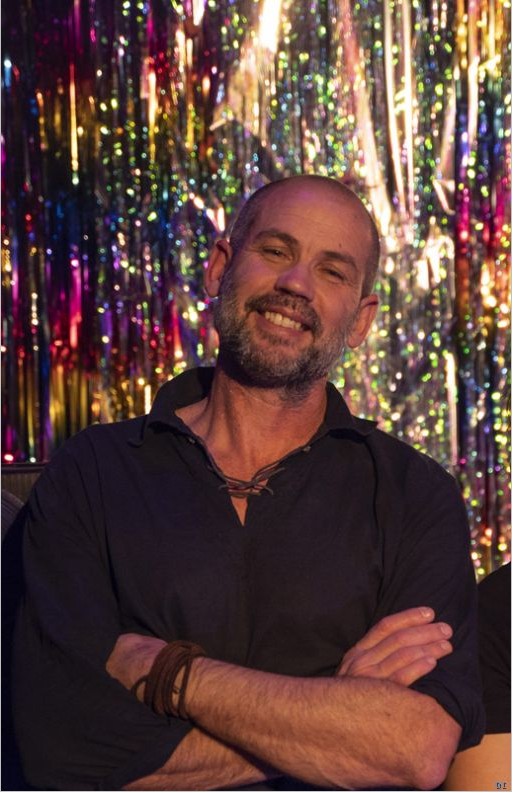
The Alpendre theater group is celebrating 50 years of uninterrupted activity with various initiatives throughout 2026. How will this half-century of history be commemorated?
The 50th anniversary of the Alpendre Theater Group will be marked throughout 2026 and 2027. I am sure that, more than just celebrating a milestone, 2026 will be a year to reaffirm the Alpendre Theater Group as a valid artistic project committed to everyone, as has always been its goal. We will have new creations, the 7th edition of “festiVArte – Angra do Heroísmo Performing Arts Festival,” gatherings, exhibitions, revivals, but never forgetting its identity. The celebrations will include an extended artistic program, revivals of memorable performances from the group’s history and, of course, another tribute to Álamo Oliveira, who sadly left us in 2025.
What legacy has Alpendre left over these 50 years? What role has it played in the cultural activity of Terceira Island and the Azores?
Alpendre’s legacy cannot be measured solely by the more than 100 shows it has presented or its 50 years of uninterrupted activity. The group stated early on that theater could be an ongoing, demanding project, contradicting the idea that relevant creation only happens in large centers. Alpendre played a founding role in Azorean theater, and we must never forget this. It created audiences, trained artists, technicians, and people, giving rise to new groups. It circulated throughout the parishes of Terceira, traveled throughout the Azores, mainland Portugal, the United States, and the United Kingdom, introduced practices, and maintained a regular program, even when it was far from guaranteed. We continue to open the space to everyone, functioning as a space for experimentation, debate, book presentations, and music. In the Azores, its impact remains the same after half a century of existence, establishing networks with other national and international structures and continuing to give visibility to the artistic work produced in the region and beyond. For me, this is the main legacy.
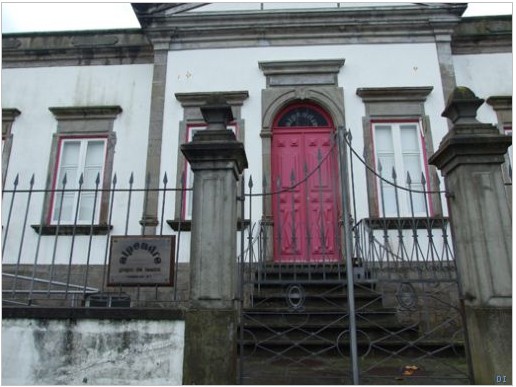
What challenges does this group face today in order to maintain its activity? Is it still one of the main spaces for cultural creation on the island?
The challenges facing Alpendre today have changed; they are not the same challenges faced by Alpendre in 1976, when that group of crazy people got together to do theater, or even in the 1980s or 1990s, when it was easy to dismantle an entire play and set it up in another space. Cultural structures, not just theater, lack the time of the people who make them happen. Sometimes it’s not just money that’s lacking, it’s people who are willing to make associations stand the test of time. We are lucky to have a fantastic group of people steering this ship through waters that sometimes become difficult to navigate. Sometimes people have no idea what’s behind it all. What used to be a place to socialize or talk and discuss ideas has become almost an obligation to be present in order to keep the machine running, to keep the machine alive. It would be easy if we were a professional group where we were paid to have this time. Things are not done nowadays just with people’s goodwill. The instability of funding, the lack of private support, public support, often unfairly associated with “subsidy-dependent,” the difficulty in planning for the medium and long term continue to be obstacles. Insularity sometimes becomes a factor that conditions co-productions, circulation, and training. Renewing audiences and the ability to dialogue with new generations has also been a challenging journey. It’s funny when someone comes up to us and asks what they need to do to join Alpendre. That’s when we see the respect and admiration that the name Alpendre commands. I always respond with a smile: “You need to have time to give, love theater, and a smile on your face. The rest will fall into place.” As for its place in the cultural landscape of Terceira, the answer can only be that Alpendre continues to be a benchmark and one of the main spaces for creation and presentation on the island of Terceira. Just look at the activities that take place at our headquarters, as well as the support given to other entities over the years, but beware, I repeat, Alpendre does not survive on prestige and goodwill alone, but on concrete conditions to make things happen and work.
What future do you envision for Alpendre? What do you expect from the next 50 years?
Envisioning the future of Alpendre is not just about imagining full houses, applause, bows, and “thank yous.” If there is one thing that my 20 years at Alpendre have taught me, it is that survival does not come only from favorable winds and stability, from “it went well, let’s keep going,” it means taking risks, diving in headfirst when you don’t know what to expect, hitting rock bottom, accepting failures, and avoiding the temptation to live off your name and legacy alone. It means growing with the knowledge that a project with history only makes sense if you are willing to be questioned and criticized, even by those who are just arriving. It means accepting that we are not the only ones doing it, respecting those who do, helping and applauding others, and that we are no better than anyone else. To this end, the coming years cannot just be about the expectation of longevity, of “here’s to another 50,” which is the easy and safest thing to say. We must strive to keep up with the changes and try to open up even more space for new projects, and ensure that Alpendre continues to be a place where people create and discuss, because without time, resources, and trust, there is no possible future, but for that to happen there will have to be a major change in the way we act, and we must never forget this group of people who are sometimes behind those who are in the spotlight and that the machine behind this great institution is there solely for the love of theater. I can even say that sometimes we pay to be there. Belarmino Ramos, for me, is the greatest example of the strength, will, and respect we must have for Alpendre. He taught me the concept of a “group of people,” which he defines so well. so if Alpendre manages to keep this “group of people” active, then the best we can hope for is not that it lasts another 50 years, but that it lasts as long as it is needed for culture.
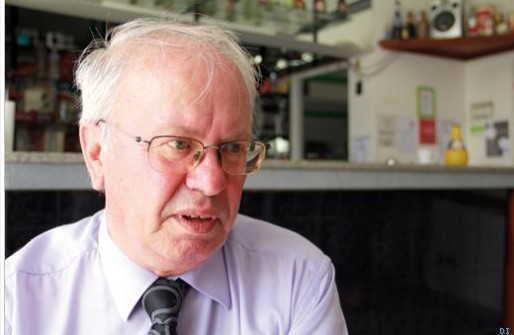
The celebrations include the revival of the play “Uma Hortência para Brianda” (A Hydrangea for Brianda) by Álamo de Oliveira and the inauguration of a room named after the writer, who passed away in 2025. What mark did Álamo de Oliveira leave on Alpendre?
Álamo left an artistic, ethical, and human mark on Alpendre. He was not only a founding member, author, or director of the group, he was a bridge to the outside world. “Uma Hortência para Brianda” is just one clear example, a text rooted in Azorean memory. Alpendre staged several of Álamo’s texts, which helped to affirm the importance of Azorean dramaturgy in the group’s repertoire at a time when writing from the Azores could be seen as a limitation. The revival of the play and the inauguration of our theater bearing his name are not just gestures of homage to someone who is no longer with us. Fortunately, we paid him several tributes while he was still alive, and this is just further recognition of how proud Alpendre is of the name Álamo de Oliveira.
In Diário Insular, José Lourenço-director.
Translated into English as a community outreach program by the Portuguese Beyond Borders Institute (PBBI) and the Modern and Classical Languages and Literatures Department (MCLL), in collaboration with Bruma Publication and ADMA (Azores-Diaspora Media Alliance) at California State University, Fresno. PBBI thanks Luso Financial for sponsoring NOVIDADES.

 Filamentos (artes e letras)