
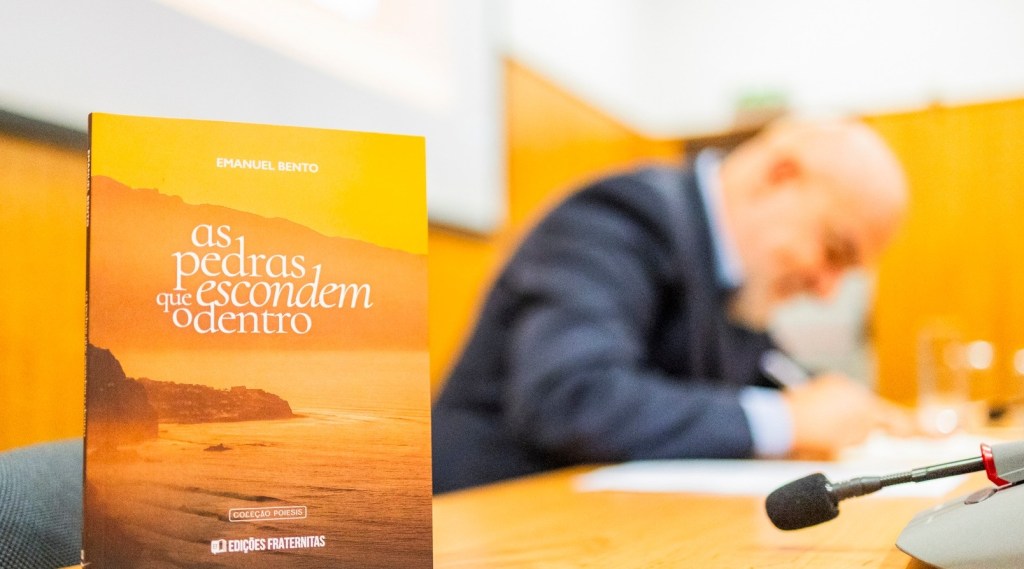
Emanuel Bento’s poetry rises from an ancient threshold, where loss hardens into matter and silence becomes a form of knowledge. In As Pedras que Escondem o Dentro (The Stones That Hide the Inside), language is not announced but summoned. Each poem feels like an act of descent—into stone, into memory, into the slow pulse of what has survived time and fracture. Rooted in the volcanic earth of Madeira, Bento writes as one who listens to the ground itself, treating stone not as symbol but as witness: keeper of heat, grief, and generations of breath. His poems unfold like quiet rites, gestures of attention offered to what remains when speech has failed.
Though born on an island (Madeira), this poetry belongs to a wider, older human story. The stones that recur in these poems are not only Atlantic basalt; they are the shared weights carried across cultures and eras—mourning, desire, exhaustion, love lived under pressure. Bento’s lines are spare and deliberate, moving at the pace of ritual rather than declaration. Meaning gathers slowly, in pauses and fractures, as if the poem were teaching the reader how to stand still. What is withheld acquires gravity; what is spoken emerges with care, as though each word had to be earned.
This small selection of translated poems invites English-language readers into a voice that understands poetry as an elemental practice of survival. Writing, for Emanuel Bento, is a way of keeping vigil over what is fragile and unfinished, refusing to abandon it to silence or forgetting. His poems remind us that we are shaped not by mastery or certainty, but by what we carry through time: what has been lost, what remains unresolved, and what continues—quietly, insistently—to ask for form. To read these poems is to enter a space where language becomes rite, attention becomes shelter, and the human learns, once more, how to remain.
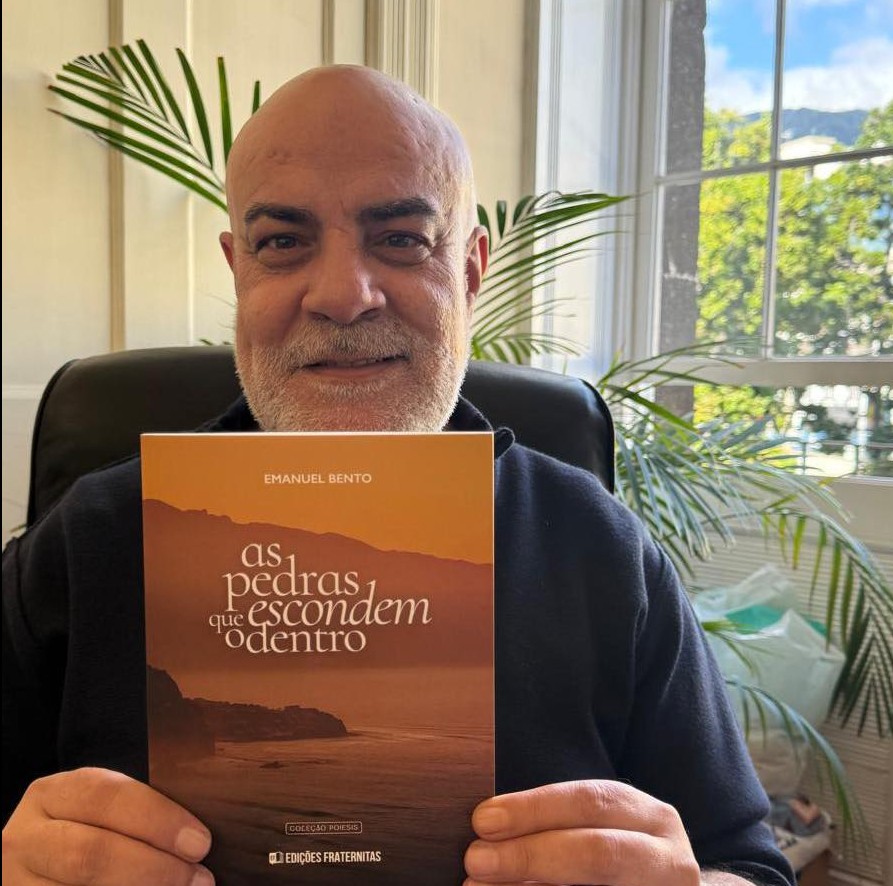
A colletion of his poetry in English: A reinterpretation by Diniz Borges
the meaning of basalt
With another year added,
and still—astonishingly—alive,
like Monterroso’s dinosaur
standing there after the sentence ends,
I thought I would understand more clearly
what feeds us,
what holds us upright on the earth,
what keeps us from drifting,
even when what holds us is rough,
unforgiving,
as stony as this island.
But no—
only a scatter of hypotheses,
no final answers to carry in the pocket.
For some, suffering.
For others, contentment.
For others still, nothing at all
resting in their hands.
And one of these—
or all of them at once—
is what I am.
From them I gather a quiet wonder,
enough to fill this passing, surface life,
enough to keep asking,
enough to give, again and again,
a meaning
to the basalt.
closer
to the truth you are
In this year that opens,
the gaze that dreams the future
reaches back to gather the past.
Time tilts downward—
the slow erosion of the dream itself,
no longer unblemished,
no longer the distant blue
once imagined as infinite.
What was surpassed has vanished;
even you no longer appear
as you once did.
Words now live at a slower breath.
Yet closer to the truth you are—
do not fear what approaches,
do not measure what you possess,
little or much.
It is what it is,
as it has always been,
even when it is nothing.
the mirror with the heart on the wall
Never forget:
no one—absolutely no one—
knows the mirror as you do,
the one you face each night
before sleep,
before waking,
where you look at yourself
and do not know who you are.
You even write your own name
on the wall that bears it—
the wall that encloses the mirror,
a simulacrum of the heart.
It confines you
with the force of being
until your mouth opens
and a word escapes,
entering the world
you are trying to build.
the abstraction of fresh water
Abstraction and silence—
this is how I am now.
I live as a missionary of absence,
yet each day and night
I still smile.
Each day and night
I pretend, for others,
to listen, to understand, to sustain—
while I wait for the miracle
that will arrive
even before the end of everything:
the love that proves
I do not exist alone,
that no one ever exists
without another.
So the lie may finally cease—
this flesh held wide open,
always bleeding.
Freed from utopia and from words,
from judgments steeped in hypocrisy,
from the disguises of truth—
the soul abandons everything,
forgets, desires nothing,
invents nothing.
It only loves—
without god or substitute,
without sadness or joy,
without principles or infinities:
the fresh water of the world.
the sea you gave me to dream
Now that you are no longer here
and return only occasionally,
on nights I least expect,
tell me—
how was it to leave the sea,
the mountains rising and falling,
only to find it again,
and her seated within it?
Tell me how it all was:
the days and nights without bread,
the monsters that found you in the dark
and that you always carried with you—
even when you were old,
even as you were dying.
What did they want from you?
They asked only what Oedipus asked:
to know who he was,
and in him, all men,
and even what awaited him.
Even now, I almost swear
they said something else—
something you hid from everyone.
That was when you stopped believing.
You turned inward
and never emerged again.
You spoke no more,
taught nothing further,
loved nothing else—
not even the sea itself,
the one you gave me
to dream.

 Filamentos (artes e letras)