
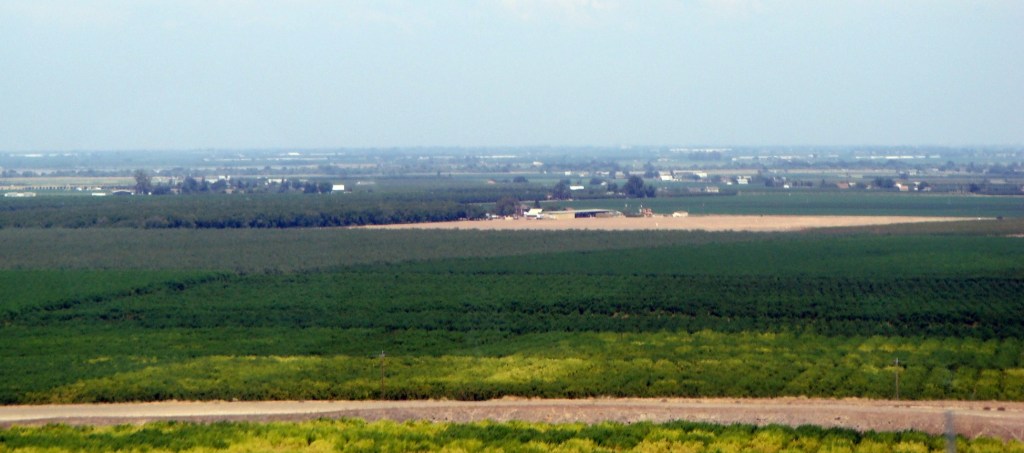
Millicent Borges Accardi’s poem enters me the way certain Central Valley mornings once did: through the smell before the light. That mixture of diesel warmth, dust, and something metallic—an aroma that never existed on Terceira or Pico or São Miguel, but which slowly became part of the air I would call home. To read this poem as a Portuguese-American from the Azores is to hear the machinery of labor arrange itself into a kind of secular litany, a creed of survival learned not from catechism but from shift work, in my case, as a teenager, on a dairy farm.
The poet’s tank farms are more than industrial containers—they are the secular saints of a working-class America rarely rendered with such intimacy. She genders, humanizes, and consecrates them. And if you grew up among people whose first vocabulary of America was shaped by dairies, refineries, canneries, welding shops, and truck depots, this humanization feels instinctive. We learned early that machines carried moods, temperaments, and dangers. We knew that equipment responded to respect, that a tank or pump or trailer could be as trustworthy—or as treacherous—as the men who trained you.
Accardi’s opening gesture—“They are like women… They are like men…”—recalls for me the duality of our immigrant households, where mothers and fathers carried interchangeable burdens. The poem’s tank farms are both intimate and distant, nurturing and forbidding. In the Azorean imagination, gender often dissolves into function: the sea can be a mother or a beast; an island can cradle you or imprison you. Here, industrial tanks bear that same duality. They become cosmologies of labor.
There is a tenderness in describing a tank you can “sleep / near… in your truck,” a tenderness I recognize from long nights my father spent sleeping in his cab, parked between corrugated warehouses that hummed like restless animals. But tenderness, in immigrant life, is always shadowed by danger: “You can be fired for walking on the dikes.” The poem understands that livelihoods hang by narrow margins, that one misstep can collapse the fragile compact between worker and machine.
When Accardi writes, “They are good tank farms… / because they can switch contents to one another / at will and receive new contents as transfer,” I hear an immigrant metaphor echoing through the pipes and valves. Isn’t this how we survive? We transfer. We adapt. We receive new content—language, customs, obligations—and we hold it until it settles into something stable, something that can be stored.
Her tank farms “serve as storage and beacons.” They become geographic certainties in a life of cultural in-betweenness. In the Central Valley, landscapes like these anchored us. Amid the churn of migration and adjustment, the refineries and tank farms stood unchanging, like the caldeiras and basalt cliffs of our islands. They carried no nostalgia, but they offered a different kind of permanence—industrial, unromantic, but steadfast.
Accardi elevates local geography into myth: “Gate 7,” “the Slab,” “Babikian Way.” Every immigrant community knows this instinct. We rename our worlds into sacred maps: the dairy on Road 20, the Portuguese Hall on 9th Street, the packing house behind the railroad tracks. These places become coordinates of becoming. They are how we claim America when America is not yet claiming us.
Her tank farms are “Easter Island / stone men.” They watch. They endure. They refuse to drift. In this, I hear the quiet heroism of our parents and grandparents—immovable, committed, carrying the weight of new continents on shoulders shaped by old archipelagos.
“They hate change,” she writes. “They like sitting still for centuries.” And here I felt the poem tilt into something elegiac, for the children of emigrants know that change is our inheritance. We are born into rupture. Our parents crossed an ocean; we crossed the border between languages; our children cross yet another cultural threshold. Stillness is a luxury rarely afforded to us. It certainly wasn’t a luxury or a way of life for me. My dad, as he would tell me, came to America to make money, and in 5 years of elementary school, I had four schools.
The tank farms’ desire to “sit still… like the hulls / of long-ago ships that don’t float or leave ever” carries a paradox: those hulls, like our own ancestors’ transatlantic ships, once moved. Their stillness is post-voyage, a monument to the journey already completed. Perhaps this is what immigrant life longs for—a point where movement is no longer demanded, where existence itself becomes stable terrain.
Accardi’s refinery is transformed into a landscape of gods, warriors, and sentinels. In the Azorean imagination, volcanic craters and Atlantic storms once filled those roles. In California, the machinery of work assumed that mythic function. Her tanks become the new giants of our adopted land, the latest silhouettes against which we measure our belonging.
For a Portuguese-American reader from the Azores, “Good Tank Farms” becomes more than a poem about a refinery. It is a meditation on labor, permanence, exile, and the strange tenderness with which working-class people—especially immigrants—attach themselves to the structures that sustain them. These cylindrical giants are not beautiful in any conventional sense, yet they acquire meaning through the intimacy of necessity. They are the American equivalent of stone corrals, tide pools, fishing coves, dairy barns: unglamorous, but shaping us in ways almost geological.
Ultimately, Accardi offers a hymn to steadfastness in a life of motion—an industrial saudade, forged of steel rather than basalt, yet resonant with the same human desire: to stand, durable and unyielding, in a world that keeps asking us to uproot.
Thanks so much for this poem, Millicent.
Diniz Borges

 Filamentos (artes e letras)