

A Filamentos essay on poetry, translation, and diasporic arrival
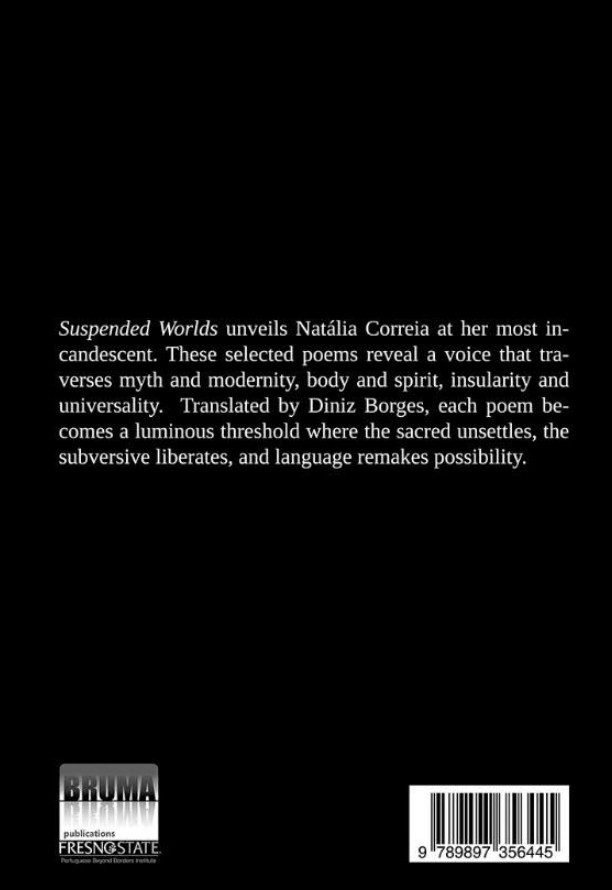
There are poets whose work does not merely cross languages but changes latitude. With the release of Suspended Worlds, the poetry of Natália Correia enters English not as an echo, but as a living force—restless, insurgent, metaphysical, and incandescent. This volume is not simply a translation project; it is an act of cultural restitution, restoring to the diaspora—and to all English-language readers—one of the most luminous, uncontainable voices of twentieth-century Portuguese literature.
For generations of Portuguese descendants in the United States, Canada, Bermuda, and beyond, Natália Correia has often been a name spoken with reverence but encountered at a distance—invoked in essays, recalled in anecdotes, cited as a symbol of fearless intellect, poetic audacity, and political defiance. Suspended Worlds closes that distance. It places her poems—long withheld by language—directly into the hands of readers who live, think, and feel primarily in English, allowing them to encounter not a monument, but a voice: ironic and prophetic, erotic and metaphysical, maternal and insurgent.
The poems gathered here trace what might be called Correia’s cosmology of freedom. From the insular memory of departure in “Grey Morning (Departing from São Miguel)” to the ontological defiance of “The Poet’s Defense,” from the maternal and mythic invocations of Mother Island to the apocalyptic lucidity of “Ode to Peace,” these poems insist that poetry is not ornament but stance—a way of standing upright in history. Correia’s language refuses the reduction of the world to ideology, dogma, or technocratic reason. Instead, it reclaims myth, eros, laughter, and revolt as epistemologies in their own right.
Central to this volume is the remarkable Introduction by Ângela de Almeida, which does far more than contextualize. Almeida reads Correia through the lens of anamorphosis—poetry as a distortion that reveals truth—and situates her work at the intersection of heterodoxy, insularity, and universalism. The island, in this reading, is not a limit but a generator of meaning: mother, matrix, spiritual center, and point of departure. For diasporic readers especially, this interpretation resonates deeply. The island becomes not nostalgia, but psychic energy—the place from which language remembers itself.
Equally powerful is the section “Natália, in Her Own Words,” where the poet reflects on her craft with characteristic lucidity and irony. Here, Correia dismantles the romantic myth of inspiration while refusing the sterility of academic self-analysis. Poetry, she insists, is neither divine dictation nor narcissistic display; it is a cosmic kinship, a rhythmic alignment with forces that exceed the individual self. For English-language readers encountering her for the first time, these pages offer a rare intimacy: the poet thinking aloud about the risks, responsibilities, and dangers of making language breathe freely in a world that prefers its words domesticated.
Thus, the Afterword, composed of Correia’s own prose, reinforces what the poems enact: a refusal of single gods, single truths, single systems. Her thought moves with baroque amplitude—drawing from classical myth, Christian symbolism, surrealist rupture, and political rage—yet always returns to the ethical core of poetry as resistance to petrification. Against the “Cyclopean eye” of power, poetry becomes flame, laughter, and refusal.
Finally, the Translator’s Note frames the entire project as an act of diasporic mediation. Translation here is not mechanical transfer but a form of listening across oceans and generations. To translate Natália Correia into English is to carry her volcanic syntax, her erotic metaphysics, her insular universalism, into a language shaped by other histories—American, diasporic, migratory. It is to allow her poems to speak not only to Lusophone memory, but to all readers who understand poetry as a form of ethical imagination.
In bringing Suspended Worlds into English, Bruma Publications and Letras Lavadas affirm a larger mission: that literature of the Azores and Portugal belongs fully within the global conversation of letters, and that the diaspora is not merely a recipient of culture, but a space of renewal. For second-, third-, and fourth-generation readers, this book offers more than access—it offers recognition. It allows them to encounter the land of their forebears not through folklore alone, but through the fierce intelligence of one of its greatest poets.
Natália Correia once wrote that her dream of happiness would be a world in which poetry would no longer be necessary—because it would already be fulfilled in life. Until that world arrives, Suspended Worlds reminds us why poetry remains indispensable: as revolt, as tenderness, as memory, as flight.
 Filamentos (artes e letras)