
Introducing Prayers and Supplications / Songs of Hopelessness by Vera Duarte
Bruma Publications · Moonwater Editions
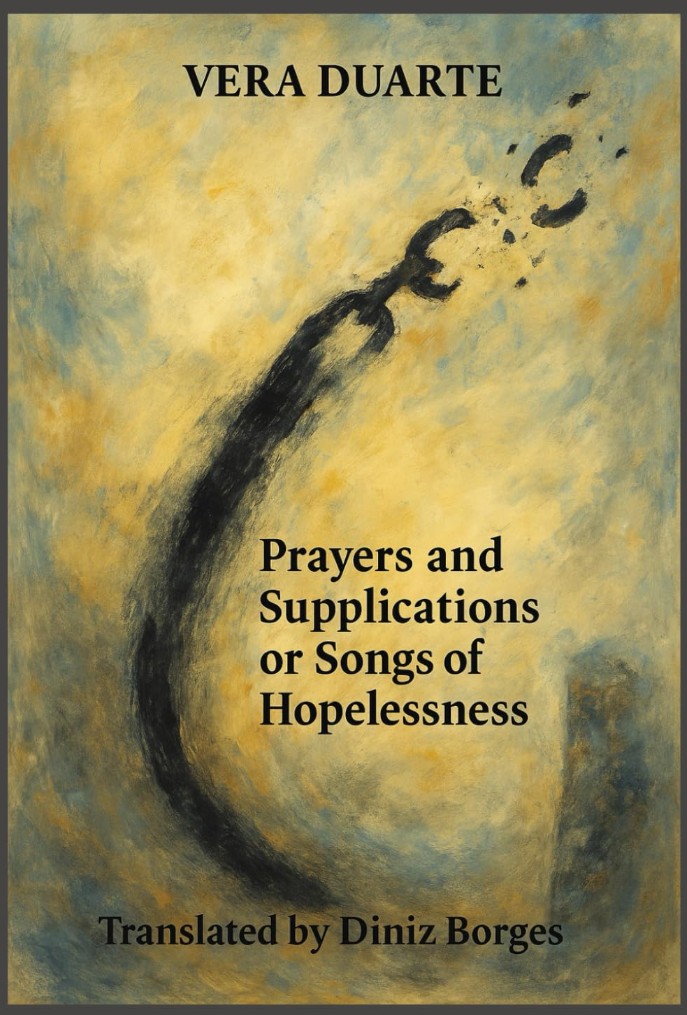
There are books that arrive quietly, and there are books that arrive bearing history in their breath. Prayers and Supplications / Songs of Hopelessness, by Vera Duarte, belongs to the latter. This is not merely a poetry collection newly available in English; it is a crossing—of oceans, of memory, of ancestral grief—into the consciousness of the African diaspora in the United States and beyond, and into the wider community of readers for whom poetry remains a moral act.
Published by Bruma Publications in collaboration with Moonwater Editions, this volume opens a necessary door. It brings to English-language readers one of the most commanding and ethically resonant voices of the Lusophone world, a poet whose work stands at the confluence of law and lyric, justice and lament, island and continent.
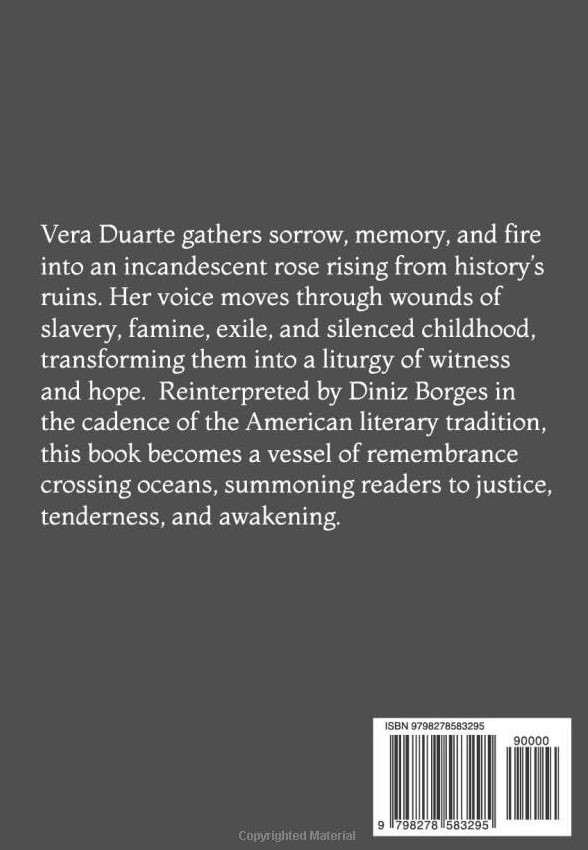
Vera Duarte writes from Cape Verde, but her poems speak to all African diasporas—to those whose histories were shaped by slavery, colonialism, forced displacement, racism, and the long afterlife of those violences in the Americas. These poems do not aestheticize suffering; they name it, carry it, refuse to look away. They bring us face to face with Gorée, with famine, with violated bodies, with children whose laughter has been confiscated by history. And yet, they also insist—again and again—on the irreducible dignity of the human spirit.
In her Preface, Susana Antunes captures the book’s central metaphor with crystalline precision: the image of the rose among cadavers. This rose is not consolation. It is defiance. It is, as Duarte writes, “a solitary bloom / in a continent vast as prophecy”—beauty not as escape, but as ethical resistance. Antunes reminds us that these poems are not content with witnessing alone; they summon the reader into responsibility, into what she calls an “ethical demand.” To read Duarte is to be placed under oath—not of belief, but of attention.

The structure of the book reinforces this gravity. The Supplications and the Seven Prayers draw on biblical cadence while expanding it into a contemporary liturgy of injustice: slavery’s shadow, the betrayals of postcolonial leadership, the commodification of women’s bodies, the erasure of children. In poems such as “Voices Without Echo” and “Silent Urgency,” Duarte gives voice to those history has trained us not to hear. Silence, in this book, is never neutral. As she writes with devastating clarity, indifference is itself a form of killing.
And yet—this is crucial—Prayers and Supplications is not a book of despair. It is a book of radical moral lucidity. Even at its darkest, it believes in the necessity of the word. “Without the word, / the island cannot exist,” Duarte writes. Poetry here is not adornment; it is survival. It is the place where memory refuses erasure, where the oppressed re-enter history as speaking subjects.
The Translator’s Afterword frames this English edition as an act of responsibility as much as of craft. To translate these poems, he writes, is to walk “along the trembling edge between sorrow and radiance.” Translation becomes here a diasporic bridge, allowing the wounds of Africa—and of all African-descended peoples—to speak within the moral imagination of English-language readers. Borges reminds us that suffering does not respect borders, and neither should solidarity. In this sense, the translation is itself a political gesture: it widens the circle of witnesses.
For Cape Verdean Americans, all African Americans, Afro-Caribbean communities, and all those whose histories are marked by Atlantic crossings, this book offers something rare and necessary: recognition without simplification. It refuses folklore. It refuses silence. It insists on complexity, on rage braided with tenderness, on grief sharpened into consciousness. And for readers of poetry more broadly, it affirms what poetry can still do in a fractured world: confront power, restore memory, and imagine repair without lying about the cost.
Vera Duarte is one of the great moral voices of our time. Her poetry belongs beside that of Aimé Césaire, Léopold Sédar Senghor, and Maya Angelou—not only for its lyric power, but for its unwavering commitment to justice. With Prayers and Supplications / Songs of Hopelessness, now in English, her voice enters the American literary conversation not as a guest, but as a necessary presence.
This book does not ask to be admired. It asks to be heard. And once heard, it does not release us unchanged.
 Filamentos (artes e letras)