
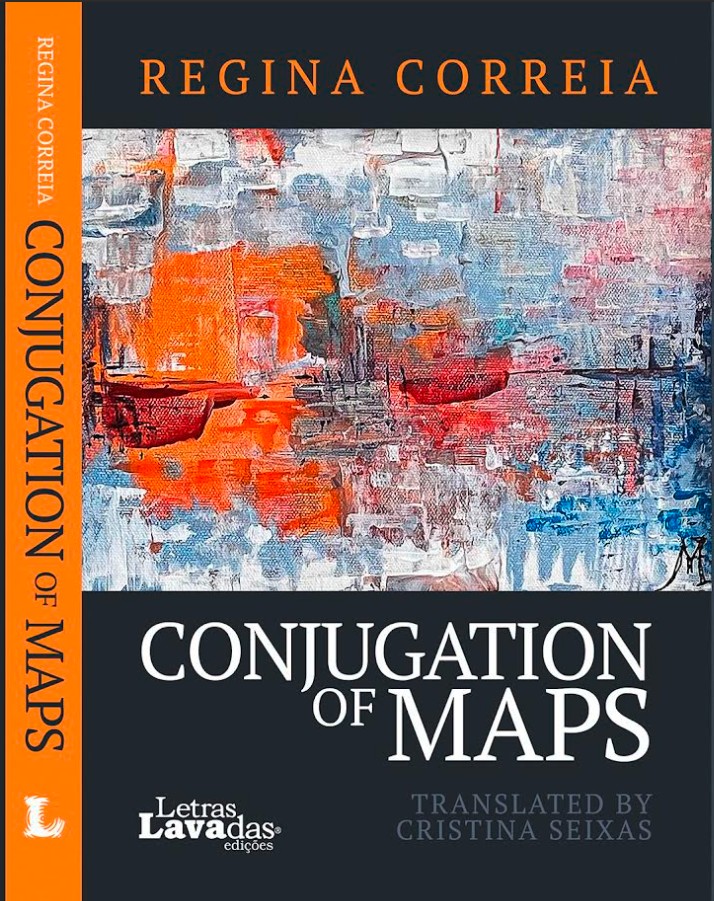
Filamentos marks the release of Conjugation of Maps, a luminous poetry collection by Regina Correia, translated into English by Cristina Seixas. Published by Letras Lavadas in partnership with Bruma Publications, this book arrives not merely as a volume of poems, but as a literary act of mapping—of memory, language, and belonging across continents.
At the heart of Conjugation of Maps lies a poetic vision shaped by movement: between Portugal and Angola, Europe and Africa, islands and mainland, intimacy and history. Regina Correia’s poems are anchored in lived geographies—Luanda, Lisbon, Stuttgart, Hamburg, Cape Verde, the Azores—yet they refuse the rigidity of borders. Instead, they propose language itself as homeland, a living grammar through which identity is continually conjugated and reimagined.
The English translation by Cristina Seixas is both precise and deeply attentive to the musical and sensorial density of the original poems. Rather than flattening the text into equivalence, Seixas preserves the tension, cadence, and lyric pulse that define Correia’s voice. The result is a translation that reads as poetry in its own right, while remaining faithful to the emotional and cultural strata of the source text. This is particularly evident in poems where exile, childhood, desire, and political memory intersect—spaces where language must carry not only meaning, but weight.
Critically, Conjugation of Maps is a book in dialogue. It converses with other poets and traditions—Lusophone, African, European, insular—through epigraphs, dedications, and subtle intertextual gestures. Essays and reflections included in the volume frame the collection as a cartography of displacement and return, where each poem functions like a coordinate on a larger, unfinished map. As one critical voice in the book suggests, these are not maps that explain the world, but maps that teach us how to inhabit uncertainty.
Visually, the cover artwork—Entardecer by Maria Isabel Brito—echoes the book’s ethos: layered, textured, and suspended between fire and water, memory and present tense. Like the poems themselves, the image resists a single point of entry, inviting the reader into a slow, contemplative engagement.
For Filamentos, the publication of Conjugation of Maps represents more than the release of a new book. It is a reaffirmation of translation as cultural bridge, of poetry as ethical attention, and of literature as a space where dispersed lives can be gathered without being reduced. In these pages, absence becomes geography; longing becomes method; and language—patient, luminous—becomes a place we can stand.
Conjugation of Maps reminds us that to read is also to travel—and that every true poem redraws the world, not as it is, but as it might still become.
Use this link to place your order.
 Filamentos (artes e letras)