
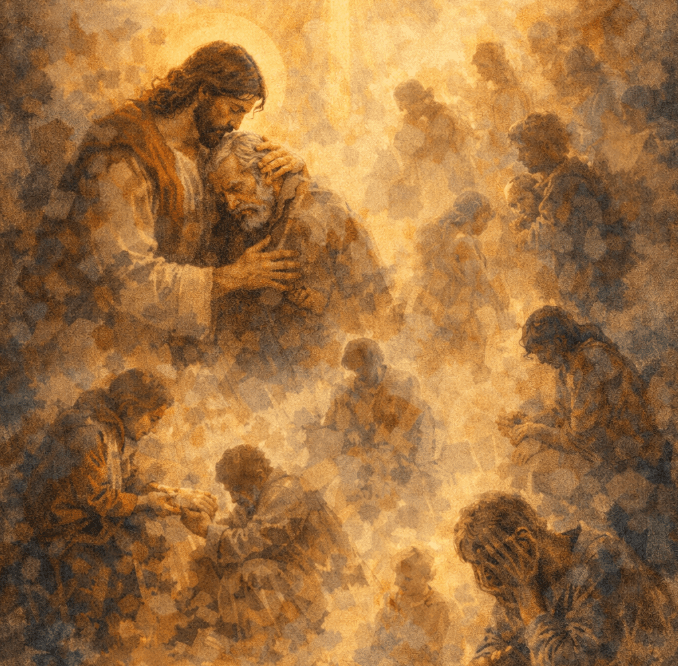
(From the editorial board of the newspaper Diário Insular-Terceira, Azores.)
During the Christmas season, the most curious forms of helping one’s neighbor—or perhaps, more accurately, “the other”—multiply. Some distribute food baskets—enough for a few, since baskets do not multiply like rabbits, and it remains to be seen whether those most in need are actually reached in the distribution. Others ask people to give—this version spreading across the doorways of places where certain goods are sold, which suggests that the business benefits everyone. There are initiatives for the poorest, for those who are not quite so poor, for the youngest among the poor, for the oldest… The problem is that the poor need to eat, drink, clothe themselves—in short, to live—every single day of the year.
In truth, there are poor people of every kind in our society. Official figures, which rise and fall according to the moods of statistics—of so-called methodology, a thing that, while not edible, can still take bread out of many mouths—speak only of the “official” poor, those who become “flagged,” largely because they expose themselves in ways detectable by the state or regional machinery, perhaps because they find no other way to eat every day. But there are many more. There are those who beg—we cross paths with them daily in the streets. And there is hidden poverty.
This last kind is particularly chilling, because it is generally made up of people who work and earn an obviously miserable wage, one that does not put bread on the table for the entire month, yet who twist themselves inside out to stave off hunger, accepting help—often from slightly better-off neighbors—only reluctantly and in ashamed silence. In truth, poverty is endemic among us. And that should shame us.
We did not dream this society into being. The model of society we chose to build does not abolish social classes, but it should leave no one behind. Manufacturing poverty is the specialty of a certain kind of savage capitalism that turns man into a wolf to other men. We rejected that capitalism and opted for a model of “social capitalism”—if the expression may be allowed—one that should invest in the redistribution of wealth, thus preventing any one of us from being forced to live without dignity, dependent on the charity of others. But the system failed. Inequalities are vast. Wealth is concentrated. Redistribution does not happen effectively. The State/Region fails in its role as regulator and social mediator, and in practice sides with those who have more and therefore can do more within the model of society into which we are sliding. And so the doors open to every kind of more-or-less seasonal charity.
Christmas is also a time to think. It is not a time to accept everything without a critical spirit. The one we celebrate in this season, Jesus Christ, left us a disruptive vision—so the word goes today.
Let us be worthy of Him.
 Filamentos (artes e letras)