

The Portuguese writer was awarded an Honorary Doctorate in Literature from the University of the Azores, in a ceremony marked by remarks from the Rector, Susana Mira Leal, and from Professor Ana Cristina Gil, who served as the honoree’s academic sponsor. Both emphasized the ethical, cultural, and literary weight of Jorge’s body of work, as well as her decades-long contribution to Portuguese civic life. In her address, Jorge invoked the formative presence of Vitorino Nemésio, reflected on the challenges posed by artificial intelligence, and warned of the growing fragility of truth in an era defined by disinformation and the rising tide of hate speech.
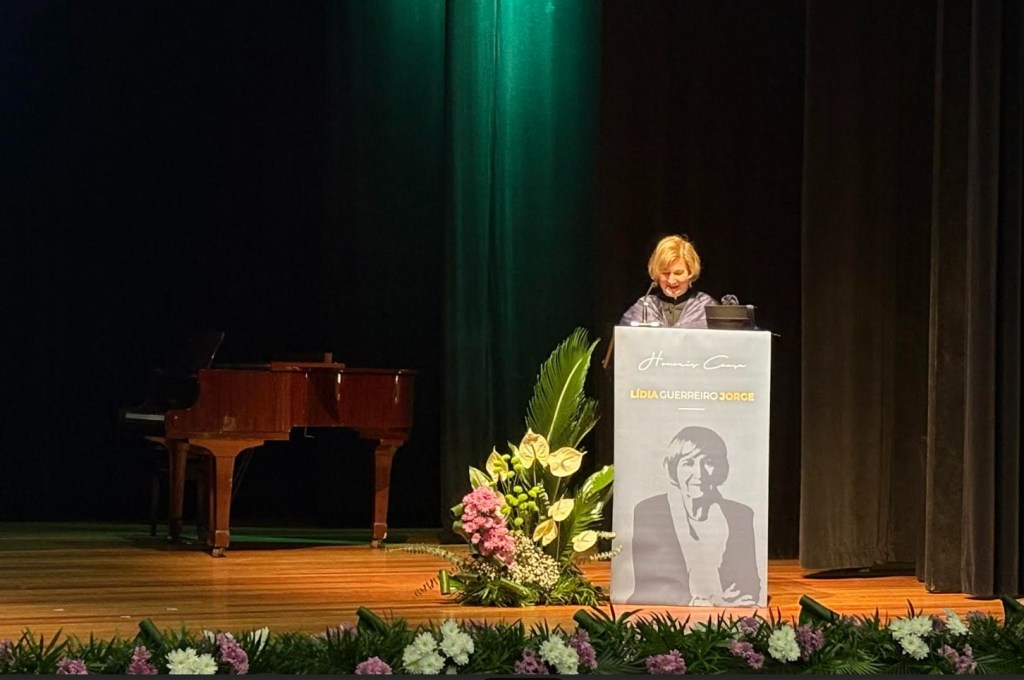
The University of the Azores (UAc), nearly at the threshold of its 50th anniversary, conferred the title of Doutora Honoris Causa upon Lídia Jorge in a ceremony held in the Aula Magna—an amphitheater that has long served as a stage for the island university’s intellectual life. The Rector, Susana Mira Leal, opened the ceremony; Ana Cristina Gil, Associate Professor in the Faculty of Social and Human Sciences, delivered the formal praise of the honoree; and the academic regalia were solemnly bestowed upon the writer, sealing her into the university’s “gallery of the notable.”
According to the institution’s statement, the honorary doctorate recognizes Jorge for her life as teacher, novelist, and active citizen; for the originality and depth of a literary oeuvre acclaimed in Portugal and abroad; for her sustained attention to the present moment and, especially, to the most vulnerable; and for her rare ability to touch each reader individually through language—reminding society of what binds us together and of what makes us human.
“We live in a time when noise overwhelms listening.”
Rector Mira Leal described the conferral of an honorary doctorate as “a flame passed from generation to generation to celebrate those whose genius, whose work, and whose intellectual courage ennoble this Academy.” As the university prepares for its 50th year on January 9, she noted that the institution has consistently chosen to honor figures who “illuminate our collective path.”
Into that distinguished lineage now enters Lídia Jorge, whose literary and civic voice leads readers into territories of profound reflection.
The Rector emphasized that such a title expresses the university’s recognition of a singular trajectory—one that has strengthened knowledge, culture, Portugal’s public life, and, above all, a practice of critical citizenship rooted in the dignity of the human condition.
But she also widened the frame outward, naming the atmosphere in which this honor is bestowed: A world where noise drowns out listening, where speed threatens depth, where a lie repeated often enough dresses itself as truth, and where collective memory trembles before seductive, manipulative narratives. In such a time, she said, honoring Lídia Jorge is not only an act of justice—it is an act of cultural resistance.
A Diagnosis of the Contemporary Condition
In her formal tribute, Professor Ana Cristina Gil described Jorge’s entire literary trajectory as “a long meditation on what it means to be human—what it means to be human today.” Her work, Gil noted, is also deeply Portuguese: attuned to the nation’s past, present, and unfolding future, and to the question of identity that persists beneath all three.
Gil walked the audience through Jorge’s fiction, demonstrating how each title has interrogated Portuguese society and offered readers—at home and abroad—a moral and imaginative lens through which to confront their own moment.
She highlighted Jorge’s widely discussed speech from this year’s Portugal Day celebrations in Lagos, calling it “exemplary and courageous” for its ability to braid past, present, and future into a single gaze. The controversy it sparked across the country, Gil suggested, proves its urgency.
Quoting from that address, Gil recalled Jorge’s depiction of contemporary citizens as spectators staring into pocket-sized screens, and, more unsettlingly, as “followers”—a subtle but significant regression in civic identity.
Jorge’s gentleness and tenderness, Gil added, stand alongside a ferocious defense of human rights, especially the rights of women. Her work is marked by an ethical vision, by a willingness to peer into the world’s disorder, and by an undiminished belief in a more just, more democratic, more fraternal future—values that the University of the Azores proudly claims as its own.
“The Azores are a constellation of contemporary faces—without whom I would be far poorer.”
In her acceptance speech, Lídia Jorge began by acknowledging the delight of receiving a distinction that, despite its intellectual stature, inevitably touches “the childlike part of ourselves that always accompanies us.”
She invoked prominent Azorean names—Onésimo Teotónio de Almeida, João de Melo, Mário Mesquita—describing the islands not only as a geographic space but as a community of contemporary presences who have shaped her life and imagination.
Among them, one figure stands above all: Vitorino Nemésio, her professor at the University of Lisbon. She recalled his improvisational lectures, his encyclopedic memory, and his belief that literature formed an unbroken chain of pages across centuries—“as if everything that had ever been written belonged to a single author.”
Jorge spoke of her early literary apprenticeship and of the decisive role Nemésio’s work played in it. A brief poem from O Cavaleiro Encantado, she said, continues to nourish her creative life because it embodies the subversive power of literature: its ability to invert meaning, to operate by ellipsis, to transform disappointment into revelation through the alchemy of metaphor and oxymoron.
“For the aspiring writer I once was, that poem became a promise—one that accompanied me day and night.”
On Artificial Intelligence: What Machines Cannot Touch
One of the central currents of Jorge’s speech was her meditation on artificial intelligence.
The long-standing link between knowledge and the discourse that expresses it, she argued, has now been fractured. Yet the poetic word—the most sophisticated articulation of a language—remains the final bastion against generative artificial intelligence.
However advanced these systems become, she said, no algorithm can invent the feeling that led Nemésio to dedicate a poem to a certain Colonel Sacadura. That gesture belongs to the realm of human relation—of experience, affection, and memory.
Even if these systems generate an infinite number of combinations, their output lacks an ontological and emotional subject. What remains untouched—and untouchable—is the “unexpected combination born of the creator’s moved word.”
Truth in the Age of Spectacle
Turning to the crisis of truth in public life, Jorge described an age in which one can announce that a boat has sunk while it sails freely—yet once the falsehood spreads, the fiction becomes more powerful than the fact.
This is not an illusion, she warned, but “the triumph of the loud voice over reality”—a new epistemological fracture, a carnivalesque inversion in which the subject and the addressee exchange places, and the most brazen declarations win simply by force of repetition.
She addressed the students directly, reminding them that the university’s motto—“science shines like a dawn”—remains a beacon. Literature and philosophy, she insisted, continue to offer essential ways of seeking truth and understanding human experience.
But she issued a caution: new technologies, when combined with the recycled rhetoric of figures like Himmler, become profoundly dangerous. Today, she noted, leaders around the world—some of them in small countries like Portugal—repeat such phrases without irony, sometimes even with servility, unaware of the humiliation embedded in the act of imitation.
*“Each word a threat, each sentence a battle cry”—*this, she said, is the linguistic landscape of the present. Those who study history can see clearly that the “modern future” now being sold to us is no future at all, but rather a return to a dark, sulfurous past.
In Correio dos Açores. A cultural journalism piece by José Henrique Andrade. Natalino Viveiros is the director of Correio dos Açores.
 Filamentos (artes e letras)