

How does art education contribute to the social inclusion of young people and adults with special educational needs?
Art education plays a fundamental role in the social inclusion of young people and adults with special educational needs because it offers a space for free expression where everyone can participate in a meaningful way, regardless of their limitations.
By using languages such as drawing, music, theater, or dance, art creates opportunities for nonverbal communication that allow many individuals to express emotions, ideas, and experiences that might otherwise remain inaccessible. This process contributes to strengthening self-esteem, autonomy, and confidence, which are essential elements for any path to inclusion. In addition, artistic activities stimulate social-emotional skills such as cooperation, empathy, emotional management, and the ability to overcome challenges, skills that have a direct impact on social interaction and participation in educational or community contexts. Arts education also values diversity because it recognizes that there is no single way to create, interpret, or communicate, allowing each participant to explore their own pace, style, and potential without the pressure of rigid performance models. By promoting collaborative work, presentations, or exhibitions open to the community, art reduces stigma and builds bridges between people with and without special needs, fostering a real sense of belonging and contributing to a more positive social image. On the other hand, many artistic practices favor cognitive and motor development, stimulating attention, memory, coordination, and organization of thought, which can complement other learning. Thus, arts education asserts itself as an inclusive, accessible, and humanizing medium, capable of enhancing individual abilities and, at the same time, bringing people together, strengthening community ties, and promoting full social participation.

What is the impact of bringing an exhibition such as “Faces That Speak” to a hospital setting?
Bringing an exhibition such as “Faces That Speak” to a hospital setting has a profound impact on both the institutional environment and the people who frequent it. First, it humanizes the clinical space, breaking the perception of the hospital as a place exclusively associated with illness, pain, or waiting. The presence of art transforms corridors and rooms into more welcoming, stimulating, and emotionally safe environments, contributing to reduced levels of anxiety and stress in patients, family members, and healthcare professionals. An exhibition like this, focused on faces that tell stories, offers opportunities for identification, reflection, and empathy. Visitors no longer see the hospital as just a technical setting and begin to relate to human narratives that promote understanding, sharing, and, perhaps, connect us with others. For patients, especially those with prolonged hospital stays, contact with art can represent a moment of escape, motivation, or inspiration, reinforcing a sense of dignity and personal value. For professionals, it serves as a reminder of the human dimension of their work, as it strengthens the link between clinical practice and emotional care. It is important to emphasize that the goal is not to transform the hospital into an art gallery or a space where people go specifically to “consume art.” The intention is rather to humanize the environment, integrating art as a resource that improves well-being and fosters more humane relationships within the institution.
What lessons and transformations were observed during the artistic residencies of the A.T.I.T.U.D.E. Project?
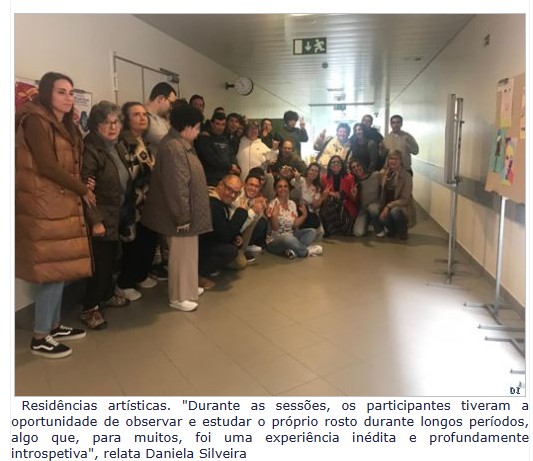
Although the person best suited to answer this question is the trainer and advisor for the artistic residencies, the artist and educator Phillipa da Silveira Cardoso, I can mention some of the lessons learned and transformations that were observed based on the feedback I received throughout the residencies. During the sessions, participants had the opportunity to observe and study their own faces for long periods of time, which for many was a new and deeply introspective experience. This prolonged exercise in self-observation was not limited to the aesthetic dimension; on the contrary, it served as a gateway to their inner dimension. When confronted with their own image, participants were led to explore emotions, memories, and personal narratives, developing a broader awareness of themselves. This artistic process allowed them to simultaneously work on the technical gaze, linked to the form, light, detail, and structure of the face, and the emotional gaze, related to identity, self-image, and how they perceive themselves in the world. According to the reports received, this dual approach fostered greater self-confidence, more authentic expression, and a more positive relationship with one’s own body and history. In addition, the group dynamics created in the residencies promoted sharing, listening, and empathy, allowing each participant to recognize and value the uniqueness of others. Together, these experiences contributed to the development of artistic skills, but also personal and social skills, which are fundamental to well-being and inclusion.
How can schools, associations, and health institutions integrate arts education into their programs?
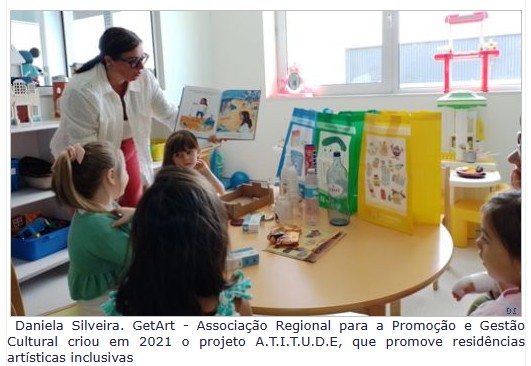
At the regional and national levels, what we have observed is a clear and continuous disinvestment in culture, education, and, even more worryingly, arts education. These are not interpretations or isolated situations: it is a fact. Arts-related subjects have lost teaching hours, qualified professionals are not being hired to teach them, and in many cases, these subjects are being taught by people without specific training. This demonstrates a clear disregard for the importance of art in students’ education. At the same time, there is a notable absence of educational projects with a structured artistic component in schools, which confirms the lack of real investment in this area. Artistic education is not being treated as an essential pillar, but rather as something dispensable, when in fact the opposite is true. The effects of this disinvestment are profound. The absence of artistic practices deprives students of fundamental opportunities to develop skills such as creativity, critical thinking, emotional expression, aesthetic sensitivity, and the ability to solve problems in innovative ways. When art is truly integrated into schools, the benefits become immediately visible: environments are more inclusive, students show greater motivation, the school climate improves, there is more cooperation and less conflict, and a sense of belonging to the educational community grows. In healthcare institutions, it is different; regular contact with art is not usually expected, as the focus is predominantly clinical. However, in this artistic residency, we invited the Hospital da Ilha Terceira to collaborate with us to be the first space to host the exhibition, and the response was immediate and affirmative. This gesture reflects the hospital’s proactivity in humanizing its spaces, seeking to create environments that better welcome patients, support families, and strengthen the connection to the surrounding community. Its Pediatrics department is a good example of this commitment, with spaces designed to provide emotional comfort to children and their families. The associations that were born within this hospital, the Association of Friends of Pediatrics of Terceira Island and the HSEIT Staff Association, have been highly active in promoting cultural and community initiatives. This work is neither occasional nor symbolic; it is consistent, structured, and continuous, and demonstrates a clear vision of the transformative role of art within a healthcare institution. It is a model that should inspire other healthcare institutions.
What role can art play in changing social perceptions of disability and diversity, and how does this exhibition aim to provoke such reflection?
We are fully aware that we are not going to perform miracles. What we are seeing at the regional level shows a clear political choice: disinvestment in culture and arts education, while the European Union proposes to increase funding for culture because of its essential role in maintaining democracy, promoting critical thinking, and combating polarization and misinformation. This contradiction is not accidental; it shows how political power can underestimate art because it has the capacity to shape critical and conscious citizens, and this disturbs structures that prefer passive societies. From an educational point of view, it is also necessary to understand that isolated contact with art does not permanently change mentalities. Transformation happens when meaningful experiences are continuous, accessible, and contextualized—when art is consistently integrated into educational, cultural, and social spaces. This is where our work comes in: we do not expect miracles, but rather to plant seeds of reflection and dialogue, stimulate empathy and creativity, and open paths for art to be perceived as an instrument of citizenship, inclusion, and humanization. At the same time, this analysis underscores the importance of public policies that support arts education and structured cultural projects. Without these policies, every initiative, no matter how good, runs the risk of remaining isolated and having limited impact. When well supported and systematically integrated, art not only transforms individuals, but also contributes to a more critical, inclusive, and democratic society.
In Diário Insular, José Lourenço-director.
We thank the Luso-American Education Foundation for their support.
 Filamentos (artes e letras)