
In the murmur of static, we discover that some voices are compasses — and that eternity begins in the very moment we hear them.
There are men whose voices reach us long before their faces ever do, long before we shake their hands or recognize the fine lines of their expressions. In my adolescence, growing up in the Central Valley of California, Mário Soares was one of those voices—an improbable companion carried across the vast openness of the Pacific night by a fragile shortwave radio my father bought for me when I was fifteen. It was a modest device, its antenna thin as a promise, its dial glowing with the faintest amber. And yet, through its crackling frequencies, the world entered our home: Lisbon’s dawn carried into California’s dusk, democracy in the making whispering itself into the bedroom of a Portuguese-American teenager still smelling of hay and milking stalls.
In those years—mid-1970s, the years of rupture and rebirth—Portugal was reinventing itself after decades of silence. My generation was shaped not by proximity but by distance: by letters that arrived three weeks late, by yellowed newspapers whose headlines belonged to another time by the moment we touched them, by the crackle of Rádio Clube Português and Emissores Nacionais cutting through static and static-laden miracles. We learned democracy not from the immediacy of streets filled with carnations, but from the attentiveness of listening. For us in the diaspora, the revolution came through sound, through memory, through the ache of belonging to a place we could not see but could not stop hearing.
Every night, long after I should have been asleep, I listened to Soares—his cadence forceful, luminous, insistently moral. My mother would open the door, whispering that I had to wake at four in the morning to help my father in the dairy barn. “Dorme, rapaz, amanhã tens que te levantar cedo para trabalhar…” she would plead, but I remained there, holding the radio close, as if by sheer will I could keep the signal from dissolving into noise. Then, hours later, before the sun rose, I helped milk cows until 6:15, came home for a quick shower, gulped a breakfast of necessity, and boarded the bus to school with Portugal still echoing in my ears.
These were the years when Soares’s words became part of my formation—not only politically but emotionally, even spiritually. He was not just a statesman then; he was a teacher from afar, affirming for us that Portugal could be plural, democratic, European, hopeful. For teenagers in the diaspora, longing for a country suspended between memory and reinvention, he gave language to possibility.
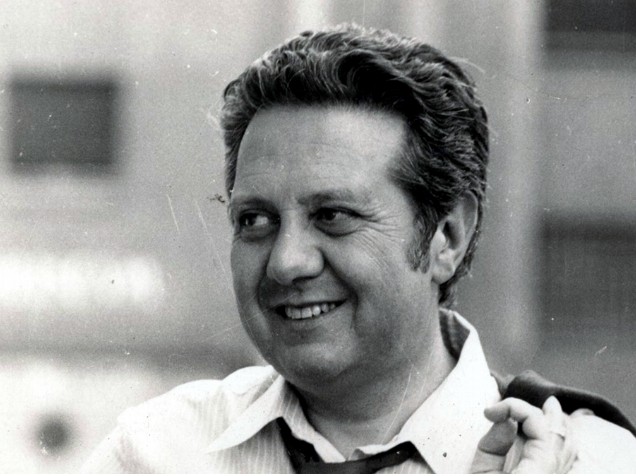
And then, unexpectedly, decades before I knew anything of my adult life, that distant voice became a face.
In 1983, when Soares—by then Prime Minister for the second time—visited California, I was twenty-four and working as program and news director for Rádio Clube Comunidade, a station I had co-founded the year before in Visalia. My colleague and friend Pedro Valadão Costa and I traveled nearly four hours to Artesia, to the Portuguese hall where the event was held. The hall overflowed with emotion, pride, a kind of transatlantic electricity. The major Portuguese news outlets were all there—Lisbon journalists with polished equipment, seasoned voices, professional air. Pedro and I had only a cheap cassette recorder, the kind that clicked loudly when you pressed “record,” but it was all we had, and it was enough to give us courage.
When Soares entered, the room stirred with that unmistakable mixture of reverence and familiarity. Reporters swarmed him, microphones rising like metallic reeds in a strong wind. Somehow, impossibly, I found myself close enough to speak. He looked at me, no sign of recognition, of course—why would there be? His first question was direct, almost procedural: “De que órgão de comunicação é que você é?”
I answered with the humility and pride of youth: a Portuguese radio station in California… in the Central Valley. He paused, slightly puzzled, and said, “Isso é local.” I told him no—no, Prime Minister, I had traveled almost four hours to be there. Something in his face shifted. He stopped moving, truly stopped, in the middle of that crowd. He sized me for a second that seemed longer than it was, then said with surprising warmth, “Obrigado por ter viajado para cobrir a minha visita. Vou falar para a sua estação.”
And then—to the astonishment of every reporter around us, and to my own disbelief—he added, “Primeiro para a estação deste jovem.”
Eight minutes. Eight extraordinary minutes of conversation, offered with generosity, depth, and a sense of dignity, he always afforded the diaspora. He gave us what we had no right to expect: time, respect, and the acknowledgment that our small, modest radio station mattered.
I carried that moment with me for more than twenty years.
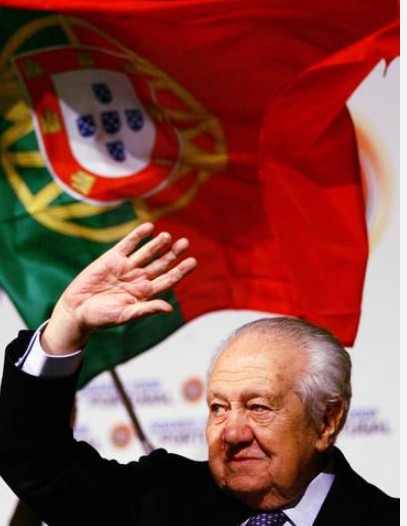
Two decades later, in Lisbon, at a literary conference, some friends and I stopped for coffee at a place rumored to be among his habitual stops. The owner confirmed it casually, as if discussing the weather. “Ele deve chegar daqui a pouco.” And indeed, minutes later, the door opened, and there he was—older, slower, but carrying the same unmistakable aura of someone who had lived history from its interior.
He greeted everyone with the ease of a man for whom public life had long since become second nature. Then he looked at me—really looked. “Acho que já o vi, a sua cara não me é estranha.” I began telling the story of Artesia, of the tape recorder, of how nervous I had been. But before I could finish, he interrupted with a small triumphant spark in his eyes: “Sim, sim… Los Angeles… num salão português muito bonito. Era repórter de uma rádio.”
I was astonished. How could he remember? Between those two encounters lay thousands of reporters, crises, elections, trips, speeches—entire nations of memory. And yet he recalled not only the event, but the fact that I had traveled to be there. “Isso é uma das coisas que admiro nas comunidades portuguesas lá fora,” he said. “Trabalham e muito para manter Portugal presente nessas terras tão distantes.”
In that moment, he gave me again what he had given me at fifteen, and again at twenty-four: a sense of belonging to a Portugal that extended beyond geography, beyond politics, into the realm of affection and recognition.
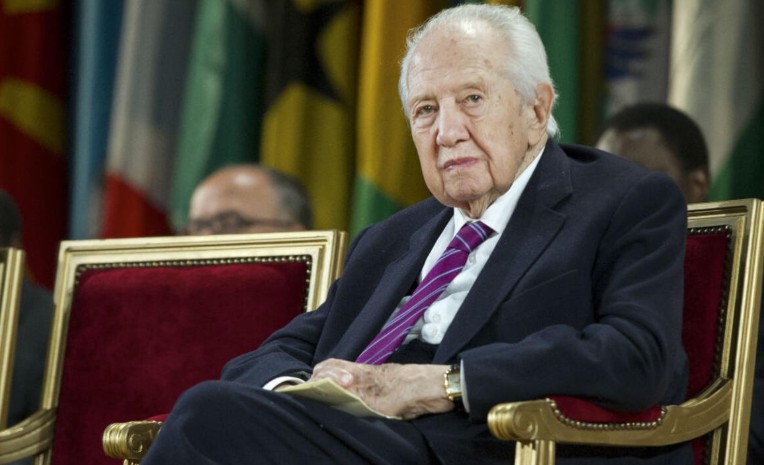
Over the years, I have read many of his speeches, letters, essays, contradictions, and evolutions. I have disagreed with him as much as I have admired him. But democracy is not made by saints; it is made by flawed, courageous, audacious human beings who insist that freedom is worth the quarrel. Soares was one of those rare figures for whom the imperfections of politics never overshadowed the greatness of vocation.
He shaped my generation. He shaped the exiled frequency through which we, in the diaspora, listened for Portugal in the night. He shaped the adolescent who listened to him under the covers with a shortwave radio, the young reporter trembling with a cassette machine in Artesia, and the adult scholar who decades later encountered him again in a Lisbon café.
Even now, when I think of the men who carried democracy on their shoulders, who insisted that Portugal belonged to the open horizon of Europe and not to the shadows of its past, I remember that voice—grainy, distant, resolute—crossing the continent and the ocean, stitching me to a homeland I was still learning to understand.
Mário Soares will always remain, in my personal cartography of belonging, both a statesman of history and a quiet companion of the radio nights of my youth. And I remain grateful—for the democracy he helped build, for the diaspora he acknowledged, and for the unforgettable generosity he once showed to a young man holding a cheap recorder, believing that Portugal also spoke to those who lived far from its shores.
Diniz Borges
Thank you for reading it. This piece was written a few months ago and will be part of an upcoming English-language book of essays on the California diaspora, featuring reflections and experiences. I decided to publish it on Filamentos today, since it is Mario Soares’ 101st birthday (Dec 7, 2025).
 Filamentos (artes e letras)