
Where islands dream, and stories cross oceans.
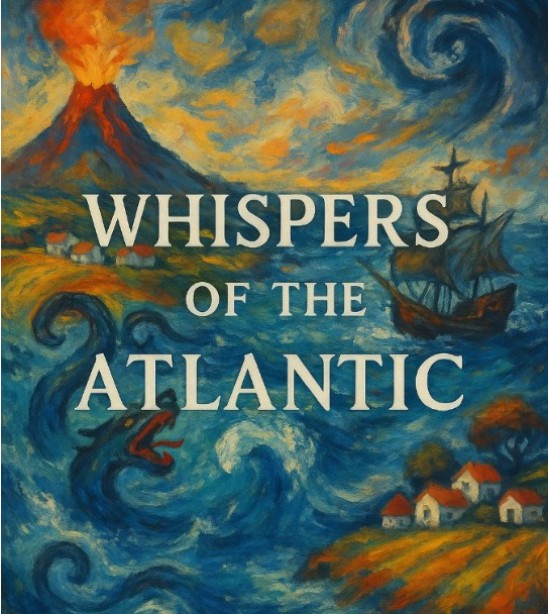
From the volcanic heart of the Atlantic rise tales that have traveled through centuries—stories whispered around hearths, sung in work songs, carried in the wind across nine islands. Whispers of the Atlantic: Legends from the Azores gathers these timeless narratives and brings them into English, offering readers a journey through the enchanted archipelago where myth and memory intertwine. Giants, saints, sailors, and dreamers live side by side with the sea, the volcano, and the hydrangea. These are not only legends of the past; they are living echoes of a people who have always dwelled between fire and water, exile and belonging, homeland and diaspora.
The Legend of the Seven Calderas
Long, long ago, when the world still breathed with the innocence of beginnings, a farmer lived on Flores with his young son, João. Each day, the boy walked great distances to fetch water, for no spring blessed the land near their home. João, however, was a creature of reverie: he lived half-rooted in the soil of chores and half-winged in the sky of dreams. Those who knew him said his heart was unblemished—simple, pure, and kind—and that one day he would accomplish wonders shaped not by strength, but by imagination.
One morning, carrying two clay jugs filled from a distant spring, João paused beside a small rain-made puddle. Tired, he set down his burden and allowed his thoughts to drift. Speaking into the silence—as children often confide in the world—he murmured, “People say that elsewhere there are beautiful lakes and great volcanic calderas. My island has none. But that’s all right… I’ll make them myself.”
Forgetting the labor of his journey, João lifted one of the jugs and poured its water onto the ground. And then—miracle blooming where logic should have stood firm—he watched a vast lake unfurl at his feet, settling deep into the newly formed cradle of a caldera. Water became geography; a child’s wish became the earth’s new truth.
Astonished and radiant with joy, João leapt into the air. “From now on,” he vowed, “every puddle I find will become a lake!” True to his word, he soon spotted another rain-pool on his left, only a few steps ahead. Without hesitation, and trusting wholly in his newfound power, he emptied his second jug. Before his eyes the water spread outward, descending into a deep basin that had not existed moments before.
Full of delight—and blind once more to the labor that awaited him—João returned to the far-off spring to fill his jugs again. And so the dance continued: each time he returned, he wandered a little farther, guided by the compass of his dreams, finding puddles scattered like clues across the island. At every one, he poured his water as if sowing seeds of wonder, and thus were born the seven lakes of Flores.
So the legend tells us that in this way appeared the Lagoa Funda of Lajes, and several others less deep, such as the Caldeira Rasa, whose muddy edges are said to swallow the careless. From João’s playful hands also emerged Lagoa Branca, the dry-bellied Lagoa Seca near Santa Cruz das Flores, the long shadow of Lagoa Comprida, another Lagoa Funda, and the serene Lagoa da Lomba.
Each lake different, each shimmering with pure, crystalline waters—waters as clear and unclouded as the thoughts of the boy who dreamed them into being.
The Legend of the Seven Calderas is an old whisper carried through the winds of Flores Island, in the Azores—an oral tradition meant to explain how the island’s volcanic bowls came to rest upon its emerald skin.
FURTADO-BRUM, Ângela. Açores, Lendas e Outras Histórias (2a. ed).. Ponta Delgada: Ribeiro & Caravana Editores, 1999. ISBN 972-97803-3-1 p. 276-277.

Vision Statement
To preserve, translate, and reimagine the legendary heritage of the Azores as a cultural bridge across oceans—connecting generations, honoring the voices of the ancestors, and ensuring that these stories remain vibrant for the future of the diaspora and the world.
Mission Statement
Through the Whispers of the Atlantic series, Bruma Publications and Filamentos are committed to:
- Collecting and translating Azorean folktales, myths, and legends with literary fidelity and poetic resonance.
- Sharing these stories with English-speaking readers in North America and beyond fosters cultural pride and cross-cultural dialogue.
- Preserving centuries-old oral traditions as living cultural treasures, not museum relics.
- Inspiring new generations of writers, artists, and dreamers to draw from Azorean heritage in building bridges across languages, cultures, and oceans
 Filamentos (artes e letras)