

Unveiling the Soul of the Azores – One Voice, One Creation at a Time
THE OLDEST WRITTEN DOCUMENT ON THE ISLAND OF SÃO MIGUEL
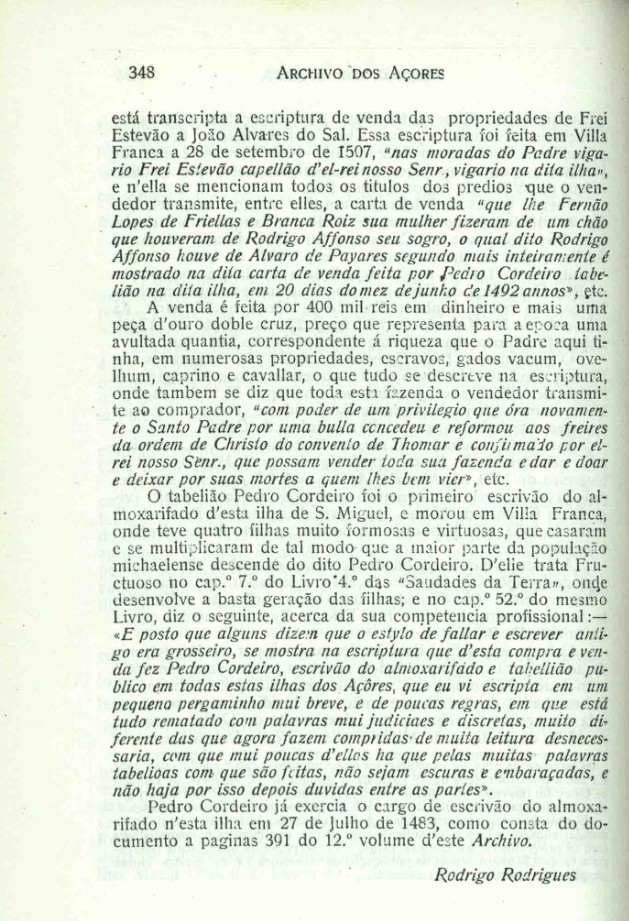
According to Rodrigo Rodrigues, whose opinion has never been refuted, a document considered to be the oldest surviving document written on the island of São Miguel[1] has been selected to feature in this section in December. It belongs to the Arquivo da Misericórdia de Ponta Delgada, a rich collection that has been on deposit at the Ponta Delgada Regional Archives since 2022 in the Regional Archive of Ponta Delgada[2].
Although produced in Vila Franca do Campo, at a time when Ponta Delgada was just a town on the island of São Miguel – not even “From a lonely wilderness to a small town” [3] and much less “From a lonely wilderness to a famous city”[4], according to the well-known expression used by Gaspar Frutuoso – the document, dated June 20, 1492, is indisputably linked to the city, as it belongs to the documentary collection of its oldest institution, which is still active today.
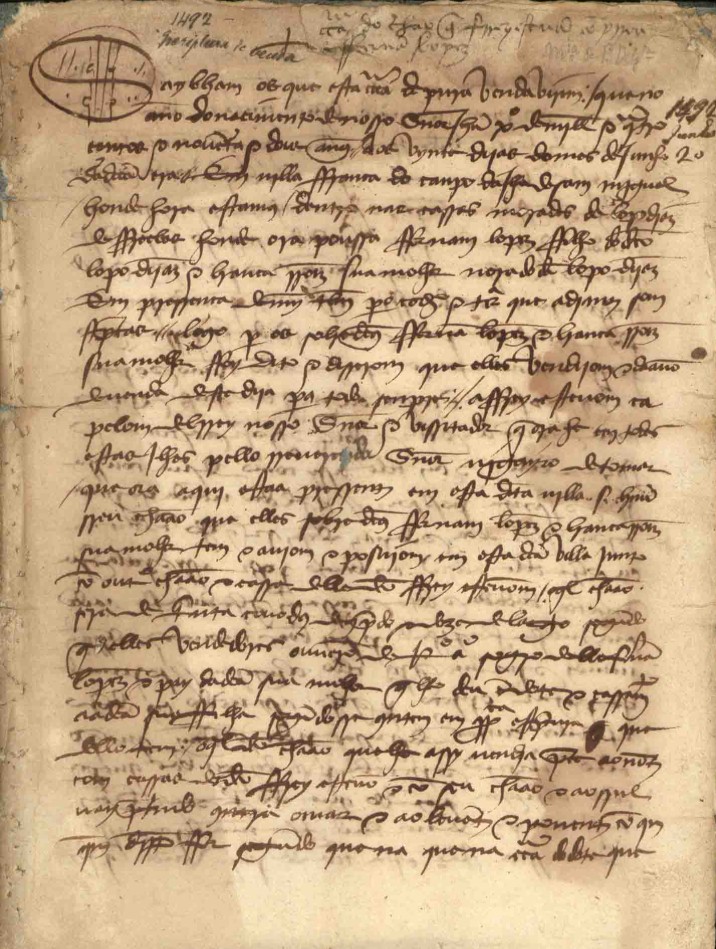
It is the authentic transcript of a deed of sale made by Fernão Lopes de Frielas and his wife, Branca Rodrigues, to Frei Estêvão, chaplain to the King and visitor of the vicar of the Order of Christ in all these islands, whom Rodrigo Rodrigues identifies as Frei Estêvão Vaz, also 2nd vicar of the Parish Church of Vila Franca do Campo and even vicar of Água de Pau.
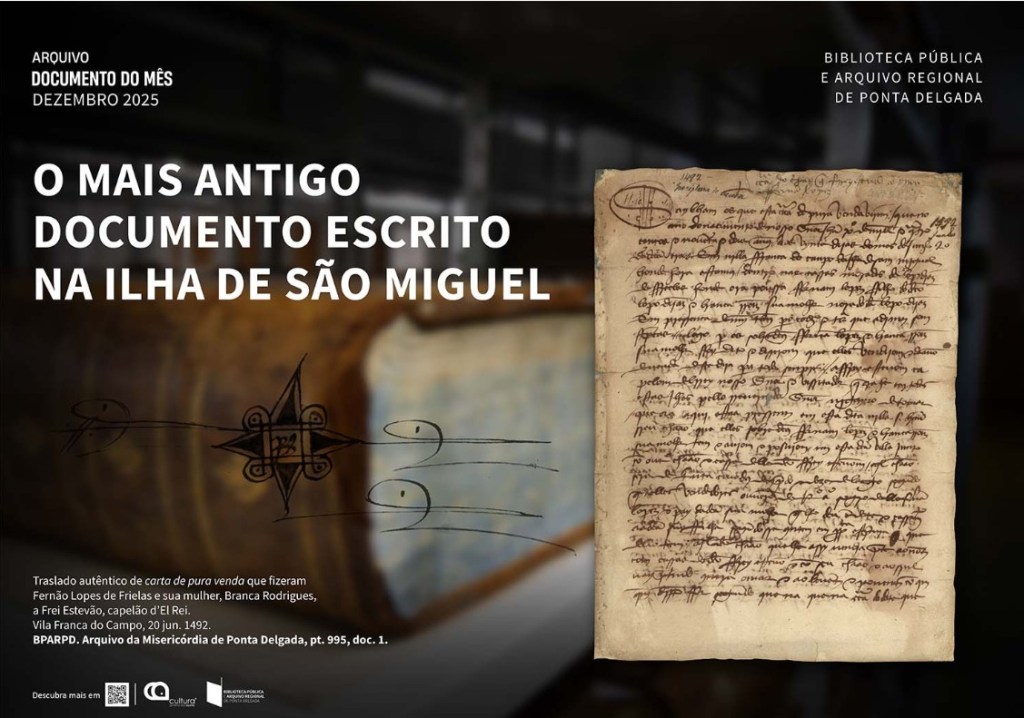
In the notes of the notary Pedro Cordeiro and for the price of one gold cruzado, in this letter of pure sale, the sellers transfer to the clergyman the ownership of a plot of land next to the chapel of Santa Catarina, to the north of which the buyer already owned his houses … with its floor, which they had received from Branca Rodrigues’ parents, Rodrigo Afonso and his wife, as a wedding dowry, from whose deed the notary even transcribes the respective amount, although he does not mention the date.
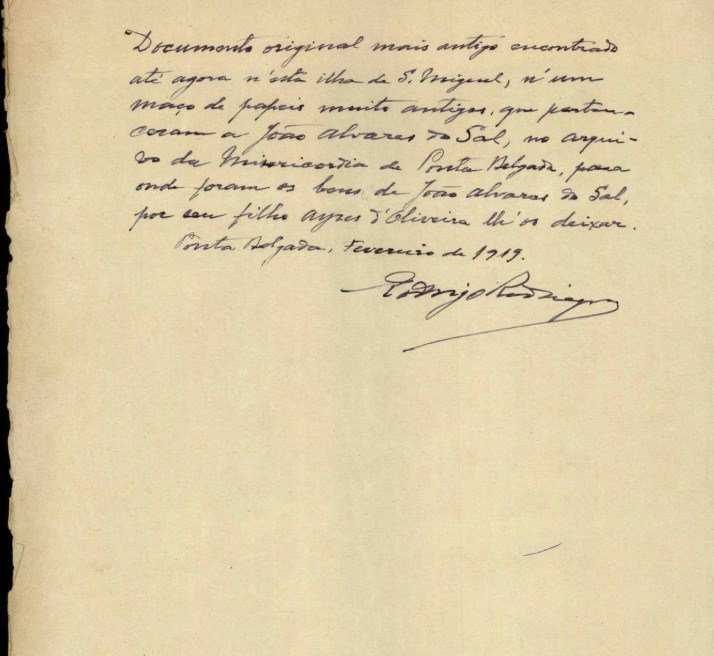
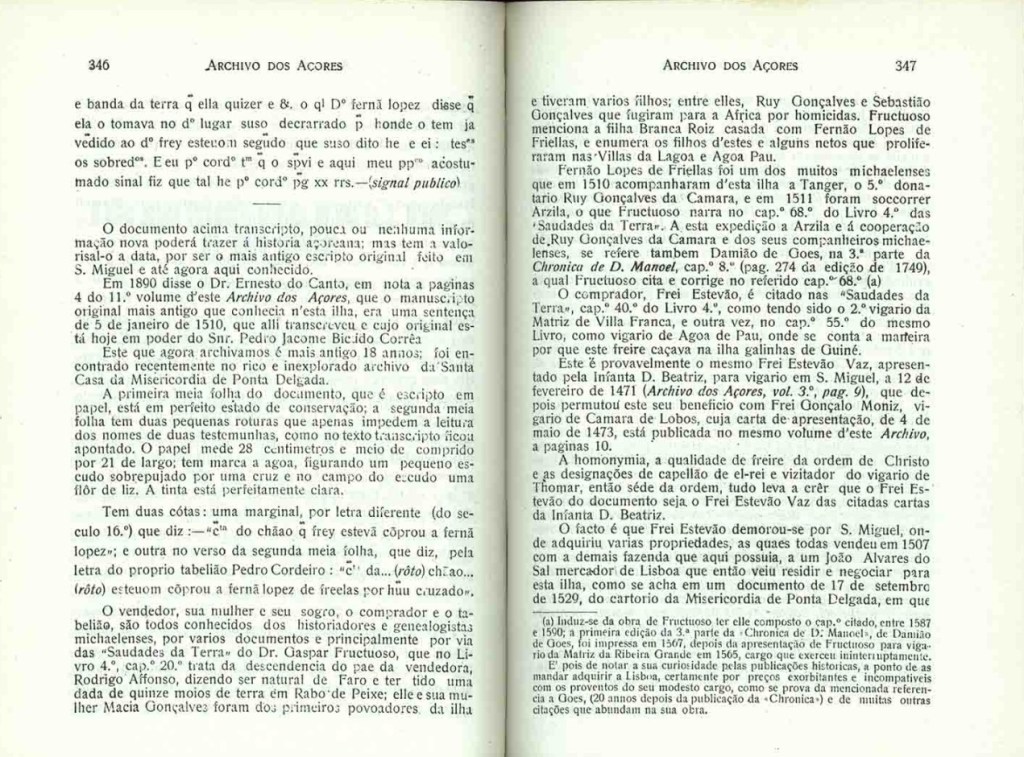
Thanks to Rodrigo Rodrigues’ article, we can better understand the note he left in 1919 in the chapel where this document is kept: in addition to the transcription he presents, identifying the parties involved and other people mentioned, he also adds information about a subsequent sale of the same land. Also made in Vila Franca do Campo, on September 28, 1507, by Friar Estêvão Vaz to the merchant João Álvares do Sal, this sale included other properties and in the respective deed, which is transcribed in another document also from the Ponta Delgada Misericórdia Archive, this previous one, from 1492, is identified in detail.
The custodial history of this document demonstrates the undeniable importance of private archives.
It is very common to find documents in family archives, personal archives, and, as in this case, in the archives of a non-public institution, whose originals have been lost over time. There is currently no trace of what would have been the office of the notary Pedro Cordeiro, who Frutuoso and Rodrigo Rodrigues also inform us was the first clerk of the Almoxarifado (treasury) of the island of São Miguel (a position he already held in 1483)[5]. However, the document now in question not only served as proof of ownership of a property that eventually passed to the Misericórdia de Ponta Delgada, through the benevolence of an heir of the merchant João Álvares do Sal, but also attests to the activity of a notary who practiced in Vila Franca do Campo from at least the end of the 15th century, with his handwriting, his signature, and his public seal of authentication.
[1] Rodrigo Rodrigues – The oldest document written on the island of São Miguel, known to date: deed of sale made in Vila Franca do Campo in 1492. In Arquivo dos Açores. Ponta Delgada. Vol. 13 (1920), pp. 344-348 – https://ccbibliotecas.azores.gov.pt/cgi-bin/koha/opac-NPdetail.pl?biblionumber=475398.
[2] The documentary description, carried out in the context of the producing entity and migrated to the ARCHEEVO / Regional Archives of the Azores database, is available for research at the link: https://arquivos.azores.gov.pt/details?id=1689669. In the case of this document, the link is https://arquivos.azores.gov.pt/details?id=1825028.
[3] Quoted by Manuel Ferreira – Ponta Delgada: a história e o armorial. Ponta Delgada: Ponta Delgada City Council, 1992. 491 p. – https://ccbibliotecas.azores.gov.pt/cgi-bin/koha/opac-detail.pl?biblionumber=60237.
[4] Ponta Delgada: from lonely wilderness to famous city: [exhibition catalog]. Ponta Delgada: Ponta Delgada Public Library and Archive, 1997. 228 p. – https://ccbibliotecas.azores.gov.pt/cgi-bin/koha/opac-detail.pl?biblionumber=46981.
[5] It should be noted that the oldest book of notes from the notary’s office based in Vila Franca do Campo, which has survived to this day, dates back only to 1619. How many books from so many other notaries with territorial jurisdiction in that town and its surroundings must have been lost between the time of Pedro Cordeiro and the first half of the 17th century?


Mission Statement:
“In the Silence of Hydrangeas: Azorean Arts and Letters” is a weekly digital rubric under the Filamentos platform that seeks to illuminate the cultural, artistic, and literary richness of the Azores and its dynamic connection to the Azorean Diaspora. Each week, we highlight writers, poets, musicians, painters, sculptors, theater groups, and cultural movements that have emerged from or been inspired by this Atlantic archipelago. Our mission is to move beyond folkloric clichés and festive portrayals to reveal the profound creative spirit, complexity, and heritage that shape Azorean identity across generations and oceans.
Vision Statement:
We envision a living archive and vibrant stage where the voices, visions, and legacies of Azorean creators—on the islands and throughout the diaspora—are celebrated, preserved, and made accessible to global audiences. This rubric aims to educate, connect, and inspire by showcasing the Azores not as a distant, nostalgic memory, but as a creative force in continuous dialogue with the world. To know the Azores is not merely to attend a festa, but to listen to the poems etched in basalt, the canvases dyed in sea-light, and the stories whispered in the silence of hydrangeas.
We thank FLAD Luso-American Development Foundation and the Luso-American Education Foundation for supporting this project.

 Filamentos (artes e letras)