

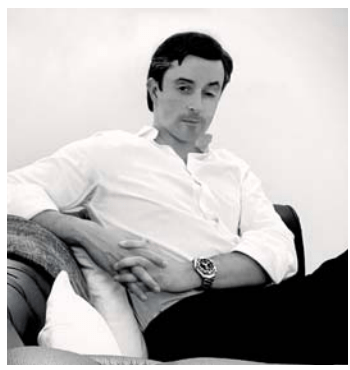
The writer João Pedro Porto has released his new novel, The Multiplication of Miracles, a work that intertwines his prose with paintings by Urbano, the artist behind 22 pieces inspired by the Palii of Siena and Venice. In the book, readers are led into the life of Berto Brizi, a Turin-born editor settled in Milan who, drifting between hedonism and idleness, invents three fictitious literary geniuses. João Pedro Porto hopes that readers “find beauty, even in the horrific (…) something between shadow and light,” and that they “allow themselves to be enlarged by stories and legends.”
Correio dos Açores — This novel fulfills an old dream of uniting your writing with Urbano’s paintings. How was that desire born, and in what way did the collaborative process influence the narrative?
I have known Urbano’s work since childhood, and people always caught me mesmerized before his paintings. The course of his art unfolds, I believe, always like a book—beginning with a meditation on existence, growing through lived experience, and arranged according to its own time. All the great themes of human existence are there. And those have always interested me. When I was too small to reach the middle shelves of the bookcases, and on many occasions at Professor Gilberta Rocha’s home, I would sit on the steps and stare at another staircase painted by Urbano. A staircase without ground or destination—simply a staircase. To this day, I see it as the most fitting metaphor for a life. My editor, Mr. Ernesto Resendes, later gave me an engraving in which we see a female figure planting, sowing spring. The allegory continued its work within me. Urbano’s art inhabits my imagination, and naturally it has always overflowed into my writing.
What emerged first: the story of The Multiplication of Miracles or the idea of integrating visual works inspired by the Palii of Siena and Venice?
It is important to clarify that this book was not a collaboration in the strict sense, because Urbano’s works already existed and did not influence the writing. We met after the fact. After his studies in London, and following in Goethe’s footsteps, Urbano undertook his pilgrimage to Italy, and from that journey sprang an entire original artistic body that rivals the Venetian sketches and watercolors of Joseph Mallord William Turner. From Signac to Monet, from Tintoretto to Renoir—the greats had all been there. Urbano became one of them. Years after his great pilgrimage, and already after this novel had been written in two versions—Portuguese and English—and accepted by some publishers in England, Urbano and I found ourselves in conversation and theme. We realized the fortunate convergence, and I preferred to bring the book home, to the publishing house of our great friend Ernesto Resendes, who thereby completed the triad necessary for the project.
Berto Brizi is a hedonist editor who invents three literary geniuses and is later confronted by them. What fascinated you about this premise?
I have been a reader of Italo Calvino ever since Urbano Bettencourt introduced him to me—just in time for Calvino to become one of my greatest references in the world of fiction. I later read Pirandello and several other giants of imaginative literature—and by this I mean writers who preferred to invent real people, real places, real times, but invented, and more real because of that. It sounds like a paradox, but if life is fiction, fiction is also life. And often—if not always—they become indistinguishable. That fascinates me in art more than anything else. The creative act is precisely that. Once created, it exists. And if it exists, in how many ways does it exist? Berto Brizi will discover this in the book, to his great anguish. And to our great pleasure, I hope.
Do these “three literary geniuses” represent something in contemporary culture or the role of the editor, or are they primarily a personal metaphor?
These three—this trinity of great ones, true liars or false reals—came to me the same way they came to my main character. Of course, the three allow for different narratives and dynamics to be built between them. How quickly invention becomes canon is obviously a pertinent message in these days of fake news, when falsehood holds the same value as truth—perhaps even more.
How do lies and truth—central themes in the novel—dialogue with the act of writing fiction itself?
It is, if we wish, a direct dialogue. Both lie as strands of the same braid, and it falls to the reader to untangle them. Fact and truth are not, as we know, the same. Our entire vision of the world is our own, circumstantial, subjective, relative… That we strive to find common visions, beginning from shared internal universes—whether through analysis or the establishment of global humanistic frameworks—and that in art we find a place of parallax, allowing our ways of seeing to be enlarged by the visions of others, is something that must survive our uncertain times. Incidentally, Paulo José Miranda published this year a book titled Machines of Fiction (Editorial Caminho, 2025), made up of literary reviews of nonexistent books and authors. Helder Macedo, in his Such Long Love, Such Short Life (Editorial Presença, 2013), has his protagonist—who receives an implausible story from a friend—create a fictional version of that story instead of continuing the new novel he had started. Italo Calvino invents invisible cities, reported by Marco Polo to the Great Khan. Borges invents countless other truths. This act of writing fiction is the closest we will ever come to the verb “to create.”
The story unfolds through an Italy never named—almost mythical. Why choose that approach instead of identifying the country directly?
Because some things transcend the names we give them. Yes, for me the beginning is the word, but after it everything accumulates like Freud’s image of Rome—a collection of times, cities built upon cities, the eternal city. There is a reason why all the so-called greats made their pilgrimages to that country. It is a true humanistic distillate, of art and of History. If, through an alembic, humanity were to drip into the Mediterranean, it would form that greater tongue of land.
How would you describe this novel’s narrative voice compared with that of your earlier works?
It is not for me to hear my own voice. Like anyone who listens to themselves, I will never hear it as it truly is. If that is not another allegory for what we have been discussing… I can say that this is a particularly dear book to me, as I dedicate it to my mother, who introduced me to Italy on a major formative journey—one I have repeated many, many times. For me, there is a meridian that passes through London and Paris, then bends slightly eastward to pass through the “boot,” a path made of returnings. I live there more than anywhere else, especially in lucid dreaming, recollection…
What do you hope readers will find in this book that they may not have found in your earlier works?
Perhaps a luminosity particular to that geography—a light cast upon the pleasures of being alive and the costs existence demands of us. I hope readers find beauty, even in the horrifying, as one finds in a Caravaggio—something between shadow and light. And that they allow themselves to be expanded by stories, by legends… that this book may be its own Goethean pilgrimage—a journey and a place of returnings.
José Henrique Andrade is a journalist for Correio dos Açores, Natalino Viveiros, director.
The book was published and is being distributed by Letras Lavadas
 Filamentos (artes e letras)