
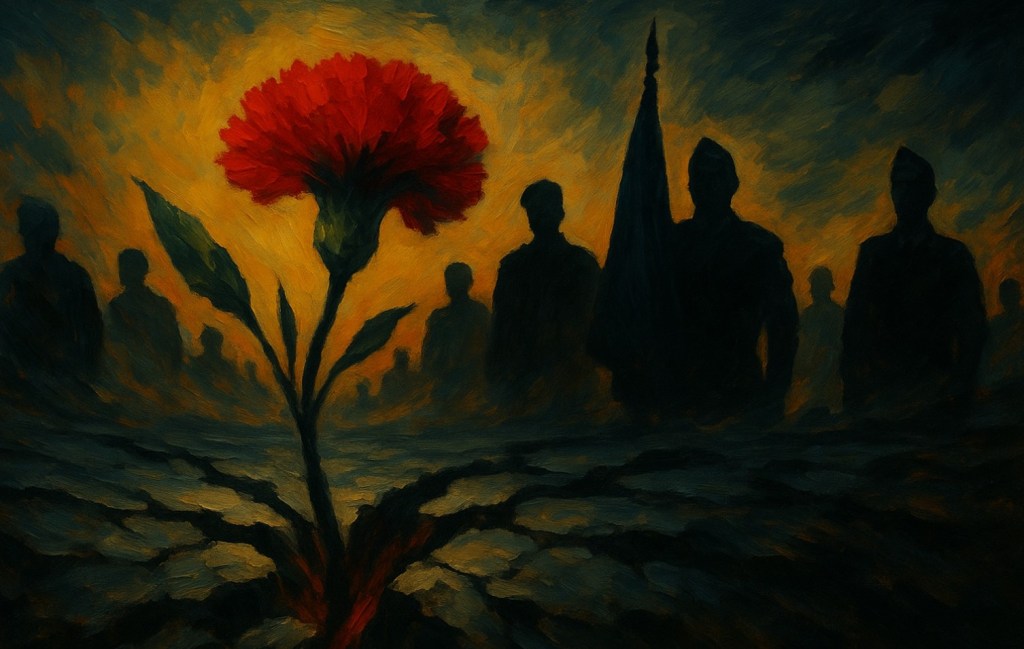
How the Spirit of 25 April Must Endure Against November’s Gathering Shadows and the Populist Winds Crossing the Diaspora
Let no shadow claim what April once illuminated.
Some dates glow in the dark, dates that insist on remaining alive long after the generations that lived them have passed. In Portugal, the brightest of these is April 25th, 1974, the morning when the people stepped into their own history and refused to return to silence. The Carnation Revolution was not an episode or interruption; it was the birth of modern Portugal. It opened the windows of a country shut for almost fifty years, released the breath held across three continents, called exiles home, returned dignity to workers and soldiers, and reminded the world that freedom can be made without vengeance. April is not merely remembered—it is felt. It is the only legitimate beginning of Portuguese democracy. It is, in truth, the memory of a people who dared to bloom; may we never trade their light for the comfort of stone.
But where there is light, there are always those who seek to redraw its borders. Nearly fifty years later, Portugal confronts an unsettling revisionist project: the attempt to elevate 25 November 1975—a counter-revolutionary moment of containment—above the emancipatory force of the 25th of April. The extreme right is promoting this project, but its spread would not be possible without the tacit or explicit cooperation of political forces that once defended the legacy of April. Traditional social democratic parties, especially those that rose to prominence in the decades following the Revolution, are increasingly drawn into the far-right’s rhetorical trap. By lending official legitimacy to the commemorations of 25 November, they are offering a symbolic blessing to a narrative that reorders the meaning of Portuguese democracy and diminishes the centrality of April. They forget that on this earth rest the seeds of freedom—watered by courage, endangered by forgetting.
It is important to be historically precise. The events of November 25th did not inaugurate democracy; they limited the revolutionary process. They may have restored some order, diffused some radical energies, and re-anchored Portugal safely within the expectations of Western allies. The regime born in April survived November, but in a narrowed form. Yet today, the extreme right presents this day as a kind of second founding—one that “saved” the country from chaos and established the “true” parameters of the democratic regime. This is not nuance; it is manipulation. And what makes it most dangerous is the enthusiastic or reluctant support given by sectors of the political center who believe they can control this narrative, use it, or benefit from it. They do not seem to realize that the far right always wins when the center legitimizes its myths, and that here rests the truth: that liberation blooms only where memory is kept alive.
This is how democratic erosion begins—not with tanks or decrees, but with symbolic concessions. When parties that were shaped by April begin to speak the language of November, when they elevate the corrective moment over the emancipatory one, when they choose the comfort of “stability” over the courage of truth, they help bleach the revolutionary memory that sustains the most fragile and essential democratic intuitions. They help make the extreme right appear respectable, responsible, and patriotic. They normalize a date that has been strategically repurposed to limit the revolutionary horizon of the Portuguese people.
The danger is not confined to Portugal’s borders. The Portuguese diaspora, dispersed across the Americas, Europe, Africa, and Australia, has long lived at a distance from April. Many emigrants left the country before the Revolution; many grew up in communities that never commemorated the 25th of April with the depth or recognition it deserved. The Portuguese diplomatic corps, as a whole, although not all, thankfully, prefers the “Day of the Race” to the “Day of Freedom”. Over time, a depoliticized vision of “Portugal” emerged abroad—one focused on folklore, nostalgia, festivals, and memory, but largely detached from the civic and democratic roots of modern Portugal. Into this vacuum, a troubling dynamic has begun to take hold. Populism, rising across the democratic world, finds fertile ground in communities that already feel culturally and politically distant from the homeland. When the extreme right in Portugal elevates the 25th of November, some in the diaspora adopt this narrative without understanding how profoundly it undermines the Revolution that made the country dignified.
For the first time in their long migratory history, large sectors of the Portuguese diaspora—living in democratic societies, benefiting from democratic protections—are becoming supporters of undemocratic movements and politicians, both abroad and in Portugal. The politics of grievance seduces them, attracting them to simplistic rhetoric about order and identity and increasingly making them sympathetic to authoritarian tendencies. The revision of November fuels this shift, offering emigrants a symbolic date that appears more “patriotic,” less “ideological,” more aligned with the conservative values that shaped old diaspora communities. And thus, a dangerous loop is formed: Portugal’s far right influences diaspora narratives, and diaspora narratives reinforce the far right’s domestic rise. If this continues, the diaspora may one day find itself standing far from the very flower that made its freedom possible, forgetting that: here lies the flower that bled so we could breathe.
The consequences are profound. A Portugal that allows November to overshadow April risks losing its moral compass. A diaspora that adopts November as an alternative to April risks severing its connection to the nation’s most noble and transformative moment in modern history. For both Portugal and its global communities, this is not merely a political dispute but a question of identity. What kind of country do we choose to be? What sort of memory shapes our collective character? Do we honor the revolution that liberated us, or do we accept the comfort of a revision that neutralizes what was most daring, generous, and egalitarian about that liberation?
To defend April is not nostalgia; it is responsibility. It is to insist on the truth: that Portuguese democracy began with the courage of soldiers who refused to continue a colonial war, with workers who demanded dignity, with citizens who reclaimed their voice. It did not begin with a counter-revolutionary correction. It did not start with the silence of radical hopes. It certainly did not begin with the ambitions of those who today seek to diminish the transformative promise of April in favor of a tamed, sanitized, and politically convenient narrative.
Portugal stands once again at a crossroads between memory that liberates and memory that blinds. The far-right gains strength not simply because of its own maneuvers, but because those who should defend April have chosen compromise over conviction. Suppose the country wishes to remain faithful to the democratic breath that gave it life. In that case, it must reject the rewriting of November and reaffirm, without hesitation or apology, that the 25th of April is the only birthdate of Portuguese freedom. And the diaspora, too, must reclaim this truth, teaching it to its children and grandchildren so that they do not become innocents in the service of ideas that would once deny them their own dignity.
If Portugal forgets April, it will one day need another. And if the diaspora forgets April, it will lose the very anchor that binds it to a homeland born not in fear, but in courage.
 Filamentos (artes e letras)