

What motivated you to create these tours and how will your personal experience of being from Angra do Heroísmo shape the itinerary?
I would say that we were motivated by a combination of opportunity and necessity. For some time now, different types of customers, particularly tourists from mainland Portugal, have been asking for this kind of experience. In fact, it was already one of the areas we were considering diversifying into, but these requests gave strength to the idea. However, we have a bookstore in a small town, with modest reading habits and worrying figures in terms of both illiteracy and functional illiteracy. The limit of our horizon, as we have always known (and time has shown), is survival. We are certainly not going to get rich. And in order to survive, all decent sources of income must be considered and all the tools at our disposal must be put at the service of the project. That is what we are doing, once again.
What places and stories are included in the itinerary?
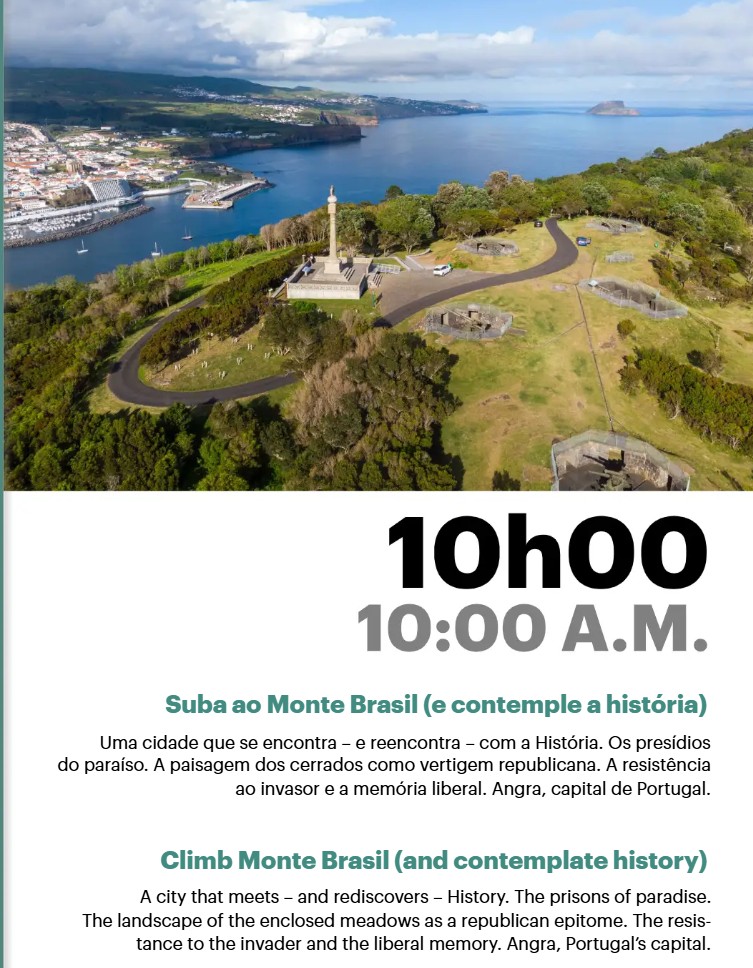
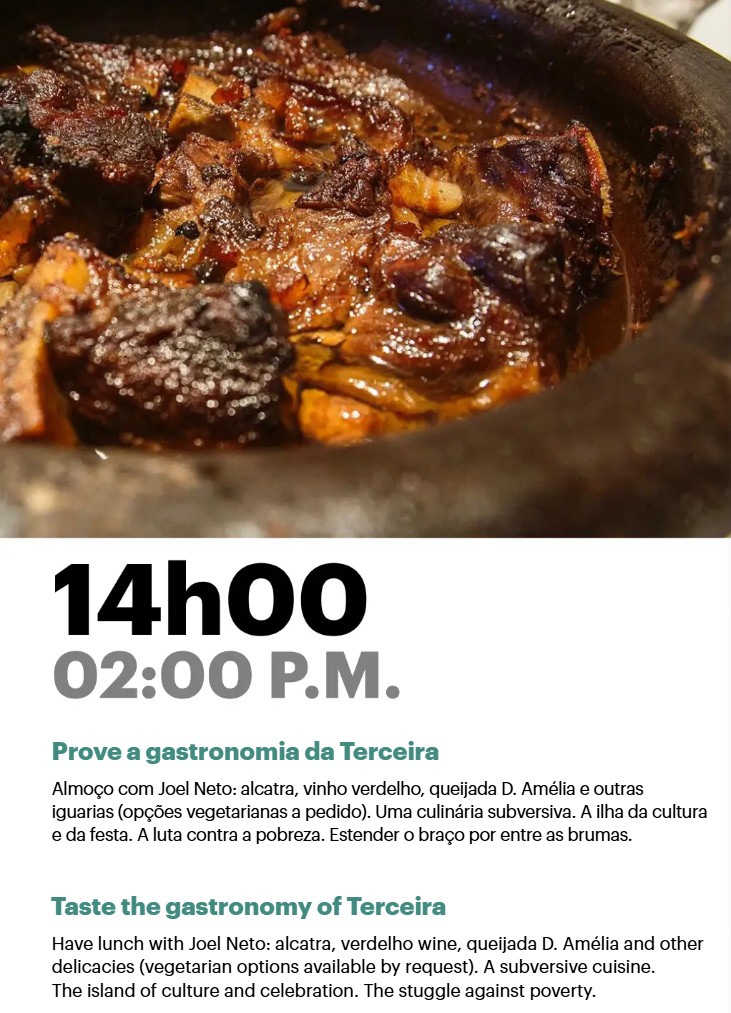
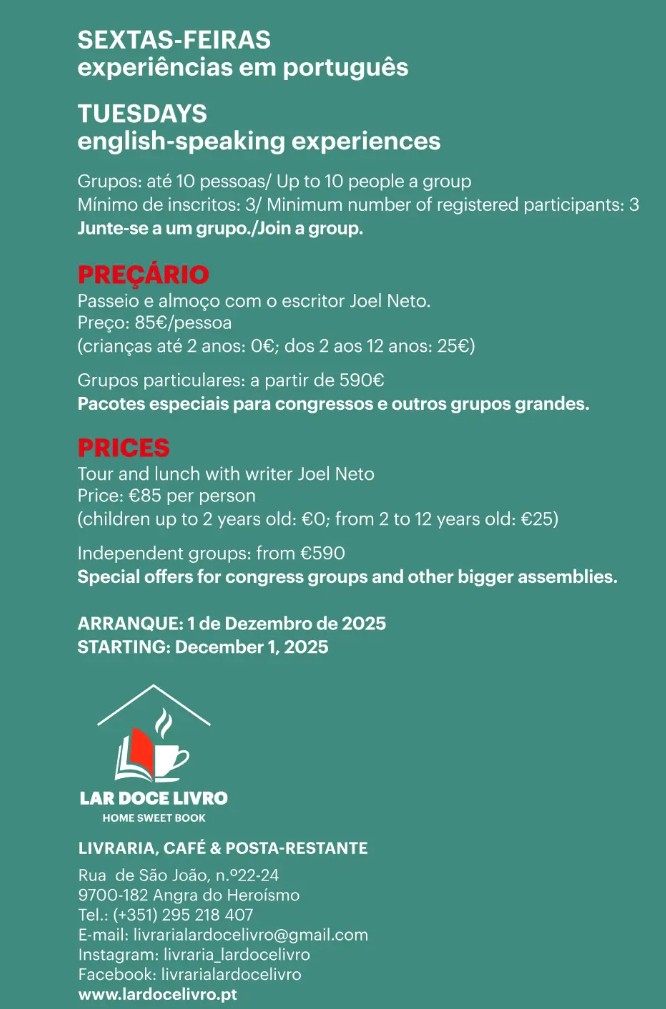
The whole island, all of history, and all of imagination can be called upon. My hope is that no two visits will be the same. The basic proposal is a three-hour tour of the city, always talking, plus another two and a half hours for lunch and a visit to the bookstore, obviously talking as well. There are obvious places to visit: Monte Brasil, the traces of its prisons, the bay, the architecture, the Garden. And there are obvious stories too: the expansion, the resistance to the invader, the liberal memory, the earthquake, the UNESCO classification. But in the background will be the savannahs. Perhaps a carpenter’s wind will blow. Botany from the seven corners of the world will be scattered everywhere. And, in the end, gastronomy will await us. All this—and much more—could be a theme for talking about the identity of this land, its subversive tendencies, its republican vertigo, its taste for celebration, the influence that the Holy Spirit has on all this. We will not be short of topics.

Is the goal for participants to see Angra through the eyes of the reader, the narrator, or both?
Perhaps neither of those two. Above all, through the eyes of the author, who will be a little of both, but is still another entity. The idea is to talk about my Angra. What I know, what I don’t know, what I speculate, and what I would like to be true. I am not a historian, or even a scientist, much less a tour guide. I have no intention of pretending to be any of those things. I am a writer. A writer adds up. His method is not Cartesian: it is the method of possibility – the method of the heart. That’s what I want to talk about: how much I love this city, how much it deserves to be loved, and what all this tells me.
There are tours in Portuguese and also conducted in English. Is Angra told by a writer a more memorable experience for a tourist?
I think the tour is intended more for travelers than tourists. A tourist is by nature a collector. A traveler, on the other hand, is first and foremost a decipherer. I believe that this experience is primarily intended for the deciphering spirit, and that can be either an outsider or a local. A curious, interested, knowledgeable person can perfectly well be a traveler in their own land. Besides, whether in Portuguese or English, my idea is to apply the same formula that has guided everything we have done in the bookstore over the past year and a half: experiment, listen, and improve. Of course, it will be easier to do this in Portuguese. I speak English as well as the next person: everyone speaks English, even the dogs on the street speak English. But Portuguese is my language, the language I write in and the language I think in. I believe I will end up taking more risks there, in order to improve the model.
What are we missing when it comes to telling the story of Angra do Heroísmo and, above all, promoting it?
I’m not that familiar with how Angra is told and promoted. Sometimes I come across one or two bits and pieces, and what I usually notice is a certain tendency towards the absolute, towards myth. There is a lack of worldliness in saying that this Carnival, or this alcatra, or this volcano are the biggest in the world in this or that. I’m not going there, that’s for sure—I’ll leave the records to Cristiano Ronaldo. However, in other destinations, when I give some time to the guides and classic itineraries, I notice a certain taste for scholasticism, for repeating and repeating and repeating what is established and well-known. I will try to at least combine this with a slightly more personal view. I am as attracted to a tavern full of drunks as I am to a museum. “Nothing human is alien to me,” says Terence. That is what distinguishes the writer, and I have to use what distinguishes me. So: a tour in which a drunken tavern can count as much or even more than a museum – that’s one way forward.
What is the current evolution of the literary tourism market? Is it something we should be aware of?
Just the other day, we welcomed a book club from Cantanhede to the bookstore: a dozen people who read together, chose one of my books (Arquipélago) and came here specifically for a question and answer session with the author. They took advantage of the opportunity and stayed at the Azores Book Hotel, ate at restaurants, visited the bookstore, and bought a bunch of books. This is just one example. It doesn’t happen every day here, but it happens many times a day in various parts of the globe. This and similar things. And other things related to books. The book, whose death we had declared, has become for many people the last hope, the last truth, the last possibility. And Angra is a city of books. It features in good books, has had great poets, holds a series of public readings in their entirety, and is even the place where Pessoa—not coincidentally, the son of an Angra native—created the first of his more than 90 heteronyms. I think we have material.
What is the assessment of the progress made so far by Lar Doce Livro, which has already given rise to a publishing house and a cultural association?
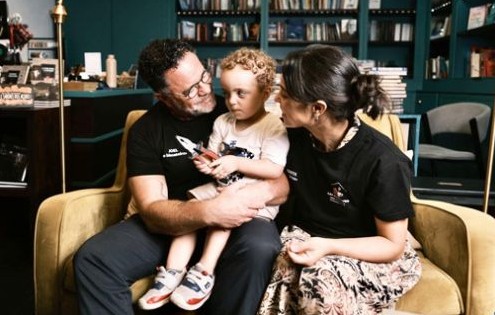
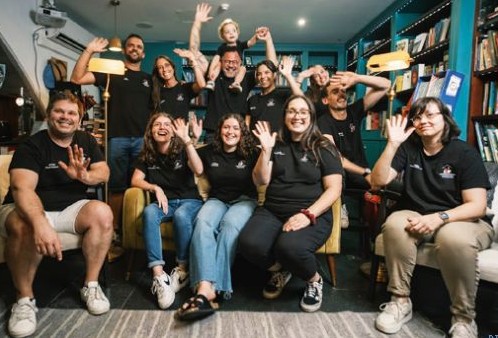
We can’t complain. First of all, among our 10 employees (five full-time and five part-time), we have not had a single salary payment in arrears. For us, this is the most important thing of all: there are 11 families (those 10 plus ours) who depend on that little bookstore, to a greater or lesser extent, and none of them have been unable to pay their rent or grocery bill because of us. If even one of them had to be in that situation, everything else could be wonderful, but we would still be failing. And, in the meantime, we are making our way. We have already sold a good few thousand books, of all genres (except fascist propaganda); we have hosted almost a thousand events in a wide variety of literary, cultural, artistic, and intellectual fields; we have hosted several sacred monsters (even a Nobel Prize winner), we have presented incredible concerts, we have read the best poets in meetings with dozens of people; we have shown and sold local products of all kinds, from food to drinks and handicrafts; we have made a sticker album inspired by our dog that has made countless children fall in love; we created a publishing house and have already published three books with it; we launched a podcast and will launch two more in the coming days, in partnership with Rádio Voz dos Açores; we participated in the creation of a cultural association – in which many friends and customers also participate – which is now preparing its first major event for 2026; we have an average rating of 4.9 (out of 5) in hundreds of Google reviews; and we remain open 363 days a year, always with our warm yellow light, jazz music in the background, and attentive smiles from our staff—all under the motto “Where there is no loneliness.” For a small family of two adults, a little boy, and a baby on the way, with almost no help and only one sick grandfather, I think it’s not bad.
Interview in Diário Insular, José Lourenço, director
Translated into English as a community outreach program by the Portuguese Beyond Borders Institute (PBBI) and the Modern and Classical Languages and Literatures Department (MCLL), in collaboration with Bruma Publication and ADMA (Azores-Diaspora Media Alliance) at California State University, Fresno. PBBI thanks Luso Financial for sponsoring NOVIDADES.
Here is a look at what this project entails…


 Filamentos (artes e letras)