“Diaspora is not exile but transformation,
the moment an archipelago realizes its true horizon.”
There are times in the life of a people when time itself seems to pause, as if the horizon were holding its breath, as if the sea that shaped us were waiting for our next word. For the Azorean Diaspora scattered across the vastness of California, those hours arrive more often now. The question rises like a tide, persistent and luminous: What have we done with the legacy carried across the Atlantic, and who will take it forward when our voices fall silent? For years, we have spoken of our youth—sometimes with hope, sometimes with quiet anxiety. Priests in parish halls, teachers in dimly lit community classrooms, elders conjuring the silhouette of Pico in the dusk, journalists threading our stories into radio waves, academics tracing fragile lineages across continents—all have weighed the fate of those born far from the basalt cliffs that gave us our earliest metaphors. And yet the conversation must continue, not out of fear, but because the Azorean condition is, at its core, an unfinished dialogue between land and sea, memory and possibility. We are a people born of islands forged by fire, wind, and abyssal longing, and now we inhabit another sacred terrain, a land whose vastness does not negate our origins, but rather completes and amplifies them.
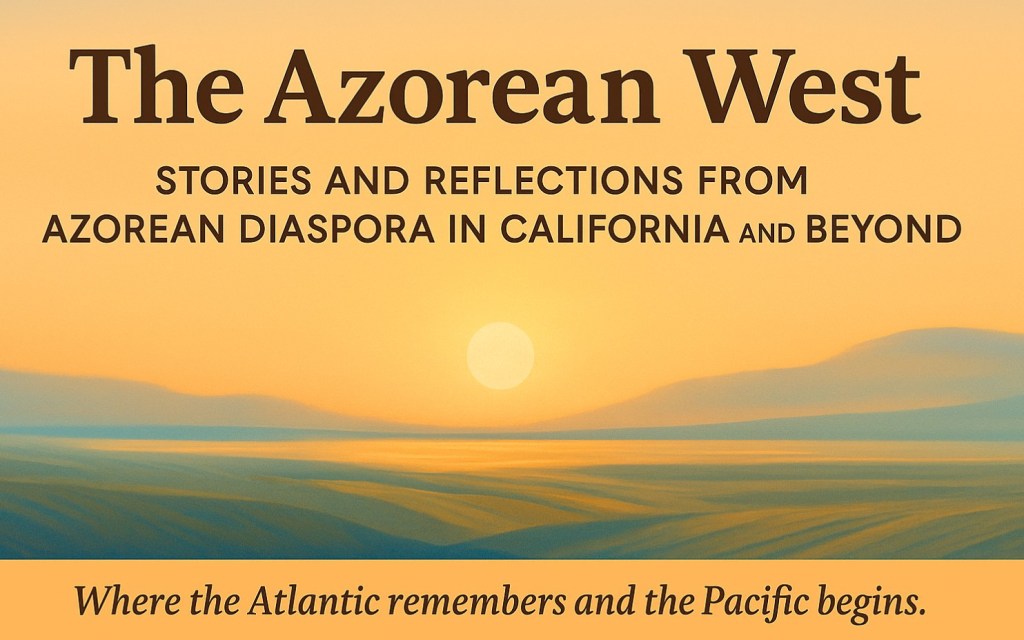
For us, California cannot be merely a destination. It is our new archipelago—a luminous, sun-drenched constellation where each of the nine islands finds a renewed reflection. Here, Pico’s volcanic certainty rises in the steadfastness of our elders. Here, Terceira’s green pastures scatter themselves across the Valley and its foothills. Here, São Miguel’s restless fertility hums through orchards, vineyards, and dairy lands. Here, the winds of Graciosa and Faial whisper across the tule fog. Here, the holy solitude of Santa Maria, Flores, and Corvo hides in quiet valleys, on remote highways, and in small towns where the ocean is remembered even when it is miles away. Here, on this wide and continental shore, the Azorean soul learns to unfold again.
We once spoke of “diaspora” as if it meant scattering, but perhaps we misunderstood the metaphor. Islands do not fragment when the tide rises; they expand. And we—the children, grandchildren, and great-grandchildren of the Atlantic’s volcanic prayer—have extended the archipelago across an ocean and into a continent that now carries our breath in its orchards, schools, factories, and suburban streets. What we witness today is not the dissolution of an identity but the slow ignition of another form—an Azorean-American consciousness rising like morning mist from the orchards of Turlock, the dairies of Tulare, the neighborhoods of San José, the coastal fog of Arcata, and the sun-poured boulevards of San Diego.
The old narrative—that our Diaspora was destined to fade into American anonymity—must be dissolved. A new truth awaits us, more intricate, more interior: our youth must not lose the islands; they must translate them into new words, new rituals, new acts of belonging. Not long ago, it was rare to find an Azorean-American with a university degree. Our families were bound to the rhythms of milking parlors, canneries, warehouses, factories, and fields. The islands taught us endurance, but American schools had not yet become our second homeland. Dropout rates shadowed us, especially in communities where labor felt more urgent than diplomas. We had not yet absorbed the old wisdom—Aristotle’s or perhaps every Azorean grandmother’s—that bitter roots yield sweet fruit.
But time, like the ocean, reshapes everything it touches. Today, young Azorean-Americans walk through university gates with the quiet authority of those who know they carry two worlds in their blood. They study medicine, literature, agriculture, philosophy, law; they become professors, activists, scientists, artists, innovators. They sit in lecture halls with the calm certainty that their ancestors crossed wider distances with far fewer assurances. And yet, this transformation is not merely academic; it is almost metaphysical: the emergence of a new kind of Azorean consciousness, one that Ortega y Gasset foresaw when he wrote that every historical change gives birth to a new type of human being.
These new beings—born of fog, orchards, wind, and diaspora—cannot simply replicate their grandparents’ gestures. They must carry the Azores not as obligation but as luminous inheritance. They are fluent in hybridity, in possibility, in multiplicity—in all the layered meanings the islands themselves contain: volcano and pasture, exile and belonging, memory and reinvention. The Azorean experience in California does not float in isolation. It lives within a vast archipelago of diasporas—some exiled by history, some by hunger or war, others by the magnetic pull of the American dream. Like the Armenians, we know that trauma and endurance can form twin pillars of identity, and that memory often burns brightest among those farthest from home. Like the Greeks, we understand the philosophical condition of islanders, how small homelands generate vast metaphysical horizons. Like the Italians, we recognize that migration demands an alchemy of work, laughter, ritual, and stubborn family ties. And with the Hispanic community, especially our Mexican and Central American brothers and sisters, we share the dignity of agricultural labor, the fluidity of bilingual life, the ritual logic of feast and devotion, and the conviction that culture is something one cultivates, not something preserved behind glass. We are all, in our way, archipelagic peoples—each bearing islands, literal or symbolic, across the migratory winds of California.
What, then, is the Azorean-Californian future? It cannot be a return to what we were, nor a surrender to what others expect of us. It must be a third space—a widening, shimmering interval where memory does not imprison, and California, this multicultural mecca, does not erase. It must be shaped by young professionals who refuse nostalgia’s paralysis. Their horizon cannot be a physical ghetto but an intellectual and cultural expanse where Azorean heritage becomes dialogue rather than echo. Identity is not maintained by repeating gestures but by renewing meaning. They must not linger in the fear that “we will disappear,” but instead ask: In what form shall we continue? What does it mean to descend from islands in a continent with no edges?
For our Diaspora to flourish in California’s cultural landscape, their Azores cannot be merely geography but a grammar of being—a way of standing in the world, a way of returning to oneself through humility, resilience, creativity, and that metaphysical depth that permeates every Azorean horizon. I want to see, not far off, a Diaspora unlike any we have known: a constellation of educated men and women who choose their heritage with the deliberate tenderness with which one chooses a story to inhabit, a community at ease with its bilingualism, its dual allegiances, its fluid forms. A community that speaks English without guilt and remembers the islands without nostalgia, one that knows it does not need to be present at every festa to be profoundly Azorean, a community that carries the archipelago within as quiet, unbreakable radiance.
Call it utopia if you wish, but islanders have always trusted the invisible. We were born on stones that rose from the ocean’s burning dream; we know that what seems impossible is often simply the next island, waiting just beyond the place where sky dissolves into sea. We who descend from fire and ocean have always known how to imagine worlds beyond the horizon. And perhaps that is our deepest inheritance: not the relic of identity preserved, but the tide of identity learned—repeatedly—to navigate.
And in that navigation—across continents, generations, and inner tides—we may yet discover that culture is not something we safeguard but something that breathes through us. For every time an Azorean heart finds courage to continue, a new consciousness rises like light over the water: quiet, persistent, and unafraid. It is the breath between seas, carrying us forward into the world that waits.
 Filamentos (artes e letras)