
Exploring the aesthetic, diasporic, and philosophical dimensions of contemporary authorship.
Interview with author Carlo Matos
By Vamberto Freitas
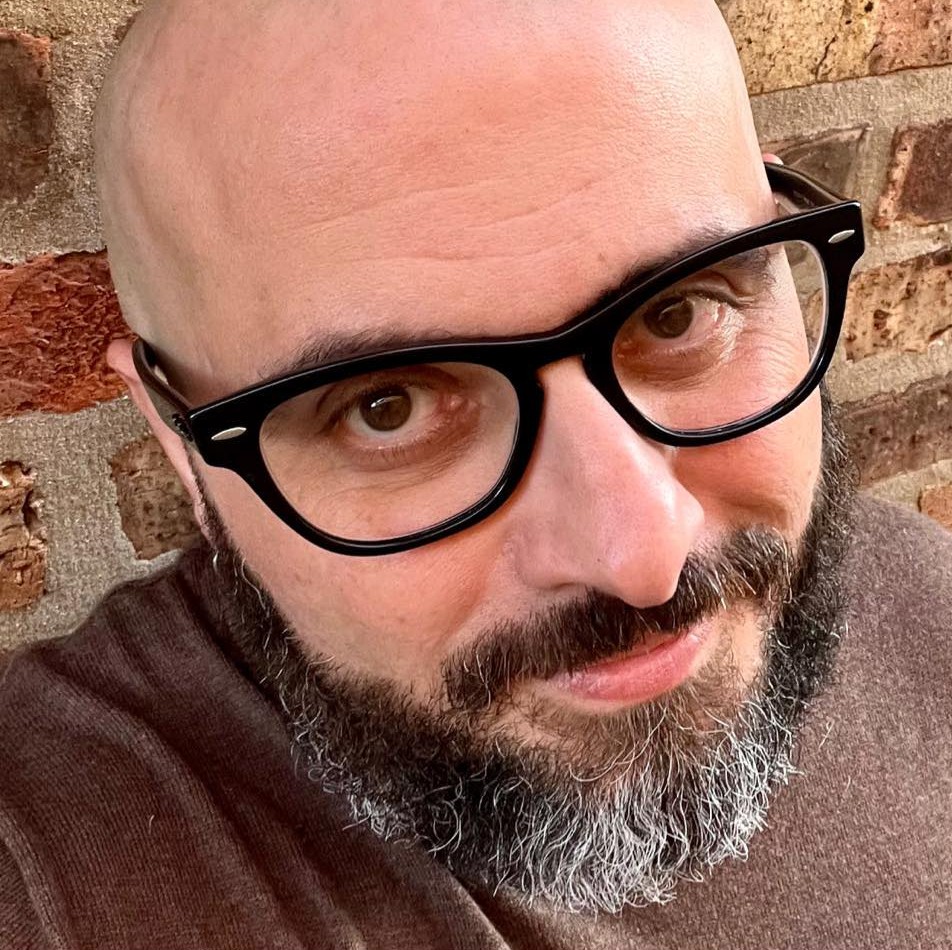
Carlo Matos is a bi+/poly author who has published 13 books, including We Prefer the Damned (Unbound Edition Press) and As Malcriadas: or Names We Inherit (New Meridian, 2022). His poems, stories, essays, and reviews have appeared in others. His books have been reviewed in such places as Kirkus Reviews, Boston Review, Iowa Review, and Portuguese American Journal. Carlo has received grants and fellowships from Disquiet ILP (Portugal), CantoMundo, the Illinois Arts Council, the Sundress Academy for the Arts, and the La Romita School of Art (Italy). He is a founding member of the Portuguese-American writers’ collective Kale Soup for the Soul and a winner of the Heartland Poetry Prize. He currently lives in Chicago, is a professor at the City Colleges of Chicago, and is a former MMA fighter and kickboxer.
Our conversation was done through writing, with continued exchanges about this interview.
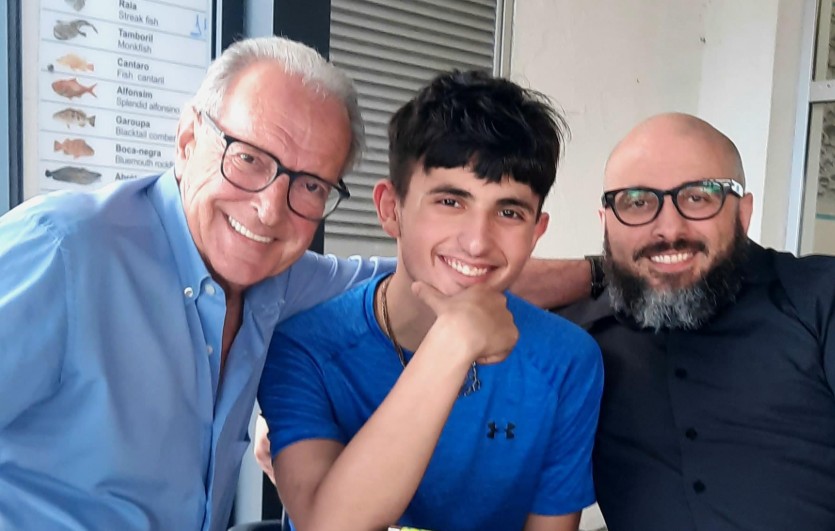
During your recent visit to the Azores (S. Miguel), you brought your son, Alex, so he could connect with his ancestral roots. I had the pleasure of meeting you and him for lunch in a Portuguese style, spending hours without a care in the world, and laughing. Tell me how important this ancestral memory is to you and your son.
The dinner we shared is going to remain one of my fondest moments both as a writer and a father. I have already written it into the memories of my future, like so many things related to my son. Since I only have this one, I am constantly living slightly out of time—a theme I come back to often in my work—seeing myself as an older man remembering the moment I am currently standing in. It is an odd feeling, but I have long since stopped fighting it. I embrace the temporal distortion, missing him even though he has yet to leave my house and go into the world. To this day, Alex and I still reminisce about how much fun we had talking to you as the sun went down over the Atlantic, our table growing a person at a time as the hours passed. I have always been told I am a lot like my father, and Alex continues that tradition. He is all Matos. It is tough for him, as it was for me, to live in a country where nothing seems serious. We have always treated Alex as a rational human, which puts him at odds with the frivolous nature of American teen culture, so he tends to get along a lot better with adults than his peers, but even there, it has to be the right adult. If you patronize Alex, he will become irate. You treated him like an equal, and it was wonderful to see the joy you brought out of him.
It was Alex’s idea to go to S. Miguel. I, of course, have always wanted to take him to meet his family—a large portion of my family still lives on the island, as you know—but we had originally planned to do it as a graduation present. When he kept mentioning that he wanted to see where his family is from, I jumped at the chance to take him sooner. Waiting only invites misfortune. Our goal is to come back after he graduates, maybe for a longer period. Since Alex always feels at odds with the culture he was born into, the Azores provides a place to dream himself into, even if those ideas are in some sense mythical or fictional, like it is for me and so many Portuguese Americans. And in a less metaphysical sense, it felt right to show him the places where I played as a kid when my family would visit the Azores every few years to make it concrete for him, even if Mosteiros only barely resembles the place I remember. The black sand beach near my uncle’s house has been the backdrop to many scenes in my work. The rocks that jut like teeth out of the ocean that gave the village its name—the monastery—loom always at the edge of those scenes. The cagarros in their dens along the cliff wall, waking up the night air, provide the soundtrack. I can’t help but wax poetic when I think about those days, and I wanted Alex to have a taste of it. He talks of going back all the time. My family was so happy to finally meet him as well. The generation after mine is very small, so they have been wanting to meet him in person for years.
When I read you for the first time, the poetry of A School for Fishermen, I was—let me put it this way—astounded by your thematic variety, but always with the Atlantic terrain of your memories, whether they came from your parents’ and grandparents’ tales or your knowledge of your distant past. Has this always been within you since childhood, or was it an intellectual exercise that came late?
It was not an academic exercise. It’s as old as my desire to write poetry in the first place, which goes as far back as elementary school, at least. I was born in Fall River, but I grew up in Somerset with my grandparents, just across the bridge, until my parents bought a townhome as well. From very early on, I knew I didn’t belong there. It is one of the reasons I spent so much of my time in Fall River. For all of its problems as a city, it was at least alive. People lived there; they weren’t entombed. Trapped? Possibly, but not dead. Suburbia appears so often in my work as a dead place where people only look alive. To use a different analogy, I have often described the suburbs as “pre-chewed,” all the flavor and nutrients sucked away. The most alive thing in those towns are their perfect lawns, an obsession I will never understand. When I think of Thoreau’s famous line about “quiet desperation” (though, for me, it invokes Tennessee Williams more than Thoreau), it takes the form of single-family homes at night, streets so quiet it’s as if you are the last person on earth. The only evidence that people live in the moribund lights is peering fearfully from behind the curtains. In my imagination—though I know this isn’t true—even the dogs don’t bark. In contrast, the Azores bustle with natural life. Part of it is, as I’ve said before, because for me, S. Miguel was a place where myth could exist, even though I had visited many times and knew it in its ordinary aspect as well. My family’s roots in this country are not deep at all. At this point, a whopping two generations have been born here, whereas my family has lived in the Azores for who knows how long. I honestly don’t know how long. I’ve asked, and my parents didn’t have an answer. Those years live only as memories and stories, which makes them so powerful in a way nothing on this side of the Atlantic can compete with. This dichotomy of place powers much of A School for Fishermen. The bridge between the two places has always been the Atlantic itself, which is why it is such a powerful image in my work, even beyond the normal power the ocean has of generating figurative language in general.
But it was more than that, too. Everything about the suburbs felt inauthentic to me. My formative years in the early 90s were ruled by a very powerful striving after the authentic, whatever that means. I remember reading Lionel Trilling’s Sincerity and Authenticity in graduate school. My professor had studied with Trilling, and even he admitted that though the sincerity section made clear sense to him, he had no idea what the authenticity part was about. It’s one of those ideas that becomes slipperier the more you try to pin it down, and yet you cannot simply discard the notion because most of us can agree that it is a real and necessary concept. The people of Mosteiros, it felt to me, were not so grotesquely mediated yet as the people of the US. The Azoreans I knew were not trying to live up to some concept of life they saw on television or in the movies. This, of course, might have been entirely inaccurate, but it is how it felt to me at the time.
So, my ancestry was a thing more real than the world I lived in, and that is why my early poems and even my first play were obsessed with shaping this idea of a past I wanted. My first play was a one-act I wrote in college called One Way to Portugal. When it was performed as a part of a festival at Hampshire College, it starred a working-class, Portuguese-American character, marrying two of my major themes way back in 1997. I also used Fado as the music for the production. It was a little simple in its dramatization of these complex ideas, but it did establish the foundation for the work in Fishermen and other books to follow. And, interestingly, because I was exploring these ideas so early in my writing career, it also allowed me to arrive at a place where I could go beyond these simple and direct conceptions of culture and class more quickly, what Chris Larkosh and I jokingly called favas and fado poems. I am not denigrating this kind of work, especially since American culture at large still doesn’t know all that much about the cultural practices I inherited, but we do need as writers to move beyond that kind of first-generation writing to stake our claim to our American present and future.
In my review of A School for Fishermen, published here in the Azores, I wrote: “Fishermen of the Azorean-American Carlo Matos is a persistent voyage in geographies lived and imagined, a narrative with various voices, all of them related to a single family that attempts to suppress anxiety brought about by the shadows of a certain past both in luminous days and darker times…” How did you come to this artistic necessity?
I always say that Fishermen is the kind of poetry book a playwright might write. Though I began as a poet, I fell in love with playwriting early in college, and I fell hard. Unlike poetry, I had almost immediate success (such as it was) in theater, whereas I struggled for years to write poems good enough to get published. I think that is largely due to all the erroneous ideas about poetry I inherited from movies, television shows, and even some well-meaning teachers. I did not have the same preconceived notions about writing plays, so I didn’t have to waste time unlearning years of bad habits. Interestingly, my dad also wrote plays when he was a young man, and I had always been involved in the theater as a performer, so theater was a part of my family culture. It’s not that my parents were supportive of my performing in stage plays, but they also didn’t resist or denigrate it, which in my house is the closest thing to support you are going to get. But even still, I had never written a play before college. Around the same time I was writing, directing, and producing plays, I managed to get my hands on Richard Zenith’s Fernando Pessoa & Co. If I have my timeline correct, I finished my first play in 1997, and Zenith’s book came out in 1998. I had been waiting my whole life to find a book of Portuguese poetry in translation. I can read Portuguese, but very poorly, and would never be able to handle sophisticated poetry or prose with any facility.
One of my degrees is in theater, and the others are in literature, so I have studied countless European authors. My doctoral dissertation, for instance, was on Henrik Ibsen. In school, I had studied writers from all over Europe, but not one from (or descended from) Portugal. Not a single one! In high school, we read many of the lost generation writers like Hemingway and Fitzgerald, but not Dos Passos. Manhattan Transfer is an excellent book, but I had to find out about it on my own. No one mentioned that Emma Lazarus, who wrote the famous poem on the Statue of Liberty, was also of Portuguese descent. And I grew up in a place full of Portuguese, so what was going on there? Why did I spend all my time reading mostly English writers? I didn’t need to get to college and come into contact with the idea of challenging established literary canons to know this was bullshit. And because my Portuguese was not good enough to read Portuguese writers in the original, I spent years and years focused on English writers of the Renaissance and Modernist periods. At least the latter included more than just writers from England, though only if they had been translated into English. Even my dissertation, though ostensibly about the Norwegian dramatist Henrik Ibsen, is focused on how West End theater in London changed in the last decade of the 1800s. Don’t get me wrong, I still love many of those writers; whether I love them or not is not the point. How “good” they are or not is not the point. The point was that writers from the country where my family is from were almost entirely erased from the curriculum of my various schools. Even to this day, though it’s much better now, the number of books translated into English is relatively small compared to the work of writers from other countries. It took Saramago winning the Nobel in 1998 for things to, finally, start to change in earnest.
Zenith’s book was the thing I had wanted for so long. And Pessoa, of course, is a wild writer to begin with, making the explorations of persona by poets like Elliot and Pound seem like child’s play. Pessoa’s heteronyms indirectly led me to the idea of writing persona poems by way of playwrighting. In that way, I could write about the themes I had been exploring for years, but from a more distanced perspective. I was still a very young man when I began to write the first poems that would eventually become Fishermen. The oldest poems in that collection date back to 1998, when I was still a junior in college. I needed to get out of my own way, and I did that by creating characters like I did in my plays. I tell my poetry students that my poems came alive the day I stopped trying to write about myself, and it’s only slightly an exaggeration. In a play, you are by necessity writing from the perspective of characters who may be worlds different from you. It was probably the reason why I had relative success as a playwright so early, but not as a poet. It didn’t happen overnight, of course; it would take another seven years before most of the poems for that book would be written. 2005, I remember very clearly, was a big year for me. It’s when “Stonemasonry,” the long poem that opens the book, came into existence. In my opinion, it was the best thing I had written to that point. I had always wanted to work in the story my father once told me about his abortive attempt at becoming a fisher man. He said he went out only once and spent the entire time clinging to the bottom of the boat, vowing that, if he survived, he would never go out on the ocean again. And he was true to his word. After the fisherman scare, he turned to stonemasonry and built walls, which is an irony I have always found delicious. Whether this story has been embellished by my father is hard for me to know, though my feeling is that it is true to the last word. João Filipe—the speaker of “Stonemasonry”—becomes a stonemason like my father, and develops an entire metaphysics, if you will, around the building and destroying of walls. I was also trying to associate stonemasonry with other forms of esoteric knowledge: the stonemason as free mason or some other kind of secret society purporting to guard hidden or secret knowledge.
Felipe’s voice came out almost fully formed. It was one of those rare, almost mystical moments I tend to be suspicious of. It’s not that I don’t make room for chance; I just don’t have patience for mysticism if it is taken too seriously. Part of writing is being open to chance occurrence, being open to the muse, as it were, but there is a difference between that and waiting around for something to come from nothing. If we, as writers, wait for the muse to come whisper in our ear, which is still such a prevalent notion in popular dramatizations of artists and writers, then we never get any actual work done, or not much work, anyway. I see this kind of thinking in my creative writing students. Writing is a grind, but I mean that the way a fighter means it. It can be difficult, yes. It can be oppressive sometimes, but mostly it is a very satisfying activity that is worth the effort, worth the hours spent. Otherwise, why do it? If it’s torture to write, go do something else. And I mean that as a liberating idea, not a condemnation or judgment. The world is full of experiences worth having; why waste time on one that brings no joy?
One of my obsessions in my middle age is the idea of having the wrong dreams. I don’t know what it’s like in the Azores, but in America, the popular notion about success is a pathological one. We are taught to never quit. You will hear this unexamined sentiment in every context you can think of. There is some merit to this idea. You can’t complain about a lack of success if you haven’t dedicated yourself sufficiently to the hard work of getting there; however, there is danger in this idea as well. If we never give up, no matter what the circumstances, then we can never know which pursuits are worth pursuing and which to abandon. There is a difference between working hard and banging your head on a locked door until you’ve bloodied yourself. I am reminded of Willie Loman from Arthur Miller’s Death of a Salesman, a character whose real tragedy was not that he failed at being a salesman, but that he lacked the strength of will or the perspective to abandon the idea of the salesman (and all that it represented to him regarding success) and pursue other interests more suited to his temperament, talents, and satisfaction. His oldest son, Biff, says of his dead father, “[H]e had the wrong dreams.” It is this failure that makes Miller’s play a tragedy. My collection of flash nonfiction essays, The Quitters, deals with the idea of failure and quitting over and over again, trying to tease out that not quitting becomes a cancerous idea rather than an avenue to success.
But my first serious brush with this idea was with Felipe. He is wrangling with his many internalized failures, some already having to do with his hidden queerness, which would become a major theme many years later in We Prefer the Damned. He has a crush on a new heteronym I invented, the son of Alberto Caeiro, the true keeper of sheep. I wanted to add my heteronym to Pessoa’s pantheon. It was my way of situating myself in the literary tradition of Portuguese modernism. Along with some references to Camões and fado, this was one of my early attempts at connecting back to Portuguese things outside of my personal experience. Interestingly, the family tree at the front of the book was one of the last things to come into being. It was not my idea. I wish it had been. It came from one of my best friends at the time, who had read nearly everything I had ever written. I recognized immediately that it was the right idea. It brought everything together. This book took 10 years from start to finish and was my first attempt at planting one foot in the Azores and one in the United States, like the colossus. And like the original Greek statue, I knew that it was likely all that would be left of me when all was said and done would be a pair of disembodied feet to mark that someone had been there, whoever he was.
The poems of Counting Sheep till Doomsday seem to me a pure play with language (Joyce style), where you have fun and denounce, once again, our darker times and your way of never giving up on humanity’s best side. How far away is my interpretation?
Right on the money, as usual, Vamberto. I did have a great deal of fun playing with words in this book, maybe more than any of the others, but it did not begin with play like, say, a Dada piece. Other obsessions were pushing me to write this book. Doomsday is my third book. I had just finished a scholarly monograph on Ibsen based on my dissertation and was at the Centrum Foundation to work on my next book, which would become Doomsday. Usually, I do residencies during the summer months, but I landed this one over a winter break. At Centrum, I had a cabin all to myself in Fort Worden State Park in Port Townsend, WA. It was winter, so most days were rainy, cold, gray, and blustery. And because I was there off-season, I felt like I was the only one there. Most days, I would not see another person unless I walked into town, which was a good half hour or more away. I don’t go to residencies to socialize, but this level of isolation was extreme for someone who had been living in Chicago. There was no Wi-Fi in my cabin either, so it was the most isolated I had felt since before the internet transformed the radical isolation of the 1990s to the hyperconnectivity of today. I don’t think I had the title for the book yet, but I am willing to bet the weather and the iron-gray, slate water of the Strait of Juan de Fuca must have left a lasting impression on me. But, as you so rightly point out, my use of the notion of doomsday was ironic, not literal.
Though the landscape was bleak (though absolutely beautiful), my mind went in the opposite direction towards humor and pop culture. I had yet to do this in my work at the time. Sometimes people mistake me when they hear me say that American culture or teen culture in general is not serious. This does not mean all pop-cultural artifacts are frivolous. There are countless songs, television shows, movies, comics, etc. that have great power, that create real meaning, that make us think about our place in the universe. I may like challenging and sophisticated work of a more literary bent, but I also love all kinds of aesthetic practice. I cannot afford to miss out on something interesting because of the packaging. I love a good action movie or silly comedy too, but most of the time there isn’t much to take away from that movie but the entertainment value, which is fine in the right context, but then there are times when there is more, and I hunger for more in all its guises: more knowledge, more beauty, more experiences.
But it became clear to me right away that I needed a different way of writing poems to integrate the pop culture references I was thinking of, so for Doomsday I thought the prose poem would be a better fit as it would distance me formally from the work I had been doing in Fishermen. Pop culture has a peculiar power over the apocalyptic, I think, as does humor. Pop culture celebrates the living now, especially since the internet has made everything so immediate. I have no use for apocalypses usually. Humanity has been dreaming up apocalypses for millennia. There is nothing particularly serious in them, hence my approach to Doomsday. These end-times narratives reinforce the idea that the world is nothing more than an endless series of conflicts, but my guess is this is a coping mechanism, a way of not facing the truth of our shapeless presents. This is one of the major themes of the new manuscript I am working on, titled Turbulence. As a species, we invent conflicts where there don’t need to be any because we can’t face the empty hours of each day. It reminds me much of my father, as many things related to my writing do. He was a hard-working man who did what he was supposed to do in terms of the social contract. He went to work. He paid the bills. Well, my mother paid all the bills, but they both worked full-time jobs. They provided opportunities for their children. But on the weekends, my father was lost. He hated that job: back-breaking work in a textile mill his entire adult life. But on the weekends, he’d putter about without purpose, the empty hours possibly more oppressive than those of his workday. Cut off from his writing because of the circumstances of his life, he struggled to give shape to those days. And it terrified me to see it, the sheer crushing gravity of him like a black hole. My luck was a little better than his and because of that I was able to find ways to give form to those shapeless hours, though I struggle as much as anyone to fill my days with meaningful activity.
I think this might be why conflict dramaturgy is so prevalent in popular entertainment. This happens to be one of my pet peeves. Every writer has their list, I’m sure, but this is one of mine. Many writers are taught to think only in terms of conflict and resolution as if it is the only way to develop a narrative. I heard it endlessly when I was writing plays. This is a very reductive—not to mention fallacious-way—of creating plot and developing character. Conflict has its place, but it is not the only or even the most important way to shape a piece of writing. To me, life isn’t a series of conflicts and challenges to overcome—though there are plenty of both—but an open space where the individual must create every moment of meaning to fill the sometimes-unendurable present with shape. But so many cultures teach that life is a battle, a hustle, something to be endured rather than something to be molded and enjoyed. Believe me, growing up as I did, I have endured my fair share of troubles, but this conflict ideology has no depth, no place to grow to, and little joy to be found beyond winning and surviving. What an impoverished way to see the world. A biological imperative does not a metaphysics make. In my life, I am as guilty as anyone in getting wrapped up in this kind of thinking, but I cannot afford this in my writing, or else I will have nothing to write about. In life, I struggle to be hopeful, struggle to have faith in others or the entire project of living, but in my work, I have to be the hopeful guy, or all that is left is repetition and eventually silence. Doomsday celebrates the whimsical and incongruous. It is in those little places where we find hidden joys, some of which we cannot share with anyone else because they are so esoteric. It’s a way of marking time, and it escapes the large but flat narratives we inherit from advertising and propaganda.
When I started Doomsday, I had just finished reading James Tate’s Return to the City of White Donkeys and wanted to try my hand at prose poetry. I was curious how short a poem could be and still be considered a prose poem. Is a one-sentence poem a prose poem? I guess, technically, it is since the sentence, not the line, is the basic formal structure. I realized that I could use the length of the poems themselves as a kind of countdown, or rather a count-up as each poem is longer than the previous one, until we finally get to “Insomniac’s Cookbook,” a long poem told from the perspective of a character whose perceptions have become deranged due to extreme lack of sleep. It’s why I start Doomsday with a nod to Chuck Palahniuk’s Fight Club: “You’re gonna’ go out. You’re gonna’ start a fight with a bear, and you’re gonna’ lose.” “Insomniac’s Cookbook” is probably the most purely experimental poem I have ever written. The derangement is prevalent in the syntax, the malapropisms—only some of which are puns—and the pure attack on grammar. Time is the most shattered element, the tenses flowing in and out without warning. I can see why you invoked Joyce for this last poem. I was thinking of Ulysses or maybe Finnegans Wake. Like in Joyce, if I may make a comparison to the great writer, the language is hard to penetrate, but it is not random or divorced from meaning. Everything is warped or stretched, sometimes to snapping, but not most of the time. As someone who was tortured by extreme insomnia for about half of my life, I have great sympathy for this strange character, desperately trying to cling to a reality that only marginally matches the one most other people are living in. But even in his derangement, the speaker of “Insomniac’s Cookbook” manages to find whimsy and even love: “Ok, let’s admit to a love scene then and start with a kiss that fades before meeting and opens on the next day . . . They were poor judges of mercy caught with a gallon of seawater to toast the day’s end.” Being out of sync is an idea I would return to in a different form in my novella, The Secret Correspondence of Loon & Fiasco, where I have a character who is stuck in an existential time loop. In the movie Groundhog Day, Bill Murray’s character gets stuck in a time loop; however, when he discusses his dilemma with a couple of locals from Punxsutawney, they admit that their normal lives, caught forever in the repetition of meaningless sameness, don’t sound very different from what he is describing. I took this as my inspiration for that book to probe another person who is not in synch with the narrative that most people at least pretend to be living in.
I love the size and shape of Doomsday. I had seen someone handing out small Bibles at the entrance to the red line train, which I rode every day my first decade in Chicago. I thought, why don’t we have more books like that, books we can slip into a pocket? When I was in college, I always had a book of poems stashed in one of my pockets, so when my book was accepted for publication, the publisher and I decided to make it fit in a back pocket. We did the same thing with my next book of poems, Big Bad Asterisk* (same publisher). If I could make them all that size, I would, but it does not work for most of the books. And there was something I liked about the small size of the book when paired up with the prose poem form. It may be small, but it is loaded with words. I don’t know what that is supposed to mean, but I remember having these thoughts when working on these two books—the contrast of poetic form and design of the book.
The wordplay then was not an end in itself. It wasn’t even a means. It was simply a side-effect of the formal and structural qualities of the book.
Your most recent book, the novel As Malcriadas: or Names We Inherit (2022), surprised me. The biographical note begins with fresh news to me: “Carl Matos is a bisexual+ writer who has published eleven books…” I believe you’re the first American writer of Portuguese descent with the literary courage to declare this in the clearest words. Of course, the novel is another voyage through a life of challenge and daring. Despite the title, it is once again a strong affirmation of life, of sadness, and joy. How did you reach this artistic need, this crowning of a great writing career that shall continue?
Thank you, Vamberto. I am awed by your words. It means a lot to me. I don’t know if I’m the first, but if I am, I hope that I will not be the last. What I learned as a young man was never to ask permission. If I asked permission, someone was going to say no. My parents said no to everything by default. I am not exaggerating. They made things very difficult for me. I grew up without very much money, but that was ok with me. I never developed a dependency on material things, so it wasn’t like I felt like I was missing out on too much. There are exceptions, of course. It was very hard, for instance, to be a varsity tennis player in high school and not be able to afford to restring my racket when I broke a string, which I would do 2-3 times every season. You can’t just borrow someone else’s racket and expect to play your best. But for the most part, it wasn’t a big deal. Where it was a big deal was when it came to life experiences. My parents could not understand the American teenager, did not understand the role social events played in making friends but also in setting up your future, like getting into college, for instance. They defaulted to paranoia and fear. I always tell people that they used up all their courage moving from the Azores to Massachusetts. All they wanted to do was hide in the safety of their home and their community, and I understand that now better than I did before. They came from an unsafe place. Now I live in one, and the imperative to protect my son makes great demands on me. If I was living in a foreign country like my parents were, I don’t know if I would have done any better than they did. It has taken recent events to fully bring this home to me.
But in my youth, Somerset was just too small for me. I know I am often overly critical of my hometown, which isn’t fair because there were some great parts to it, but the truth was that it was just not a great fit for me. There were things to do, and I couldn’t do them there. Even my attitudes towards most things didn’t match the norm. I thought Somerset was a conservative place—though not a Republican one—until I moved to other parts of this country and found that I was living in quite a progressive place by comparison, which is quite sad. I needed to find a place more suited to my worldview. Amherst, where I went to college and grad school, was the first place where I found a larger number of people whose ideals were closer to mine, who were less blinded by notions they inherited from their parents or various traditional or cultural practices. Chicago, of course, is a better fit still, though I moved here because of a job and not because I thought I’d find more opportunity here, though I have found that too.
My natural inclination, given how I grew up, is to just do whatever I am going to do, regardless of what other people think. I don’t make announcements. I don’t ask for affirmation or support. I just do it. I have been bisexual my whole life. I have always known, and it never bothered me in the slightest that most people didn’t know. My theater friends knew, but theater kids are usually a lot more progressive, especially in their attitudes towards sex. I knew there were people out there like me and one day I’d go find them, which is exactly what I did. But this kind of behavior has one major drawback. The reason I can “get away” with it is because I read to most people as a heterosexual, and because I date far more women than men, I pass as straight most of the time, and so people don’t harass or challenge me. That’s all very well and good if you’re me, but what if you are someone in the queer spectrum who cannot pass or doesn’t want to? They don’t have this privilege, and so my general invisibility—which is a huge issue in the bi world—benefits the conventional and intolerant. This is one of the things that led me to write As Malcriadas and We Prefer the Damned and to update my bio and make things more public and visible.
With As Malcriadas (and We Prefer the Damned), I was enacting visibility because bisexuals are erased and largely misunderstood by both heteronormative and queer cultures. It is changing, but very slowly, so I felt it was important for me to bring it to the foreground. But, as usual, the work itself is what matters most to me, not the issues raised. What I mean by that is that I see all experiences as irreducible constellations. I want to relish in their complexities and ambiguities. I don’t write polemics, and my work is not didactic. I am not trying to convince anyone of anything. In Malcriadas, for instance, I refused to explore a simplified notion of bisexuality. I wanted to show how complex it could be, how particular to the individual. I wanted to engage with an authentic, lived experience. The book is about late 90s America as much as it is about coming of age. Additionally, (and just to make things even more complex) in We Prefer the Damned, I also delve into the places where bisexuality and polyamory intersect for me. Polyamory is an even more misunderstood and maligned idea, getting thrown in there with swinging and often seen as nothing more than deviant sexual practice. For many poly individuals, sex is not the primary concern. It would be a lot simpler if that were all it was about. Polyamory is about alternative ways of constructing relationships. It requires advanced communication skills and self-awareness. It is far more challenging than monogamy, but there are rewards if you get it right. For me, poly is about love. That is where it begins and ends. Love is not a limited resource, and it takes all kinds of different forms, as we all know, so why does it become strange when this idea is applied to romantic relationships? I was happily married for over 20 years, so I know the joys and devastations of monogamous love. For a long time, I too bought into the notion of finding the “one true love,” but I’ve concluded that this idea has some serious limitations and problems. But again, I’m not advocating for anyone to be bi or poly or any other thing. But I do demand the right to pursue my life without being subject to anyone else’s notions of how to live or love or anything else, which is a political act in this country. In my work, I always go for the irreducible or the esoteric rather than the universal. I don’t know what other people want, and they are free to want whatever or whomever they please, so long as they leave me and others like me alone.
When I wrote As Malcriadas, all I was trying to do was write a Gen X, grunge rock, working-class romance. I often joked that it was my potboiler. I’ll never forget that Sylvia Plath said the same thing about The Bell Jar. I am not sure either one of us succeeded in that regard, but I think the books are probably better off for it. More than anything, Malcriadas is a love story and a coming-of-age narrative. Though it is not autobiographical—in that no one character is someone from real life—it does draw a great deal from real experiences. This is hardly novel or surprising, of course, for a novel of this kind. I wanted to show the depth and many contours of the lives of the children of working-class immigrants (a nearly invisible class in the US) growing up at the end of the twentieth century. The narrative of the hard-working immigrant has many positive aspects to it—aspects that other groups are not always afforded—but it is also profoundly limited. Since America is anti-intellectual at its core, the culture at large often tends to assume this is even more true of so-called lower-class people. What I mean by this is that they assume that the humanities and fine arts are for the children of privilege, and the rest of us should be happy with our practical jobs. And to be clear, I am not demeaning or attacking vocations or any other kind of job. I respect nearly all forms of real work and despise all parasitic jobs that take advantage of the hard work of real workers. What I am talking about is this notion that we are not allowed to pursue literary, artistic, or scientific endeavors simply because of our economic backgrounds. I face this nonsense to this day in my job at City Colleges. We, the professors, want to help our students reach whatever academic, creative, or career goals they set for themselves, but we are often at odds with management who want to turn our institutions into primarily vocational training schools. I celebrate our vocational programs but not at the expense of the students who come to me and go to graduate school and achieve in academia or business or what have you. This vocational-training focus is classism (and by extension racism/ethnocentrism) masquerading as egalitarianism. We can serve all of our populations without putting unnecessary limitations on their future potential.
It is straight-up class warfare, keeping those creative jobs open for the children of privilege while the rest of us pump their gas and mow their lawns. I pumped gas for years, so I know that experience firsthand. What these people don’t know or don’t want to know, is that this anti-intellectualism doesn’t necessarily go all the way down, as it were. I have found myself many times in my life surrounded by so-called “lower-class” individuals, being one myself, who were some of the best artists, musicians, and writers I have ever encountered. And I am not the only one to say this. In the “All Dharmas Are Marked with Emptiness,” from his book Late Rapturous, Frank Gaspar describes a girl who works at the supermarket who printed an entire anthology of poems on a single eight-and-half-by-eleven sheet of Xerox paper and folded a hundred copies down to wallet size and passed them out to anyone who dared look her in the eye.
I have known many working-class folks, people who worked in supermarkets, gas stations, and convenience stores, who wanted so much to not only escape from their social class, but to transcend it. And to many of us, there was nothing more transcendent and nothing more out of reach than the world of Art, with a capital “A.” Privilege makes room for opportunity—there is no denying that, and lack of opportunity destroys many people of talent—but it does not encourage—at least in this country—creativity or excellence. And I am not just talking about the children of immigrants. My father, as I’ve said many times, was an amazing musician and a poet of promise as a young man. My father has a third-grade education, but he could have been a real talent if he had been born in a different time or in a different place. He wrote plays—musicals, actually—that he produced with his brothers and performed all around the island of S. Miguel. Last summer, when Alex and I came to see you, we ran into a woman in Mosteiros who claimed to be one of my father’s former girlfriends, and the story she wanted to tell me was of when she performed in one of his plays. My father may have been poor, he may have had very little formal education, but his imagination was not impoverished, and that may be why mine was not either. It is a tragedy that he did not have the opportunity to live the life he deserved.
Some part of me misses that younger version of myself. He was in some sense a purer representation of how I see myself. I was forged in this environment, but I do not live it anymore, which is a real problem for me. In purely socioeconomic terms, I am not working-class anymore. I’m lucky to be able to give my son the kind of life I always dreamed of when I was young, but I don’t really fit in with the social class I am “supposed” to belong to now any better than I did when I was young. It’s hard enough being first generation born in this country. You don’t fit in with the immigrants and you don’t fit in with the locals. And everyone like you is as clueless as you are. You are always outside. This outside feeling did not get better when I went to college. I still felt like a barbarian swinging a club around. There was something rough and unpolished about the way I did things, the way I spoke in class, how I handled challenges and criticism. Being always at a disadvantage, my immediate response to a challenge was to meet it and crush it with force, but this was less than helpful in a classroom, especially if what you want is real understanding and not just to sound smart. This barbarian-ness came into even sharper relief in my grad school years. Dinner parties and literary events were a special kind of torture. To this day, I feel like I am intruding on a world I don’t belong in. Always with my face pressed to the window, never at the door. It is the result of a purely socio-cultural phenomenon. Even today, when I do readings, I run for the door the moment I can, not because I want to, not because I don’t want to be there, but because I am so awkward that I am more terrified that I will say the wrong thing to the wrong person than that I will miss out on an opportunity to meet someone special. I’m more at home in the gym with my fighters than I am among writers. There have been, of course, many times I forced myself to stay at an event (or was waylaid by someone who could see flight in my eyes) and ended up having a great time or meeting someone special worth spending more time with. There are always exceptions, but my immediate feeling is that I don’t belong. It’s exhausting, and I’ve never managed to overcome it. It is completely internal now as no one in my adult life has gone out of their way to make me feel excluded. Writers, on the whole, are a pretty good bunch of people, but these things go beyond the rational.
My characters in As Malcriadas are outsiders, to be sure, but they are also doers. It’s true that many of them fail. It is also true that many will sabotage themselves, which is the saddest thing to me when I see it in real life. And I have seen it enough times to never want to see it again, but for the ones who survive, they become the makers, the ones I am always searching for in my work and, quite possibly, with my work. Other than to write the best possible book I can, I don’t write for a specific audience, mostly because most Americans don’t read very much. But my most secret hope, I guess, is that my work might bring more of those rare makers into my life. And if you’ll pardon the compliment, I never would have come to know you and your amazing work if I had never written a book.

Being brought up in a conservative community in Fall River, with parents and other close relatives and friends, and then writing about it was, once again, a very courageous act. What were the reactions from them and other readers?
I can’t say there was much of a reaction either way. I’m sure there is some talk going on behind my back, but that is to be expected. It doesn’t concern me. They don’t understand, and in some way, they have never understood. As I’ve said before, I do what I want, and if you stay out of my way, I’m happy to let you. And because I live in Chicago, I am free to live my life out in the open without having to deal with censure or critique. Since most of my readers are not of their generation—and given that I surround myself with people with largely progressive attitudes—nothing I’ve written about is much of a surprise or shock to them. Though some of these ideas are uncomfortable or alien to my family, the nice thing is that it has not interfered with their appreciation of my work. Although they were always supportive in their way of my various creative endeavors over the years, they didn’t take my literary career seriously until you mentioned me on the news some eleven years ago. This is one of my favorite stories to tell. You and I had only recently connected. I wish I could remember how we were introduced, or rather who introduced us, but I can’t. My uncle João in Ponta Delgada was home watching RTP, and you were doing a segment on literary matters. I have always dreamed of living in a place where a literary scholar would be given airtime on the regular news to talk about books. It’s almost unthinkable here. Anyway, the interviewer asked you a question about Portuguese-American writers, and you mentioned my name. My uncle immediately called my parents to ask if I was Carlo, because you had mentioned that I had family in S. Miguel but lived in Chicago. Carlo is not my given name, so my uncle wasn’t sure if it was me. My mother answered that I was indeed Carlo, and he told her that you had just mentioned me on the news. I was in Western Massachusetts doing a residency at Wellspring House at the time when they called to tell me. From that moment on, they took my work very seriously because you had contextualized it for them and in Portuguese. I could have won every literary award an American writer can win, and it would not have affected them in the slightest. But you they respected; you, they understood. I will always be thankful to you and to my uncle for making that possible. You have no idea how huge it was for me that you had a full-page spread in Açoriano Oriental about me and my work the week I was in the Azores. My family in S. Miguel was so happy. They each saved a copy for me. It was a literal dream come true. When I was a young man, I had often dreamed of coming to the Azores and finding one of my books in a bookstore, and you did me one better.
There is another anecdote I think will be instructive in answering this question if you’ll indulge me. This past February I was supposed to be doing a reading from We Prefer the Damned and giving a workshop at the University of Connecticut, but the night before I left Chicago, I had an attack of vertigo. These attacks of vertigo are so severe I cannot stand or even sit up, and it can last up to 12 hours and sometimes longer. Even after the vertigo disappears, I am not well for another two days or so. The night before I was to leave, I got vertigo—I almost vomited on my poor barber—and had to cancel the reading and move the workshop two days later to Zoom. I cannot tolerate letting people down, and it didn’t help that it was also my 48th birthday. I was already feeling terrible for having had to back out on the reading, but there was more pain to come before this day was out. At about 6 pm on the night of the reading, I get a phone call from my brother. He never calls because he knows I hate talking on the phone. I use text almost exclusively, but it was my birthday, so I assumed that was why he was calling. I answered and he asked me where I was. At first, I was confused because that was not what I was expecting him to say. Before I could finish saying the words, “I am home,” I realized what had happened. My mother, father, brother, and nephew had driven from Massachusetts to Connecticut to surprise me on my birthday and attend my reading. In all my life, in the 25 years or so that I have been writing seriously, my parents have never tried to surprise me, so I did not for a moment think this was even a remote possibility. But yes, my family had gone to UConn, and I was not there. I was devastated. I’m still devastated. The only saving grace is that my mother also suffers from the same vertigo (it has a genetic component), so she knew firsthand that there was no way I could have gotten on an airplane. This terrible day, however, did demonstrate that whatever ideas in my work may have troubled them, whatever parts of my life they don’t want to think about, it, at least, did not deter them from coming to hear me read. My relationship with my family has always been complicated, as it probably is for most people, but I was very moved by this and will not forget it.
Another original among us is a Portuguese-American writer and college professor in Chicago, who is also a boxer, motorcycle rider, and practitioner of other sports. Could you tell us a bit about this lifestyle?
Speaking of running from the flabby and ever-present now. My interests have always been varied. I have never wanted to focus on one or two things to the exclusion of all else. I feel like this is one of those other pathological ideas we have all accepted without consideration. As a child, I couldn’t decide if I wanted to be a musician, an actor, a poet, an astronomer, the goalie for the Boston Bruins, or some other such thing. And I didn’t see any reason to exclude any of these possibilities until there was a reason to focus more on one or eliminate one, though people were always trying to convince me that I would pay some imaginary price if I continued to pursue too many interests at the same time. I was never going to be the goalie of the Boston Bruins, but many of my other interests were a possibility. Believe it or not, this is exactly how I picked a graduate school. I applied to literature programs, creative writing programs, and theater programs in directing and dramaturgy. I then let the universe speak. Whatever school/program gave me the best package was the one I was going to pursue. UMass Amherst’s Ph.D. program in literature gave me the best deal so that was where I went to school. This, of course, did not stop me from continuing to pursue my theater career or my creative writing. It just meant that for the moment, I had decided to pursue this one particular avenue academically. I started graduate school in 2000, but I continued to write and produce plays until 2012, and the only reason I stopped was that I did not have the time to attend rehearsals anymore. My son was 4 at the time; I was a tenured professor, and I was competing in MMA. It was just getting to be too much, and what is the point of writing plays if you’re not going to be at rehearsals? I love rehearsals more than the performances, so I could no longer justify pursuing playwrighting. It was time to put it on hold. My publishing career was fully underway at that time as well, so in this case I finally had to make a decision about which to pursue. I have never returned to theater, and I don’t think I will, but if a new play came out of me, it would not take much to get me going again. Though I have published more poetry than anything else, I am a restless experimenter in all genres.
There is something about theater that no other art form can reproduce for me. The containment of the stage is unique, especially in a black box theater. Strindberg’s Intimate Theater—and particularly his play The Ghost Sonata—left a large impact on my notions about theater practice both as a writer and as a director. One of my pet notions is containment and these small theaters are the best at maximizing containment. UMass’s theater department had a main stage and a black box theater, so most of my plays were written for the Curtain Theater, which ironically had no curtains. Cities like New York and Chicago have black boxes seemingly on every street corner. To be honest, it’s not as good as it used to be, as the real estate shenanigans of corporations and predatory landlords have made many of these spaces too costly to rent for small theater companies that survive on shoestring budgets. In a black box, the actors are contained by the limits of the playing space, yes, but it is more than that. The kinds of plays I admired by Sam Shepard, Edward Albee, Lanford Wilson, and others tended to use very few locations, keeping the actors isolated in one room in many of their best plays. Plays like The Buried Child, for instance, require that the characters are always invading—sometimes literally—each other’s space. The tension builds because no one can escape. Even if they leave, and they do often in Shepard’s plays, they are always drawn right back. Adding the proximity of the audience to the stage—in some cases, the actors are right on top of the audience—turns the whole theater into a pressure cooker. I love this sensation. When those lights go down for the first time, I still get the tingling sensation I got when I was a young man. At these close distances, an actor can’t fake it. The audience can see them sweat, can see the spit coming out of their mouths, can see exactly where you are looking. If you don’t go all the way, you will be exposed. And the audience has nowhere to hide either. It’s wonderful.
This is something a movie, for instance, can’t do as well, especially given the way most mass-market movies are made today. These are very different art forms that only appear to have a lot in common. Many popular big-budget movies jump from one place to another, use relentless fast cuts, and overuse the close-up as a replacement for interiority or connection with the audience. Because of this, the dramaturgy of many movies gets shapeless fast. Even if we consider movies of a different stamp, like, for instance, the work of Wes Anderson. I don’t know much about Wes Anderson, but I do know that he has a theater background, given the sheer number of times playwrights appear as characters in his movies. Many of his movies have a central location: a boat, a house, a hotel, a train, etc. For many of these movies, in my opinion, they lose something the moment his characters leave the containing structure. Life Aquatic, for instance, is one movie while they are on the boat and a different and less interesting one when they leave the ship. This is even more obvious in The Darjeeling Limited once the characters leave the train. I would love to see these movies with the characters unable to escape the pressure cooker, as it were. This is one reason good plays often make terrible movies, I think.
This notion of containment would grow for me over the years. I’ve come back to it over and over again. For instance, it is one of the key concepts of my scholarly book, Ibsen’s Foreign Contagion: Henrik Ibsen, Arthur Wing Pinero, and Modernism on the London Stage, 1890-1900. In it, I conceive of Ibsen’s influence on West End theater as if it was a foreign contagion, and I track all the containment strategies the critics used to keep Ibsen’s plays from contaminating native English writers like Arthur Wing Pinero—an Englishman whose father was from Portugal—and Henry Arthur Jones. From the moment Ghosts hit the London stage, the reviewers, led by the infamous Clement Scott, began borrowing vocabulary from the newspapers, which, at the time, were rife with details about the advancements in scientific practice as pertained to contagious diseases. It also helps explain why a play like Ghosts, which only had two private performances in London, garnered over 500 printed reviews and editorials. It’s a fascinating moment in theatrical history.
I have always wondered if there was a way to contain an audience at a poetry reading. Is there a way to bring that kind of tension to a wholly different kind of live performance? One of the reasons Amy and I decided to write The Book of Tongues as a series of letters between the royal lovers Pedro and Inês is that we thought they would play better live. (I love the epistolary form and had played around with epistolary poems as chapter headings in The Secret Correspondence of Loon & Fiasco.) Amy also has a theater background, and sadly we have often felt that poetry readings are boring, which is a shame. And I want to make it clear that we were critiquing only ourselves. Hearing poetry has its place, don’t get me wrong, but it has none of the intensity and power of a play, for the most part. I saw Ginsberg just before he died, and he had this giant auditorium in the palm of his hands. When he read “Howl,” we were all mesmerized, but these moments are very rare at readings. And part of it is because every person in that room knew that poem, at least to some degree. The work most of us do is not meant to be performed. I know that mine isn’t, in any case. And this causes a problem because if the true experience of our poems is seeing the words on the page, then what are we doing reading these words aloud, often to people who have not seen the poems before? Poetry readings always felt like they were beside the point to me, a way to sell books but not much value as a performative practice. Amy and I have performed pieces from Tongues many times and they definitely get better responses live than most of our other work, but I’m not sure we’ve found the solution to this problem yet because though these pieces are more “dramatic,” whatever that means, the real experience of that book is still seeing the words on the page. I often joke that I’d rather tell the stories around the poems rather than read the poems themselves. I don’t mean to explicate the poems. No one wants to hear that. Just the fun stories that always arrive while we work.
I guess I still have some unresolved issues regarding theater to work out. Where were we? There was a time when the notion of being a well-rounded individual was not only common but something to aspire to. However, in the age of “lifestyles,” this idea has become suspect. In the present, people tend to think that if you pursue multiple passions, it will mean that you have no focus and that you will do many things poorly rather than one thing well, but that has not been the case for me at all. If anything, my varied approach to art and life has fueled the production of my work not taken from it. For instance, over the last year I have been making knives. I took a 16-week class and then built a little shop in my garage. Forging is so primal. I love working with my hands. It is so different from my time sitting in the café typing, but it is a creative endeavor, so it feeds the same part of my brain that fuels the writing. Solving problems, seeing things from different perspectives, finding your way rather than following some kind of formula—these are what make for the best writing, and it is the same with knives. I have no interest in turning this passion into a business—the quickest way to ruin a thing as far as I’m concerned—but that doesn’t mean I don’t work as diligently when making knives as I do when writing a book of poems or a novel.
And this kind of thinking could be used to describe so many of the activities I pursue to this day. I don’t have hobbies because I do everything 100% even if I don’t expect the same kind of fluency or success from all of them. For instance, I began kickboxing in graduate school because I had put on some weight from the sedentary life academics often lead, and many of the men in my family die young from heart attacks. However, it took me exactly one class to realize that not only did I love kickboxing, but that it was something that I was going to pursue seriously. Five years after starting kickboxing, I had my first fight at age 30, and then I transitioned to MMA, where I had the rest of my fights. At no point did I want to become a professional fighter—though there were many fighters at my gym I trained and trained with who did—but only to see how far I could take it. Every fighter knows that fights are won and lost in the gym. The fight itself is the fun part. I wanted to see how far I could push my body and to see if I could apply the things I was learning in the gym against actual, trained fighters. It was an intoxicating 15 years or so, where I pushed my body to extremes I never would have thought possible. It doesn’t take much of a leap to see how that kind of discipline and drive is also the key to any kind of success in artistic practice.

As for motorcycles, I began riding 3 years ago. Motorcycles have opened a whole new set of experiences I never thought I’d be attracted to. If you’ve never ridden hundreds of miles all by yourself, then you are missing out on a very powerful experience. Hours out in the elements, no music, no audio books, no phones at all. This is the only experience that has ever given me the feeling that some people describe as Zen. I’m not a Zen person. Matoses don’t know how to relax. But on long motorcycle rides, I experience time very differently than I do anywhere else. I will draw an analogy to the experience of aging. You feel every single moment powerfully, and yet, overall, time flies by without mercy. On a motorcycle, I am hyper aware of the moment. I have to be if I don’t want to die, and yet nine, ten hours will go by without me realizing it. And it is a fun way to see this country. I have, I think, fourteen states I have yet to set foot in. I plan on remedying that in the years to come. But riding the motorcycle is only one part of the experience. I also do my own upgrades, maintenance, and repairs—unless it is something that can only be done in a garage. I want the total experience. With knives, I don’t just make them, I also learned how to fight with them. I have been training for years on how to use the Bowie knife and the tomahawk. Why? It is outside the normal experience of so-called civilized society, but not because I ever want to use these skills in real life. Knowledge is what is important. And, more simply, these things provide much-needed contrast from all the reading and writing that I do perpetually, as I’m sure you fully understand. I rarely run out of creative energy, but I do burn out on certain activities/projects like anyone else. It’s why I am always working on more than one manuscript at a time and why those tend to be in different genres. At the moment, for instance, I am getting close to finishing a speculative novel titled In the Alien Field and about halfway on Turbulence. I need constant variety. It is an exhausting way to live but it’s just the way I was made. It was not a decision.
And, most importantly, I don’t do these things to have content to write about. That’s not what I am describing. When I was an undergraduate, I went to a reading—one of many—by the poet James Tate. I have told this story many times. He said something I never forgot. He said that when he was a kid, he thought he had to go out into the world and have amazing adventures so he would have something to write about. And so he did go out into the world, and yet he has never written about any of them. This entire anecdote has the quality of a James Tate poem; meaning it has the same kind of arch wit and humor that characterizes much of his poetry. But I think I understand what he meant because although I too have gone out into the world to have adventures, I am not writing about them either; that is, it’s the process of being inside something, not the surface elements of the activity, that matters to me. For instance, I didn’t write about MMA until I was retired from the sport, and even then, it wasn’t really about MMA but about other themes like quitting. I haven’t written anything about motorcycles and any knife imagery in my work predates my interest in making knives.
I want every moment of my life to be full of joy or power or depth or authenticity. I know this is impossible. Some of the things we are forced to do or forced to endure are a total and complete waste of time, or provide no value, perspective, or meaning. But if this is all there is to existence, then I better make the most of it while the getting is good. I never wait. Waiting is a form of procrastination, and I am afraid of procrastination almost as much as I am afraid of intellectual decline. Once you begin finding reasons for not doing things, how do you decide what to do or when to do it? It’s an ouroboros. It eats itself. It eats your time. I know so many people who are afflicted by this malady, and I have so much sympathy for them because no person would do this to themselves on purpose. I cannot bear the thought of having things left undone. There is despair in that notion I don’t ever want to experience.
Do you read other Portuguese-American writers?
Oh yes! There are so many good ones out there. It’s the place where my writing makes the most sense. Like you said on RTP, there was a time not that long ago I honestly thought I was the only Portuguese-American writer in existence, and this is a story many Portuguese-American and Portuguese-Canadian writers tell. The liminality is terrible: neither one thing nor another. Having found all these wonderful writers has given my work of this latter part of my life a new sense of itself, a more complete context. Luís Gonçalves and I decided to publish one of the first anthologies of writers from the Portuguese diaspora titled Writers of the Portuguese Diaspora in the United States and Canada. As the title suggests, our goal was to publish Portuguese Americans and Portuguese Canadians to show the bridges between the two groups. For a long time, there were only a few other anthologies of this kind in existence: Luso-American Literature: Writings by Portuguese-Speaking Authors in North America, The Gávea-Brown Book of Portuguese-American Poetry, and Memória: An Anthology of Portuguese Canadian Writers. Today, there are a few more I am aware of like Behind the Stars, More Stars: The Tagus/Disquiet Collection of New Luso-American Writing, and Here & Elsewhere: An Anthology of Portuguese Canadian Writers. The inimitable Diniz Borges—an amazing critic in his own right and champion of Azorean and Azorean-American writers—published Into the Azorean Sea: Bilingual Anthology of Azorean Poetry, which includes writers from the Azores and those of us who descend from the Azores. He translated the Portuguese poems into English and vice versa and is, to my knowledge, the first person to seriously attempt to bring these two groups together. The language barrier, even for those of us who grew up speaking Portuguese, can be prohibitive, but we are hungry for more work from the Azores and would love more of our work to make its way there. We need a lot more of this kind of thing. If there is one thing I want to do, it is maybe to edit an anthology of this sort.
As far as Portuguese-American writers go, I am fond of Millicent Borges Accardi’s work. Full disclosure, we are very close friends. She was the first Portuguese-American writer I ever met. Well, we met online, but that is how I got involved with what would eventually become Kale Soup for the Soul, a loose collective of Portuguese-descended writers in America and Canada. The first Kale Soup event took place as part of the Association of Writers & Writing Programs conference in Chicago in 2009. Since I was local, I helped with the logistics of the reading and was surprised and excited to be asked to be a part of the reading as well. The other readers had met at the first Disquiet International Literary Program in Lisbon, but I was not present at that one. I would not go until 2019, so this meeting with Milli proved fortuitous. We owe Milli a lot when it comes to visibility. In those early days, she was one of the people creating events for Portuguese-American and Portuguese-Canadian writers and connecting us with Portuguese departments at institutions like Brown University, Rhode Island College, and UMass Dartmouth, among many others like the Portuguese Consulate in Boston. She was not the only one, of course, but I think her contributions need to be celebrated as much as her work. I like all her books but the one I am most partial to is Only More So because it shares so many of the same anxieties and desires I seek out in my own work. In her poem, “The World in 2001,” she writes,
My Dad and me, we made fun of slackers . . .
Workers who lost
jobs. Girls who had babies out of wedlock. Folks who couldn’t save.
We thought those who failed just didn’t . . . try hard enough, and that anything could be
accomplished with a clean breath of ambition, care and love.
Her relationship with her father, always the locus of her cultural anxieties and desires, here manifests itself in the context of attitudes toward work. Work both joins and separates in the same way that many traditional ethnic experiences do. It joins her to her father, who is the symbol of her Portuguese heritage, and sets them both apart from those who have a different and maybe alien relationship to work.
I am also fond of Paula Neves’s work. Her first full-length collection of poems, titled Passaic, was released in the past year. I like Amy Sayre Baptista’s work so much that we have collaborated on a book titled Book of Tongues: The Dead Letters of Pedro & Inês, which should be out later this year from FlowerSong Press.
There are so many Portuguese-American and Portuguese-Canadian writers I admire like Irene Marques, Humberto Da Silva, Sam Pereira, Nancy Vieira Couto, Katherine Vaz, Frank Gaspar, Maggie Felisberto, Jeremy Klemin, Anabela Freitas, Eduardo Bettencourt Pinto, Darrell Kastin, and so many others. This list is not meant to be in any sense exhaustive. There are writers of all different stamps to appeal to a wide range of readers. If I had one wish, it would be that there were more crossovers with visual and musical artists of Portuguese descent. When I talk about creating art or when I’m in the classroom discussing the process of writing with my students, I almost always draw from other disciplines, painters and sculptors most of all. I am not sure why this is the case, why the way they talk about the creative process speaks more to me than the way writers talk about their work. I guess I always wanted to be a painter, but I have zero facility for painting or drawing. I still remember the look on the face of my poor costume design professor in college when she looked at my renderings for Beckett’s Endgame. I worked on those drawings for days, and they were just terrible. I can’t even trace images with any facility. Thankfully, it was not a drawing class, and she graded the design, not the rendering. Everyone always wants to be the thing they cannot be, I guess.
If forced to pick one book from our diasporic writing that is my favorite, it would be Darrell Kastin’s The Undiscovered Island, which was recently re-released. It captures everything about the Azores I’ve been trying to represent since A School for Fishermen and later in my novella, The Secret Correspondence of Loon & Fiasco. Kastin’s islands are mysterious, mythical, lyrical and full of yearning and longing for something always just out of reach or just beyond knowing. I have tried many times to capture the misty quality of the Azores, but I think Kastin did it better. I highly recommend this book. But you can’t go wrong with work from any of the writers I mentioned.
How are you doing with or experiencing as a writer the current political and cultural situation in the United States?
I don’t think you’ll be surprised when I say it is nightmarish. I cannot believe a country so obsessed with WWII would find itself descending into the madness of fascism and totalitarianism, but there was a part of me that always knew that the surface narrative of democracy was merely frosting atop a cake of racism, class warfare, and so-called white supremacy. A successful country—whatever that means—will always grow tired of its own successes and eat itself. I wake up every day knowing there will be more nonsense to contend with, and it has gone from absurd to terrifying quite quickly, as I assume it always does in cases like this. It’s the worst kind of paralysis because everyone knows where this ends and yet no one is doing much of anything. Once actors and game-show hosts become political figures, you know your days are numbered. We got so good at making banana republics, somehow, we finally made one of ourselves. There is a kind of poetry there, I guess. For the first time in my life, I have considered seriously getting my dual citizenship and moving to the Azores, but that is easy to say. Real life is a lot more complicated than simply running for it. I have seriously considered retiring to the Azores many times, but I am at least a decade away from retirement.
For the last five or six years, I’ve been working on my second full-length novel titled In the Alien Field. It is a departure from most of my work in that it is my take on speculative fiction. On the surface, it is a vampire versus aliens story, but that is not what the book is about. The book is a utopian fantasy. I’ve grown tired of dystopia. We’re living it, so I am not sure what value there is in rehearsing these stories, especially since humanity always finds some way to become the hero in the end. If I had written Terminator or The Matrix, there would have been no sequels because the humans would have lost, and with what AI is doing to our world, we may yet lose that battle, I hate to say it. My novel focuses on a community of vampires called the bruxsa. Bruxsa society is everything I wish our world was. They are a non-hierarchical, polyamorous, a-religious, bisexual culture dedicated to art, music, philosophy, and all the other things created in this world that have actual value. They are called the bruxsa because they arrived in the Azores with the Portuguese. They took on the cultural and linguistic features of the Portuguese settlers and hid in plain view. In fact, in my novel, they are the ones who founded the village of Mosteiros, which, as you know, is where my family is from. These are not your pale, blood-thirsty, undead, sun-sensitive monsters usually depicted in movies and books. They are very much alive. They eat normal food, reproduce like most other animals, and are not thwarted by crosses or holy water or sunlight. Yes, they do drink blood, and it is blood that gives them their immortality, but that is the only thing that connects them to the vampire tradition as I understand it since Bram Stoker. The aliens, however, are not monsters either. Their defining characteristic is that they are silent and inscrutable.
The aliens don’t even conquer the Earth in the conventional sense. They arrive to find the planet decimated and in ruins because a global plague has killed off nearly all of humanity. I was deeply influenced by the pandemic when I started working on this book. They simply take advantage of the situation and begin a project of undoing the damage done to the environment by humans. In a mere 50 years, they turn the planet back into a natural paradise, something the bruxsa call The Renewal. They do this so they can grow their mysterious plant in a healthy environment. The bruxsa are finally free from the fear of being hunted down and killed by humans and now live in a world no longer on the precipice of destruction. Where are the humans? There are some, a tiny fraction, that have survived, but they work on the alien farms, no longer masters of their planet or their destinies. The only thing that brings the bruxsa and the alecrim (what they call the aliens) into conflict is the fact that the bruxsa need human blood to retain their immortality. I can’t say much more without giving too much away. I am getting close to finishing it and am struck by how much wish fulfillment there is in this book. Bruxsa culture is where I belong, but no such culture exists in this world, I don’t think. And my country is falling ever further from it, becoming ever more crass, greedy, cruel, anti-intellectual, and hypocritical. It has always been a tough place for an artist to live since this culture confuses how much money something makes with quality, and we know that this relationship is often an inverse one. I’m not saying good art can’t make money—because sometimes it can—but how much money something makes is no measure of artistic merit. That’s why you have people now who are famous for being famous rather than being famous for doing or making something.
When we came to visit you, you said to Alex that the reason you liked my work was because it was sophisticated. You have no idea how much that meant to me. I find it incredibly exhausting to be perpetually considered—even in very positive reviews—a difficult, cryptic or obtuse writer. I’m not saying I spell out everything because I don’t, but my work is far from cryptic. My son loves The Quitters, for instance, and he was 15 when he first read it. I felt like I was being painfully obvious in We Prefer the Damned, far more than I am usually comfortable with, but it didn’t change the critical perception at all. Social media has exacerbated this problem as well because now the level of “difficulty” for popular entertainment is even lower since the creators know they are playing to an audience that is most likely on the phone, so they reduce everything to manageable bits of information, so a distracted watcher never loses the thread of the plot. What you get besides oversimplification to a disturbing degree is dialogue that essentially re-states what the images are doing. It’s like watching a movie or television show in an echo chamber. It becomes tedious very quickly, the interactivity is lost, the intellectual engagement is lost, and the emotional effects are shallow and on the surface.
The problem with my novel, other than the fact that it dances perilously between a literary work and a speculative fiction novel, is that my only answer to our predicament is for humanity to basically die off. This is no solution. It may not even be particularly productive, I don’t know. What makes everything that is happening so maddening is how unnecessary it all is. There is not now, nor has there been for a long time, any reason for the income disparity that is the root problem of so many issues we are facing. There is no reason to work as much as we do. There is no reason for all the unnecessary administrative jobs invented as an excuse to maintain a system that no longer works. When the industrialists welched on the promises they made to workers when they stole the gains made by mechanization for themselves, they doomed us to this ridiculous charade. By now, we should all be working a minimum of hours and spending the rest of our time pursuing meaningful experiences while AI and the machines handle the heavy lifting. But, when your imagination has become impoverished, that idea might be scarier than the idea of working yourself into the grave. Otherwise, I cannot understand what the hell we are doing and probably never will.
From Gávea-Brown, VOL. L, NO. 2, 2025
ISSN 02767910
We thank Gávea-Brown and the author of the interview, Vamberto Freitas, for allowing Filamentos to publish this astounding interview.
A brief note from Filamentos: Few interviews manage to honor both the critic and the creator equally. This dialogue between Vamberto Freitas and Carlo Matos achieves precisely that, offering readers a moment where insight and imagination sit at the same table. Originally published in Gávra-Brown and now finding a second life in Filamentos, the conversation unfolds with the elegance and precision that have long defined Freitas’s mastery of the literary craft. His questions move with the grace of someone who understands that criticism, at its highest form, is not dissection but illumination—an art of revealing the hidden architecture beneath a writer’s voice, the pulse beneath the page.
Carlo Matos responds with the brilliance and generosity that mark him as one of the most compelling and daring writers in the Luso-American constellation. He reflects on the written word as voyage and metamorphosis, as an act shaped by diaspora, hybridity, and the restless imagination of a creator who refuses boundaries. In this exchange, Freitas’s profound literary intuition meets Matos’s inventive fire, creating a conversation that is less an interview than an exquisite duet. Together, they remind us why literature endures: because it enlarges our humanity, deepens our gaze, and insists—quietly, fiercely—that the world is still transformed by those who dare to write it anew.
 Filamentos (artes e letras)