
Unveiling the Soul of the Azores – One Voice, One Creation at a Time
Amor da Pátria – Love of Country
Masonic Lodge Founded within the Portuguese Masonic Confederation on November 28, 1859, in Horta, where it was registered under number 20, working in the French Rite. In 1867, it transferred to the Portuguese Grand Orient and, in 1869, to the United Lusitanian Grand Orient, where it was registered under no. 9. In 1870 (June 18), it was elevated to the status of Chapter Lodge. In 1905, it was awarded the title of Augusta e Benemérita (August and Meritorious). In 1928 (19.6), it changed to the Ancient and Accepted Scottish Rite, having been installed in this rite on 10.1.1929 and also elevated to the status of Chapter Lodge in 1930 (30.3). It demolished columns on an unknown date during the period of clandestinity (1935-74). It was constituted as a secular association, first under the name Gremio Litterario Artista and then Sociedade Amor da Pátria. On July 2, 1862, it founded the Caixa Economica Fayalense, as well as, on other dates, several primary schools and a shelter for disadvantaged children. It built its own headquarters from scratch, a building of great architectural beauty, which housed the Regional Assembly of the Azores for several years. For the period from 1859 to 1869, the names of the known brothers in its ranks were published by A. H. O. Marques (1990: 277-78, 320). For 1892, see J. A. Dias (1995: 280-82). The following venerables are known: 1867-69 – José Bettencourt Vasconcelos Correia e Ávila (Martim de Freitas); 1870 – Manuel Maria da Terra Brum; 1875-76 – Miguel Street d’Arriaga; 1877 – Manuel Maria da Terra Brum. João Alves Dias (1999)
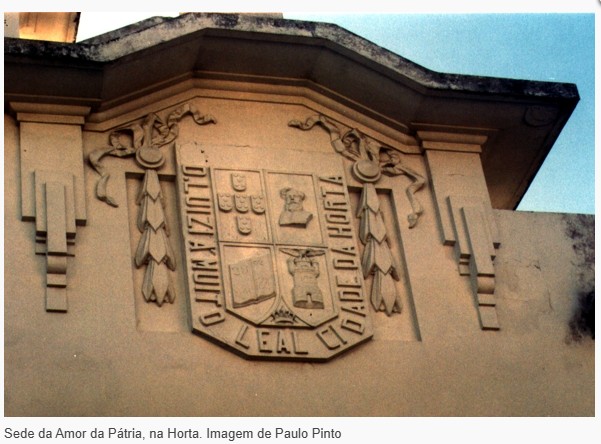
Sociedade – Recreational association founded on November 28, 1859, in the city of Horta, on the island of Faial, whose founding members were Manuel Maria da Terra Brum (3rd Baron of Alagoa), his brother João José da Terra Brum, João de Bettencourt Vasconcelos Correia e Ávila, Laureano Pereira da Silva, João António Morisson, Manuel Veloso de Carvalho, José Afonso Botelho de Andrade, António Joaquim de Almeida Beja, Francisco da Silva Carvalho, the brothers António and Manuel Garcia da Rosa (sons of the Baron of Areia Larga), Roberto Augusto de Mesquita, João Pereira Sarmento, and Manuel José Bettencourt. This society, which originated in a Masonic lodge in Horta with the same name, is considered the first recreational society in the history of this Azorean city and still exists today. With its first headquarters located in the manor house of José Francisco da Terra Brum (2nd Baron of Alagoa), on what is now Rua D. Pedro IV, it developed, in addition to various cultural activities, economic and assistance activities. Promoting literary and artistic soirées for charitable purposes and operating a reading room, on November 5, 1860, it opened a night primary school, and in August 1862, it extended its activities to bank credit, opening the Caixa Económica Faialense. After a violent fire on August 13, 1930, which completely destroyed the manor house that had become the society’s headquarters, the current spacious building, designed by architect Norte Júnior, was inaugurated on June 30, 1934. In 1976, when the political and administrative autonomy of the Azores archipelago was institutionalized, the Regional Legislative Assembly of the Azores was housed there for several years. By Resolution 64/84 of March 30, the building where the Amor da Pátria Society is located was classified as a “property of public interest.” Luís Menezes (Nov. 1995)
Bibl. Official Bulletin of the Grande Oriente Lusitano Unido (1869-1930), Lisbon. Costa, F. C. (1959), Faial over five centuries. Boletim do Núcleo Cultural da Horta, 2, 1, December: 47-63. Lima, M. (1940), Anais do Município da Horta. Famalicão, Of. Gráficas Minerva: 506-508. Marques, A. H. O. (1986), Dictionary of Portuguese Freemasonry.Lisbon, Ed. Delta, I. Id. (1990), History of Freemasonry in Portugal. Lisbon, Ed. Presença, II. Id. (1996), Ibid., Lisbon, Ed. Presença, II. Id. Dias, J. J. A. (1995), Love of Country is the only star that guides us: Freemasonry on the island of Faial in 1892. Horta, Horta Cultural Center.
Mission Statement:
“In the Silence of Hydrangeas: Azorean Arts and Letters” is a weekly digital rubric under the Filamentos platform that seeks to illuminate the cultural, artistic, and literary richness of the Azores and its dynamic connection to the Azorean Diaspora. Each week, we highlight writers, poets, musicians, painters, sculptors, theater groups, and cultural movements that have emerged from or been inspired by this Atlantic archipelago. Our mission is to move beyond folkloric clichés and festive portrayals to reveal the profound creative spirit, complexity, and heritage that shape Azorean identity across generations and oceans.
Vision Statement:
We envision a living archive and vibrant stage where the voices, visions, and legacies of Azorean creators—on the islands and throughout the diaspora—are celebrated, preserved, and made accessible to global audiences. This rubric aims to educate, connect, and inspire by showcasing the Azores not as a distant, nostalgic memory, but as a creative force in continuous dialogue with the world. To know the Azores is not merely to attend a festa, but to listen to the poems etched in basalt, the canvases dyed in sea-light, and the stories whispered in the silence of hydrangeas.
We thank FLAD Luso-American Development Foundation and the Luso-American Education Foundation for supporting this project.

 Filamentos (artes e letras)