
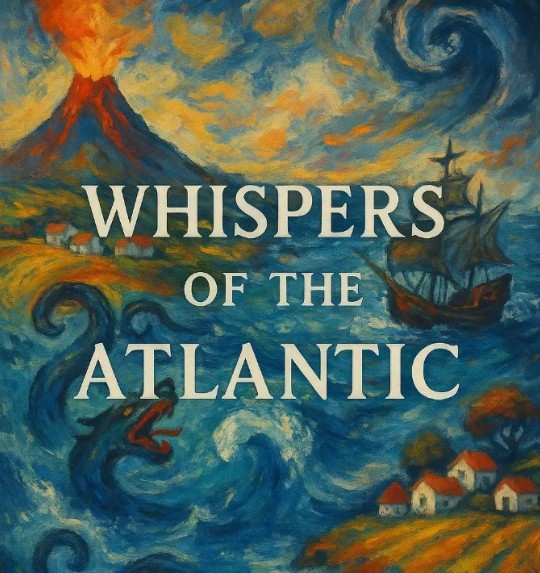
Where islands dream, and stories cross oceans.
From the volcanic heart of the Atlantic rise tales that have traveled through centuries—stories whispered around hearths, sung in work songs, carried in the wind across nine islands. Whispers of the Atlantic: Legends from the Azores gathers these timeless narratives and brings them into English, offering readers a journey through the enchanted archipelago where myth and memory intertwine. Giants, saints, sailors, and dreamers live side by side with the sea, the volcano, and the hydrangea. These are not only legends of the past; they are living echoes of a people who have always dwelled between fire and water, exile and belonging, homeland and diaspora.
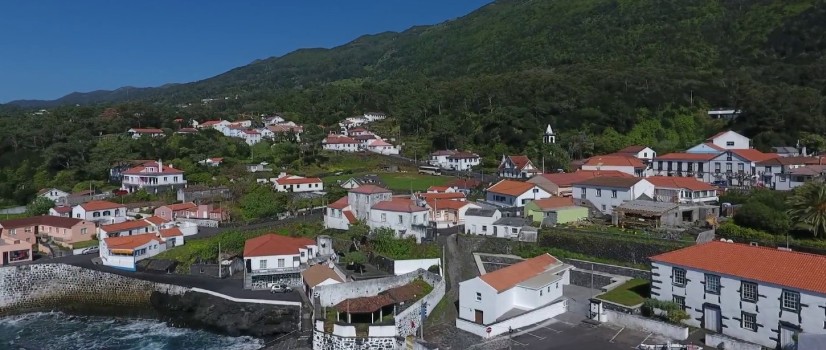
Legend of Urzelina
On the crest of the enormous mountain range that crosses the island of São Jorge from end to end, many, many years ago, stood the majestic castle of Prince Romualdo. His lavish court indulged in orgies, banquets, and other diversions, which astonished the working population.
One dawn, the royal trumpet echoed through the mountains, announcing the great hunt that would begin at the sound of the Ave Marias.
In front of the palace, the carriages, horses, and many servants in livery were parked, loaded with hunting equipment.
The poor and mistreated farm workers had already begun another day of hard work when the second trumpet sounded and the prince’s entourage set off at great speed, laughing with joy as they climbed the hills.
The wood pigeons flew away in terror at the shouting, and Lina, the prince’s beloved, winding her horse through the heather and rocks in pursuit of some pigeons that were fleeing from her, ended up straying from the entourage.
When they realized she was missing, they forgot about the hunt and searched everywhere for Lina, but could not find her. They returned to the palace, their joy replaced by discouragement and sadness.
The prince ordered all doors to be closed, all parties and entertainment to cease, and during the following nights and days, his sobbing voice cried out, “Lina! Lina!” as he ran like a madman, ragged and disheveled, through cliffs and ravines in search of his beloved.
One night, as he returned to the castle, Romualdo came across a terrible sight. At the bottom of a ravine, a dead horse crushed his beloved Lina with all its weight. The prince ran down the cliff, kissed the petrified corpse, and, in tears, cut a braid of her beautiful blond hair. He picked up a branch of heather and wrapped the braid around it.
He returned to the castle, discouraged, as if dead. He never wanted to know about celebrations again, and the courtiers began to call that plant “Lina’s Heather.”
Shortly thereafter, the prince died of grief, and as the years passed and the hypocritical court that had flattered him forgot him, his grave became completely covered with “Lina’s Heather.”
In honor of the prince’s pain, whom God had severely punished, the seaside village where the atrocities committed in the castle echoed and where the people who suffered the tyranny of the courtiers lived was named “Lina’s Heather” and later, by agglutination, “Urzelina.”
The flattering and hypocritical court, with no respect for the prince’s death, redoubled the festivities and tyranny towards the people, but was punished. God, who watches over the poor, caused a volcano to erupt at the foundations of the palace; the lava buried the entire evil court and destroyed everything around it, flowing all the way to the sea.
From Popular Legends
Whispers of the Atlantic: Legends from the Azores
Vision Statement
To preserve, translate, and reimagine the legendary heritage of the Azores as a cultural bridge across oceans—connecting generations, honoring the voices of the ancestors, and ensuring that these stories remain vibrant for the future of the diaspora and the world.
Mission Statement
Through the Whispers of the Atlantic series, Bruma Publications and Filamentos are committed to:
- Collecting and translating Azorean folktales, myths, and legends with literary fidelity and poetic resonance.
- Sharing these stories with English-speaking readers in North America and beyond fosters cultural pride and cross-cultural dialogue.
- Preserving centuries-old oral traditions as living cultural treasures, not museum relics.
- Inspiring new generations of writers, artists, and dreamers to draw from Azorean heritage in building bridges across languages, cultures, and oceans.
 Filamentos (artes e letras)