Ethnic literature is the soul’s cartography. It arises where geography and memory converge—where the journey of a people transforms into a chorus of words. Every community that crosses an ocean carries with it an invisible library: songs of departure, proverbs of endurance, silences shaped by exile. When those stories find language in a new land, they do not merely describe an experience; they enlarge the world.
For diasporic communities such as the Portuguese of California’s Central Valley, literature becomes both a mirror and a bridge—a way to remember who they were and to converse with the world around them. It gives form to a plural identity, at once insular and continental, rooted in ancestral soil yet nourished by American sunlight. In the multicultural garden of a nation like the United States, such writing is not peripheral; it is central. It enriches the republic of letters with new timbres, idioms, and affections, reminding the larger society that democracy of voice is the highest form of freedom.
And for the homeland, particularly one like the Azores, born of wind and water—this continuation of storytelling across the diaspora is both return and renewal. The Azorean imagination has always been oral, tidal, mythic. Its tales, like its islands, emerge from the sea and return to it, each one echoing the rhythms of survival and the metaphysics of longing. To see this tradition continue in the diaspora is to witness the sea writing itself anew on distant shores. Thus, when a Portuguese-American writer like Anthony Barcellos builds a novel out of the hum of tractors, the arguments of kin, and the soft grammar of saudade, he does more than tell a story—he extends a civilizational act. He joins the long procession of island storytellers who believed that to narrate is to endure, that to give voice is to exist.
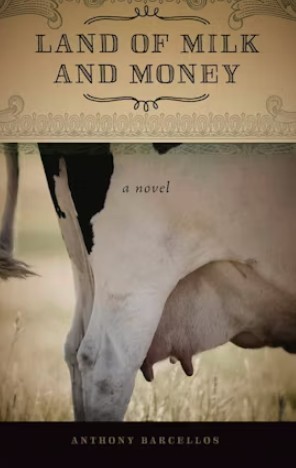
Some books are not merely written; they are tilled from the soil of experience. Land of Milk and Money by Anthony Barcellos is one such book, a work that grows like alfalfa from the volcanic and irrigated ground of California’s Central Valley. It is not just the chronicle of a family but the testament of a people—the Azorean immigrants who, crossing the Atlantic, cultivated new islands of belonging in America’s western heartland. In the rhythm of its sentences and the ache of its silences, Barcellos captures the paradox of diaspora: the necessity to leave one’s homeland to preserve it. The novel opens with a courtroom and closes with a benediction, moving between the language of law and the quiet syntax of longing.
As Vamberto Freitas so aptly describes, the novel is “a magnificent and expansive artistic take on the arrival empty-handed in the New World, and the subsequent triumph and fall, of Azorean people who—without speaking a word of English—built, up and down the San Joaquin Valley, some of the most substantial agricultural empires.” Barcellos’s America is a land of contradictions—milk and money, faith and fatigue, inheritance and betrayal.

Barcellos constructs his narrative as he once built his childhood treehouse—rope by rope, knot by knot. Time folds and unfolds through alternating courtroom chapters and flashbacks, much like memory itself, returning to the family dairy where everything began. The patriarch, Chico Francisco, is the founding myth of this saga: a man who believes that “water is a promise waiting to be kept.” His wife, Teresa, is both matriarch and moral compass, and her contested will propels the family toward disunion. Their sons—Candido, pragmatic and driven, and Paulinho, reflective and humane—embody the generational dialectic of immigrant life: the tension between work and wisdom, success and serenity.
Freitas identifies this struggle as “a universal portrait of greed and feigned love, an almost biblical retelling of the oldest of human themes—brother against brother, clan against clan.” Through this domestic fracture, Barcellos offers nothing less than a moral map of diaspora: a study of what happens when the dream of abundance eclipses the memory of hunger.
Julian Silva recognized in Barcellos’s novel the continuation of what he himself had begun—a literature of attachment and transformation. Freitas called these works—Silva’s The Gunnysack Castle, Vaz’s Saudade, and Barcellos’s Land of Milk and Money—“the great trilogy of Azor-Californian modern life.” For both Silva and Barcellos, the Central Valley is a transplanted Azores, where memory takes root in new soil. Silva once observed that “our fathers’ dairies were cathedrals of endurance; their fields, an act of prayer.” Barcellos continues that legacy, showing how attachment can both bind and blind: the Francisco family’s fierce loyalty to land and lineage sustains them and destroys them in equal measure. Like Silva’s characters, Barcellos’s protagonists live at the intersection of gratitude and grief. They are neither fully American nor fully Portuguese; they belong, as Silva wrote, “to the in-between, where identity is always being translated.”
At the novel’s heart stands Paul Francisco, Chico’s grandson—the scholar, the dissident, the inheritor of saudade. Freitas calls him “the most creatively rebellious grandchild of the founders,” endowed with “observational acuity and knowledge of the outside world.” Through Paul’s eyes, the reader sees both the beauty and the banality of the immigrant legacy. His eventual decision to abandon the dairy and become a university professor symbolizes a passage from physical labor to intellectual cultivation. Yet he never escapes the pull of his origins. “He looks with saudade upon his past but already belongs to another America,” writes Freitas, evoking the bittersweetness that defines the diaspora experience. In Paul, Barcellos gives us the archetype of the second-generation immigrant intellectual—the bridge between the plow and the pen.
If Anthony Barcellos’s structure reveals his craft, his dialogue reveals his genius. His conversations breathe like living organisms—humorous, impatient, tender, and raw. Capturing the rhythm of Central Valley Portuguese-American speech, he achieves something rare in ethnic fiction: dialogue that feels both authentic and musical. Scenes like the festa do Espírito Santo, where flirtation unfolds between jokes about “breeding stock,” or the sibling quarrels over inheritance, display an ear for idiom and timing that rivals the best of American realism. The banter between brothers and cousins is fast, funny, and precise—real people talking, not characters performing.
In this, Anthony Barcellos joins the company of the great American stylists of dialogue. Like Ernest Hemingway, he understands that what is unsaid carries the most weight; like F. Scott Fitzgerald, he captures the intoxication of speech as social currency—how words both reveal and conceal. At times, his familial repartee evokes John Steinbeck’s rural naturalism, the chorus of farmers and dreamers whose voices define place more than plot. Yet Barcellos’s dialogue also carries the echo of Portuguese literary mastery. In the Azores, Álamo Oliveira’s Até Hoje achieves a similar feat—turning everyday speech into a mirror of moral complexity. Oliveira’s dialogues, like Barcellos’s, oscillate between intimacy and irony, between the laughter of the kitchen and the silence of loss. And from mainland Portugal, Miguel Torga—the doctor-poet of rural souls—offers another parallel. Torga’s peasants, like Barcellos’s dairymen, speak in a moral vernacular that fuses labor and language, transforming conversation into confession.
Barcellos’s dialogues therefore belong to two traditions at once: the crisp naturalism of American prose and the lyrical humanism of Lusophone storytelling. To sustain such bilingual authenticity in tone and rhythm across hundreds of pages is a rare literary accomplishment—one that marks Land of Milk and Money as both art and anthropology.
Vamberto Freitas insightfully compares Barcellos to Steinbeck, noting that “Steinbeck, the first to fictionalize the dynamism of California’s mechanized countryside, would not have disdained this narrative… he would likely have regarded it as the sequel to what he had himself established in literature from those same sources.” Indeed, Barcellos extends Steinbeck’s vision into the Portuguese world, replacing migrant laborers with immigrant landowners—those who turned survival into success but at the cost of simplicity. Barcellos’s California is not mythic; it is moral. His Central Valley is a stage where prosperity meets nostalgia, and where each legal document conceals a lost prayer.
As Freitas concludes, Land of Milk and Money is “another great novel of the highly consequential and successful Azorean saga in North America.” It is both literature and ledger—a book that registers what might otherwise have been forgotten. Julian Silva and Barcellos together form the twin pillars of the Portuguese-American canon. Both capture the tenderness of attachment, the ache of inheritance, and the ethical dilemma of belonging. Their characters remind us that the land we cultivate also cultivates us—that in every acre, every lawsuit, every family supper, the past whispers its unfinished sentences.
At its close, Land of Milk and Money leaves the reader with a lingering resonance—the sound of laughter breaking through fatigue, the hum of memory over the whir of milking machines. The novel ends, as Freitas writes, “with a guffaw that says it all: the continuity and inevitable rupture of our past and present.” That laughter is the sound of survival—the Portuguese-American hymn that has echoed for a century across California’s plains. Through Anthony Barcellos’s art, the land of milk and money becomes the land of memory and meaning, where even the most ordinary voice is rendered extraordinary by its endurance.
And within California’s broader multicultural and ethnic literature, Land of Milk and Money stands as both a mirror and a cornerstone. It belongs beside Steinbeck’s The Grapes of Wrath, Maxine Hong Kingston’s The Woman Warrior, Helena María Viramontes’s Under the Feet of Jesus, and Amy Tan’s The Joy Luck Club—works that map the interior geographies of migration and labor, family and faith. Barcellos’s Central Valley is California’s moral heartland, where the plow becomes pen and the milking barn a cathedral of memory. His novel affirms that the Portuguese-American experience is not a footnote to the Golden State’s story but a vital chapter, written in milk, sunlight, and saudade.
In the end, Land of Milk and Money is a luminous act of reclamation—a novel that tills silence into song and restores the Portuguese voice to California’s literary soil. Like water coursing through the valley’s canals, Barcellos’s prose carries both reflection and renewal. It reminds us that the truest wealth of any land is not its harvest but its humanity, and that the stories of those who once arrived with nothing have become the enduring music of belonging.
Diniz borges
Note: This essay has been written for over a year. I was finishing it when I got the sad news from the author’s sister that Anthony had gone to his portal and was not well. I had to review it and was waiting for Anthony to get back home —well, so I could surprise him with it. Unfortunately, that didn’t happen, and he passed. It has been in my files for well over a year. It is time for it to be published here on Filamentos, a project Anthony collaborated on and always praised. We all miss you, my friend.
 Filamentos (artes e letras)