
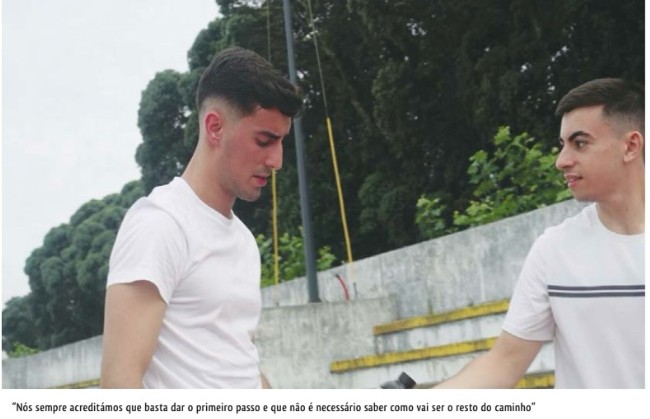
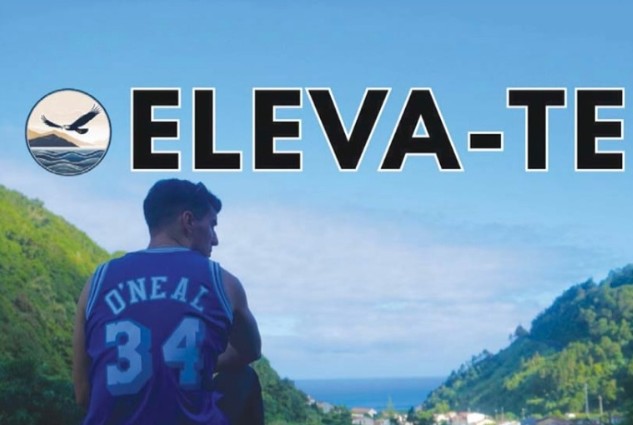
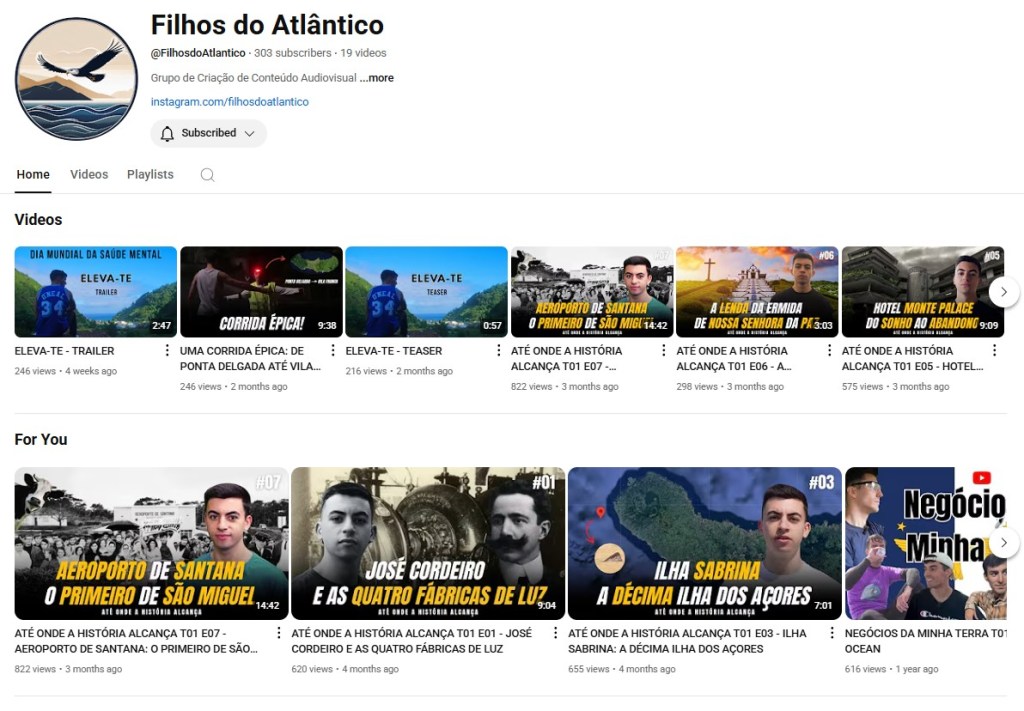
The YouTube channel “Filhos do Atlântico” (Children of the Atlantic), created by Francisco Teixeira and Pedro Arruda, was born out of a desire to promote aspects of the Azores through audiovisual content. With programs such as “Negócios Da Minha Terra” (Businesses of My Land) and “Até Onde a História Alcança” (As Far as History Reaches), the creators share initiatives and stories about Azorean monuments. They are currently preparing to release the documentary “ELEVA-TE” (Rise Up), which addresses mental health and stories of overcoming adversity.
Correio dos Açores – What is the history of the “Filhos do Atlântico” project?
Francisco Teixeira (Founder of “Filhos do Atlântico”) – This project came from an idea that my friend Pedro Arruda and I had. We had planned the first program, “Negócios Da Minha Terra” (Businesses of My Land), but we weren’t sure what the future would hold after that series. However, we always believed that taking the first step was enough and that it wasn’t necessary to know what the rest of the journey would be like.
We are currently a group creating audiovisual content on YouTube. Academically, I recently presented my master’s thesis, and Pedro has begun his journey toward that degree. When we conceived the project, I was in my first year of my master’s degree, and he was finishing his bachelor’s degree. Today, we are both graduates of the University of the Azores (UAc).
Throughout my professional career, I have been in direct contact with several businesses across the island of São Miguel, and this experience made me want to learn more about initiatives that I considered interesting enough to be publicized.
We needed a way to publicize the projects, and that’s how our YouTube channel “Filhos do Atlântico” (Children of the Atlantic) came about. We chose this name because it sounds good and allows very interesting doors to be opened, but always without straying from the essence of the channel and its objective, which is to make the community aware of interesting facts about our region.
We currently have two published programs: “Negócios Da Minha Terra” (Businesses of My Land), which I present, and “Até Onde a História Alcança” (As Far as History Reaches), which Pedro is in charge of. We are also preparing a documentary titled “ELEVA-TE” (Rise Up), scheduled for release at the end of this month.
What were the biggest difficulties you faced in the beginning? Did you have any support?
We have the support of secondary staff, who help us and sometimes even come up with other ideas, but most of the recording was done by Pedro and me, at least for the first two programs. For my program, Pedro did most of the recording, and for his program, I did most of it. We ended up supporting each other.
One of the difficulties we faced was selecting what was interesting. There were episodes from the first series that never made it out because I didn’t think they were interesting enough for the audience. One of our mottos is to publicize only what makes sense to share; it must be interesting, because if it’s not, it won’t be released.
In terms of funding, the project is supported entirely by us, but we also receive other forms of support, such as kind words from close friends and people who work with us and help with the audiovisual aspect.
We try to be like sponges, that is, we aim to absorb as much as possible from others, but without ever losing our essence. This method would be to turn the concept into content, because there are people who understand the subject much better than we do, and we want to learn from them how to transform the idea into something people want to watch and enjoy.
As for difficulties, I can give you an example: a week and a half before starting filming for “Negócios Da Minha Terra,” I tore ligaments in my left ankle. The doctor said I wouldn’t recover in time, but it was something we couldn’t postpone, since the first episode was about PDL White Ocean —the event with the most logistics and the one I was most eager to do. We had to fight against time, and with a lot of physical therapy, I managed to walk a little on the day before the episode, and we went ahead with the recording even though I was limping. But despite everything, this project has been very interesting because it has been very organic.
How did the channel’s second series, “Até Onde a História Alcança” (As Far as History Reaches), come about?
This series came about curiously. At first, Pedro and I were afraid that the channel would revolve too much around me, but I always suggested to Pedro that he keep an open mind and be on the lookout for something he would like to talk about.
Pedro’s program, which he developed to discuss historical monuments in the region, came about naturally, and I fully supported the initiative. As he is a tourism student, the idea came about spontaneously and sincerely.
But the important thing is that we enjoy what we present, and I think that’s something that’s present in both programs. We’re enjoying making the seasons.
In your opinion, how has the community received the two programs?
The feedback has been excellent, and we have had a very diverse audience. The comments on the channel demonstrate this. Our audience has not been either young or senior citizens, but above all, people who want to know more about our archipelago.
In my opinion, we have been well received, but obviously, starting a project like this from scratch requires evolving step by step, and there will always be someone with doubts about our commitment. But it is up to us to continue to captivate the community.

What role do you hope to play in preserving Azorean culture?
I hope we can contribute, but not be the main part, because that would mean no contribution from the rest of the community. We intend to cooperate with quality and make people want to learn more about our roots.
How did the idea for the documentary “ELEVA-TE” come about?
“ELEVA-TE” came about because I had a childhood friend who committed suicide, and that had a profound effect on me. These situations impact all of us, but when they happen to someone we know, they are very painful. I started researching the subject and discovered that the suicide rate in the region is almost double that of the national average per 100,000 inhabitants. I also quickly realized that it is a very sensitive topic.
As for anxiety, this was a subject that always came up in conversations with my university classmates and with people in general.
I strongly believe that by overcoming the obstacles placed in front of us, we will ultimately improve our self-esteem and reduce the feeling of failure we all experience at times.
I have always believed that negativity attracts positivity. For example, when we are at the gym training and not enjoying it, and our muscles are aching, it is a difficult situation, but one that ultimately produces good results. This makes us feel satisfied with ourselves for having overcome that difficulty.
In the documentary, I show this by presenting situations where I was uncomfortable and didn’t enjoy what I was doing. I show the process of climbing the peak and completing my thesis, and how proud I felt to have done so. With this project, I also wanted to show that any of us, regardless of age, can and should change if we’re going to change something we don’t like. In six months, I underwent a physical transformation, climbed a mountain, wrote my dissertation, and much more. This only reinforces the idea that anything is possible.
In this documentary, I also addressed the issue of drug addiction on the island and how these people are marginalized, but I reinforced the idea that there is also a way back from this addiction.
The overall message is very much along these lines: if we face a situation we don’t like and want to change, we can.
Why talk about mental health and why now?
I found myself in a situation where I was a little dissatisfied with myself; for example, I had a year to write my thesis, and in the first six months, little or nothing was done.
That’s when I said, “You’re going to prove to yourself that you can do it.” And I feel that we all feel that way, wanting to do something but not having the initiative to take the first step. Often, the day ends and we haven’t done what we were supposed to, leaving us disappointed in ourselves.
The documentary helps in that regard; it shows what can happen when we take the initiative to do something. Some people feel bad about themselves and have low self-esteem, and often just taking the first step can make them feel better.
I also feel that most people who go through these difficult times feel lonely. They don’t think that they don’t have friends, but rather that they can’t count on themselves. The project shows that everything is a phase and that we can get through anything.
In your opinion, how would you define the reality of mental health here in the region? Is there still a taboo surrounding this subject?
Without a doubt. Mental health is still seen as taboo, and most people who suffer from mental disorders are unfortunately still seen as weak when they reveal that they are not mentally well. There will always be negative comments, which make them afraid to reveal what they really feel, leading them to think they are alone and not understood.
I believe that, despite their fears, these people should allow themselves to be heard and understood by talking to someone or seeking professional help. The professional in the field may not have the exact answer, but they may be the push they need. That’s exactly how I see the documentary: as an impetus for them to seek help. And if the documentary helps even just one person, I’ll be very proud.
What were the biggest difficulties you faced in carrying out this project? Was there ever a moment when you thought about giving up?
I never thought about giving up on the project itself. Obviously, I had a lot of doubts about myself. I wondered if I could really accomplish everything I set out to do, like the thesis. The truth is, I always thought I wasn’t smart enough to write a dissertation.
What do you hope the audience will feel when they watch the documentary?
I hope they feel motivated and inspired, and that they know they can achieve everything they want in life. That’s the purpose: whatever they want to do —from traveling alone to fulfilling every dream they may have —the goal is to get people to take the initiative and live without fear.
If I had to sum up the documentary in one word, it would be ‘overcoming’. In other words, how people fight against what they fear doing. We intend to release the documentary at the end of this month.
Do you feel that the community should embrace this type of initiative?
My opinion is that things are as they are, and it is up to us, content creators, to make quality programs that people want to watch. If we produce quality content, people will follow our work, and it is up to us to evolve with each program and make it appealing to the community. The program will speak for itself. If people are interested, they will surely want to watch it and will feel motivated.
What are the plans for the future of “Filhos do Atlântico”?
As far as we can reveal, we are preparing new seasons of the programs that have already been made. We are not going to reveal what we have not yet done and have planned, as it is still very much in the notebook stage, but we can guarantee that we still have a lot to present about the Autonomous Region of the Azores.
DP-Correio dos Açores-Natalino Viveiros, director.

 Filamentos (artes e letras)