
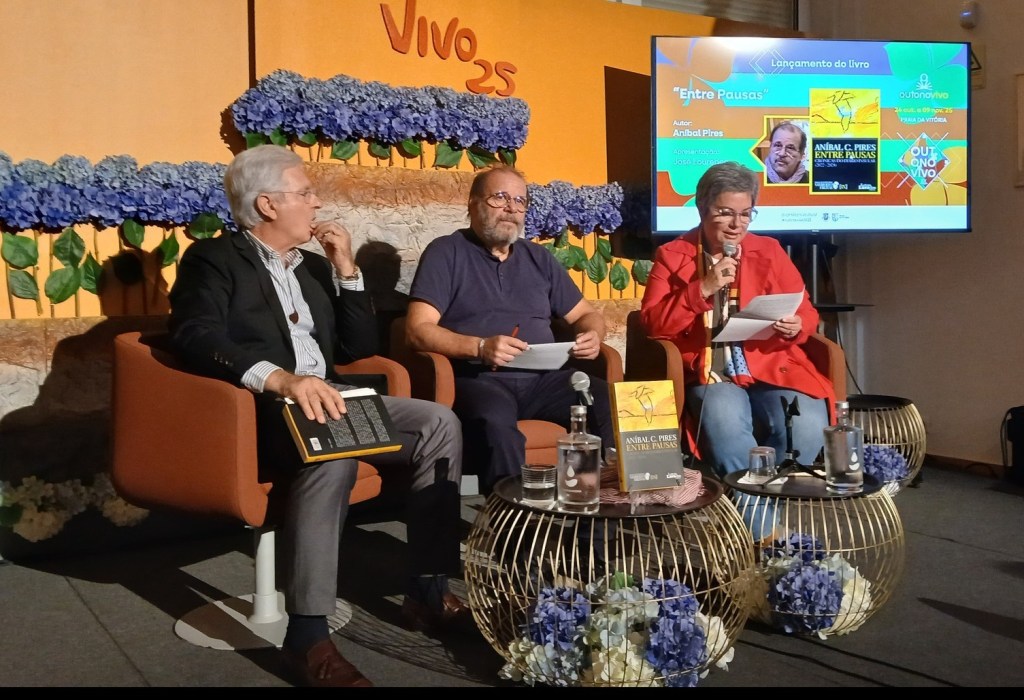
How did these chronicles, Entre Pausas, come about?
These and other chronicles are born at the pace of life and time, of concerns, but also of the pauses that everyday life imposes on us. This book brings together the chronicles published in Diário Insular between January 2022 and December 2024. They are in chronological order and include all texts published during that period, meaning there was no selection, only a revision. The texts now published emerged, like others, from a look at what surrounds us: the country, the region, the world, but also what inhabits us, the doubts, the contradictions, the memory. “Entre Pausas” (Between Pauses) is, therefore, a title that explains itself. It is in the interval between one event and another, between the news, oblivion, the fog of information, and the official narratives whose purpose is manipulation and domination, that I seek to understand what really endures and comes closest to reality. These chronicles were written for Diário Insular, which gives them a dimension of dialogue with readers and residents of the Azores who live and read the themes they address. This book is the result of a return to the pages of the written media after a hiatus from December 2019 to January 2022, which will continue for some time —I don’t know how long. It will be for as long as time allows me the discernment and willingness to continue sharing my opinion and promoting reflection. The chronicles collected in the book “Entre Pausas” are a look, my look, at some of the events that marked this period, always leaving room for readers to deepen their reflections on the topics addressed, while refraining from expressing my opinion. The proposal to read this book is, therefore, an invitation for readers to journey through these years of analysis and critical thinking in a register I consider attentive, timeless, and thematically diverse.
How have you seen the region and the country evolve over these years?
With great concern, but without losing hope that this cycle of setbacks will come to an end in the near future. The changes that have taken place in recent years have intensified the implementation of political, social, and economic agendas that produce social exclusion and poverty, which are clearly visible to us. I would say that the scientific and technical revolution, intended to improve working conditions and the well-being of populations, has veered from expectations and serves only to concentrate wealth and deepen social, cultural, and economic inequalities. The civilizational setbacks that have occurred and which are at the root of the deterioration in living and working conditions, while not the only reason, have contributed to the rise of neo-fascist populism, also in the Azores, and to its electoral support. The normalization of these political forces, promoted by the media and by parties that, in their power struggles, have used their tacit support, has also contributed to the rise of political organizations that promote ideas that do not conform to the principles of the rule of law. The deterioration of public services, which is a political choice and project of those who govern us, not an inevitability or fatality, is worrying, as is the wave of privatization of public companies. Governments seem more like sales centers, which are not very effective in promoting and adding value to the product they want to sell, turning these processes into political and economic crimes. But suppose those who exercise executive power in the region demonstrate their ineptitude daily. In that case, it is no less true that the opposition, embodied in the PS, is a veritable desert of ideas and political projects, not necessarily alternative, but at least mobilizing enough to ensure change. What separates the PSD from the PS is only the D in the PSD’s acronym, which the PS lacks. Hope lies in the emergence of critical awareness amid a time of great disenchantment and informational noise amplified by social networks.

There is a real debate about freedom of expression and the limits beyond which democracy becomes at risk. Where do you stand in this discussion?
Freedom of expression is an essential pillar of democracy, but it cannot be confused with the right to offend or manipulate. I defend freedom of expression, I fight for the right to freedom of expression. But we cannot confuse freedom of expression with isolated opinions unsupported by data or taken out of context. The expression of opinion must be based on information, knowledge, and ethics. We must be aware of its impact. The risk today is the trivialization of hate speech: excessive noise, lies fabricated by the spread of fake news, and resentment disguised as opinion. Democracy begins to be at risk when the public space is taken over by those who confuse freedom with impunity. Defending freedom also means protecting the truth, serious debate, and respect for others who are different but equally dignified.
What issues should be in the newspapers and opinion articles but are stubbornly overlooked, especially in the Azores?
Perhaps those that do not make appealing headlines but define the future: the depopulation of some of our islands, but also of some of our cities, the aging of the population, and the shameful poverty that grows in the interstices of statistics. We need to talk more about those who work, and the conditions in which they work, the precariousness and low incomes that contribute to working poverty, those who leave and those who stay, but also those who come here to live, work, and contribute to the sustainability of public finances and social security. We need to discuss sustainability and social, territorial, cultural, and economic cohesion, that is, real sustainability, not that of speeches and circumstances, but that of people and communities. And above all, there is a lack of time. Time to listen, to understand, to write in depth in a media space filled with immediacy, which, being a characteristic of simplification, is always reductive, superficial, and fragmented, which, in the long run, can become harmful.

Where is the region heading today, politically and socially?
I don’t want to sound defeatist, especially since I am an optimist, but I would say the paths we are taking don’t bode well. None of the long-standing structural problems has been definitively resolved. We can add to these some that stem from poor regional governance, such as an issue that citizens, legitimately concerned with ensuring that there is bread on the table for their children day after day, care little or nothing about, but which should concern us all. I am referring to the imbalance in public accounts and the possible financial collapse of the region, leading to the need for external financial intervention and all that this entails in terms of loss of autonomy. Autonomy, already severely curtailed by the European Union, has long since ceased to be Lisbon. The decision-making center has moved eastward and become even more distant, and no new technologies can help us in this regard. We remain a region with a high poverty rate, high functional illiteracy, high job insecurity and low incomes, high school dropout and failure rates, and major development disparities. The regional economy continues to rely on monoculture —now tourism —which makes us dependent and very susceptible to external factors we cannot control. We all remember the lockdown period in 2020 and the times that followed. I would say that this regional government, while recognizing its democratic legitimacy, is a patchwork quilt of little chapels, which makes it, not only for that reason, but also for that reason, the worst government in the history of Constitutional Autonomy. Without much effort, we can find positive aspects of governance in the PSD governments presided over by Mota Amaral, and the same is true of the PS governments, both those of Carlos César and Vasco Cordeiro, but the same cannot be said of the governments of José Manuel Bolieiro. Yes, I know. Reduced airfares for inter-island travel, yes, that’s true, but at the expense of seasonal maritime transport, which, while not the best solution, allowed for a mobility that air transport alone cannot ensure in an archipelagic region such as ours. Regional politics is going through a period of uncertainty, with some dangers looming. It could be said that this is partly a reflection of what is happening in the country and in the European Union. Still, the partisan dispersion that supports the current regional government and the growing mistrust of citizens are symptoms of something deeper: the crisis of representation and collective meaning. Cohesion —the main goal of autonomy —is not guaranteed and needs to be nurtured, fueled by social justice, education, and policies that put people, rather than private (political and business) interests, at the center of decision-making.
Interview published in Portuguese on November 4th in the newspaper Diário Insular-José Lourenço, director.
Translated by Diniz Borges
 Filamentos (artes e letras)