To speak of ethnic literature in Canada is to recognize that the nation’s story is not contained in two official languages alone, but in a mosaic of accents, memories, and tongues. The Canadian experience is written in the margins of migration, in letters carried across the Atlantic, in prayers whispered in kitchens, and in the resilient laughter of children born between worlds. If literature is the soul of a country, then ethnic literature is the lifeblood that keeps it plural and humane. Among these vital voices are the Portuguese-Canadians, whose presence has long been woven into the fabric of Montreal, Toronto, Vancouver, and many other cities and towns in between.
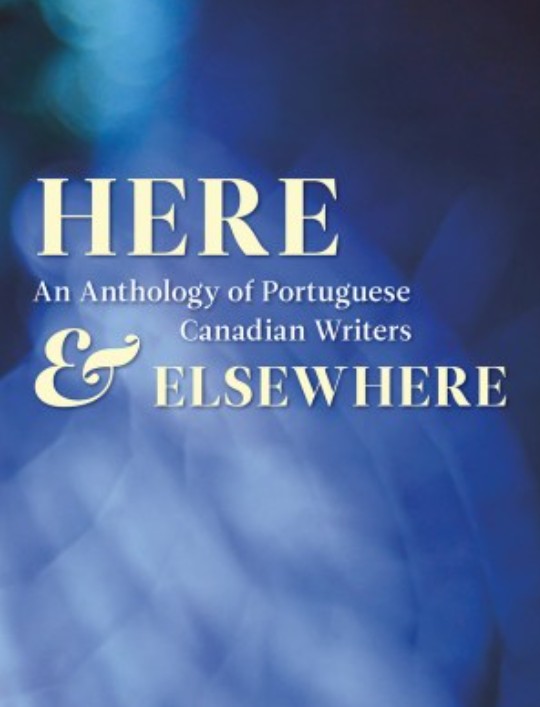
Here & Elsewhere: An Anthology of Portuguese-Canadian Writers, edited by Fernanda Viveiros and published by Arquiplégo Press, is both a literary offering and a cultural map. It brings together authors of various generations and styles, demonstrating that Portuguese-Canadian writing is not monolithic but richly diverse. From lyrical evocations of Azorean landscapes to sharp postmodern humor, from personal testimonies to historical reimaginings, this anthology asserts Portuguese-Canadian literature as an indispensable part of Canada’s multicultural tapestry and the broader Lusophone diaspora.
In her introduction, Viveiros reflects on the themes that emerged as she selected and arranged the anthology: “a feeling of never fully belonging to any country, of existing in the space between.” This liminal condition—one foot in Canada, the other in Portugal or the Azores—defines the diasporic imagination. Viveiros insists that it is not a limitation but richness: the in-betweenness becomes fertile ground for creation. She notes the “wide range of literary styles” that the contributors bring, underscoring the vibrancy of this community’s literature. Viveiros herself has long been an advocate for Lusophone voices in Canada, and this anthology is another step in her tireless effort to carve out a place for Portuguese-Canadian literature within the national canon. Her work demonstrates that editing is not only a technical task but also a political and cultural act—a way of insisting that these voices be heard “here” in Canada and “elsewhere,” across the Lusophone world. Her tireless work must be acknowledged and praised.
Inheritance, Memory, and Displacement
Kelly Pinho’s “Inheritance” is a striking opening to the anthology. Through sensual imagery—the smell of azaleas, figs changing color on the trees, the salt air of Terceira—the story recreates the sensory world of the Azores. Yet it is haunted by loss. The narrator’s father loses his farmland to the expanding American air base: “My father had been turning my mother’s skin into the color of overripe figs since he lost his farming land.” The metaphor of bruised figs fuses personal and political trauma, showing how displacement disrupts not only livelihoods but also family bonds. The narrator’s struggle with her father’s violence and her own inheritance of pain reflects the larger diasporic condition: “We were all fighting the different versions of ourselves and the hurt we had inherited.”
Robert Peris-Fleming’s “Senhor Silva’s Last Ride” offers another generational perspective. The elderly Silva, returning from Faial, feels anonymous in the airport lounge, invisible on the plane. His memories of the past—his wife Matilde, his youth, his unfinished love for Filomena—collide with his marginalization in the present. The piece captures the loneliness of the immigrant generation, those who built lives in Canada but remain haunted by unfinished ties to the islands. The dream sequence in which Silva imagines climbing Pico with Filomena is particularly poignant: desire and memory become more real than the bureaucratic, indifferent present of airports and airplanes.
Sonja Pinto’s two poems, “Praia Preto” and “Santa Barbara Burial,” evoke identity through fragmentary lyricism. “Here, I am (half) a tourist. / Here, I am (whole),” she writes. The lines express the paradox of second-generation identity: to be rooted in Canada yet haunted by ancestral homelands, to belong and not belong at once. Pinto’s work suggests that wholeness is possible not by choosing one identity over another but by embracing the hybrid.
Paul Serralheiro’s “Portuguese Voices” makes explicit the anthology’s cultural stakes: “It is vital to tell our story, so we don’t forget where we came from.” His poems recall the hardship of immigrant parents, “large families toiling in fields, children working from a young age, becoming productive before they could dream.” At the same time, he writes of his own dislocations in Montreal: neither entirely English nor French, yet undeniably Portuguese. His piece insists that Portuguese-Canadian stories—of bakers, builders, churchgoers—are central to Canada’s history of labor and community-making.
Irony, History, and Fragmentation
José Avelino Gilles Corbett Lourenço’s “I Will Always Love You, But Can I Please Have My Stuff Back?” shifts tone dramatically. Mixing irony, pop culture, and breakup banter, the story uses humor to explore memory and attachment. References to Ikea blankets, Miatas, and McGill hoodies situate the Portuguese-Canadian experience firmly within contemporary urban life. Yet beneath the wit lies the diasporic question: what do we hold onto, and what do we let go of, when relationships and identities unravel?
Richard Simas’s “Pico” meditates on the iconic Azorean mountain, weaving together geography and identity. His text captures the impossibility of fully returning: Pico is at once majestic, ancestral, and unreachable. In his hands, landscape becomes a metaphor for exile.
Irene Marques’s “Letters From the War” extends the scope to Portugal’s colonial history. Drawing from her novel Uma Casa no Mundo, Marques reimagines the colonial wars and their aftermath. Her inclusion in this anthology is significant: it reminds us that Portuguese-Canadian identity is not only about nostalgic connections to the islands but also about confronting Portugal’s complex, sometimes painful past.
Humberto da Silva’s “Variations on a Drowning” fractures the narrative itself, mirroring the disorientation of exile. At one moment, the drowning victim is a hero; at another, he is a failed man. The story insists that memory is never stable, that “memories are just stories we tell ourselves, and we remember only what we can bear.”
Voices that Expand the Tapestry
Esmeralda Cabral’s “Daughter from Lagoa” is a gem of autobiographical prose. She recalls: “we walked down the main street in Rosto do Cão, Lagoa, four abreast, taking up the entire road.” Childhood memory becomes communal history, situating identity in the very geography of São Miguel. For Cabral, belonging is both intimate and public, both here in Canada and elsewhere in the Azores.
Emanuel Melo’s “Tia Catarina” paints an affectionate portrait of an aunt in the Algarve, whose exuberant hospitality embodies diasporic kinship. “Oooooh, you’re here! How was your trip?” she exclaims, greeting the narrator with warmth. The story shows how family members abroad can become cultural anchors, embodying joy and resilience in the face of displacement.
Sonia Nicholson’s “Good Citizen” situates the diasporic struggle in bureaucratic reality. At the Portuguese consulate in Vancouver, the narrator reflects: “There are, it seems, two sets of rules: the official and the unwritten.” The search for dual citizenship becomes an allegory for identity itself—caught between law and longing, regulation and memory. Nicholson’s piece highlights the persistence of belonging as a lived negotiation rather than an abstract feeling.
Paulo da Costa’s “Beyond Bullfights and Ice Hockey” critiques stereotypes. By juxtaposing Portuguese bullfights and Canadian hockey, he insists on identities that exceed clichés. For da Costa, being Portuguese-Canadian means inhabiting spaces of creativity and contradiction, where cultures do not merely coexist but transform each other.
Diversity as the Heart of Diaspora
The greatest achievement of Here & Elsewhere is its embrace of diversity—not only of generations but of genres and styles. Pinho’s sensual narrative of Terceira contrasts with Serralheiro’s testimony of Montreal’s working-class immigrants. Pinto’s lyrical fragments stand beside Lourenço’s postmodern humor. Marques’s colonial reckoning expands the diasporic horizon, while Cabral, Melo, Nicholson, and da Costa show the ongoing vitality of Portuguese-Canadian writing today.
The anthology insists that there is no single Portuguese-Canadian identity; there are many. Some texts are steeped in Azorean landscapes; others are set in Canadian cities. Some are nostalgic, others ironic, even irreverent. Together, they form a polyphonic chorus. In a multicultural nation like Canada, this multiplicity is not marginal but central—it exemplifies what it means to live in a country of many histories and many futures.
To read Here & Elsewhere is to walk along a coastline at dusk. Each wave carries fragments of a life: a fig from Terceira, a bureaucratic document stamped in Vancouver, a song remembered in Montreal, a poem written in Victoria, a memory of Pico’s volcanic cone. The anthology gathers these fragments and arranges them into constellations, so that Portuguese-Canadians, and Canadians more broadly, can see themselves reflected in the night sky of literature.
This anthology is not only about being Portuguese in Canada—it is about what it means to be human in the in-between, to carry multiple homes in one body, to exist both here and elsewhere. The writers remind us that to belong is not to have a fixed address but to keep planting hydrangeas in a variety of soil, letting them bloom in colors that resist forgetting. In their words, we find the beauty of survival, the dignity of memory, and the courage of reinvention.
And so, Here and Elsewhere becomes more than a title—it becomes a metaphor for the diasporic heart itself. It charts how identity is drawn not on maps but on the tides of remembrance, how belonging is redrafted in every generation that dreams across languages. Between fog and snow, sea and soil, these Portuguese-Canadian writers offer not only stories, but coordinates—showing us where memory becomes home, and where the human spirit, forever in motion, finds its compass in the act of writing.
Diniz Borges
 Filamentos (artes e letras)