
Poetry is the oldest bridge between silence and eternity. When a poet dies, his breath continues in the rhythm of words—for poetry does not end with the poet; it begins anew in those who read him, remember him, and carry his cadence forward. Each poem is a seed of immortality, a word cast into the sea of time, destined to reach distant shores.
For diasporic communities, poetry becomes both a compass and a harbor. It names the unspoken, heals the wound of distance, and binds the scattered islands of memory into an archipelago of belonging. Poets are the custodians of that continuity—their voices echo across oceans, teaching us how to be at once here and elsewhere. Through them, the past remains tender, the present meaningful, and the future imaginable.
“I tell my Avó that the lime green sweater she likes is
from a secondhand store. She cracks up like
I won the lottery. Turned water to wine…
Still, the art of salvaging will never be lost on our kind.
We will always have more than we bargain for…
And everything old becomes new again,” Avó says
between bites of yesterday’s broa.
— Marina Carreira, In This Country
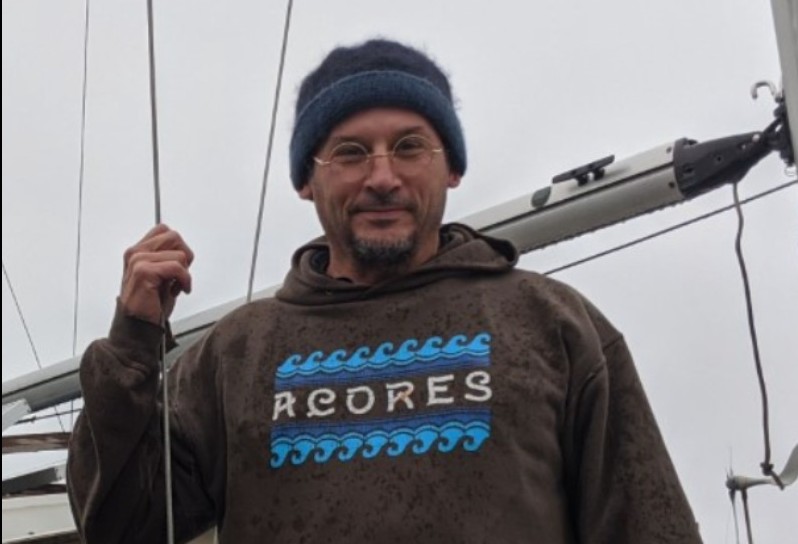
Michael Garcia Spring’s life was a journey between coastlines — the rugged Pacific edge of Oregon and the imagined basalt cliffs of the Azores. In both geography and spirit, he belonged to a seafaring lineage that shaped his art and his soul. Born in Hanford, California, to a Portuguese-American family whose roots reached back to the islands since the early 1700s, Spring grew into a poet of profound listening — one who, as he once told fellow poet Millicent Borges Accardi, carried “nostalgia for places I’ve never been.” His passing on October 30, 2024, marked the loss of a luminous voice in Luso-American letters, but also the solidifying of a legacy that continues to echo dentro do som — inside the sound.
His final collection, Dentro do Som / Inside the Sound (Companhia das Ilhas, 2021), masterfully translated into Portuguese by Maria João Marques, represented not only his literary maturity but also his full circle: from the California fields of his childhood to the volcanic ground of his ancestors. There, the sea was never a metaphor but a pulse — a sentient being that carried both longing and renewal.
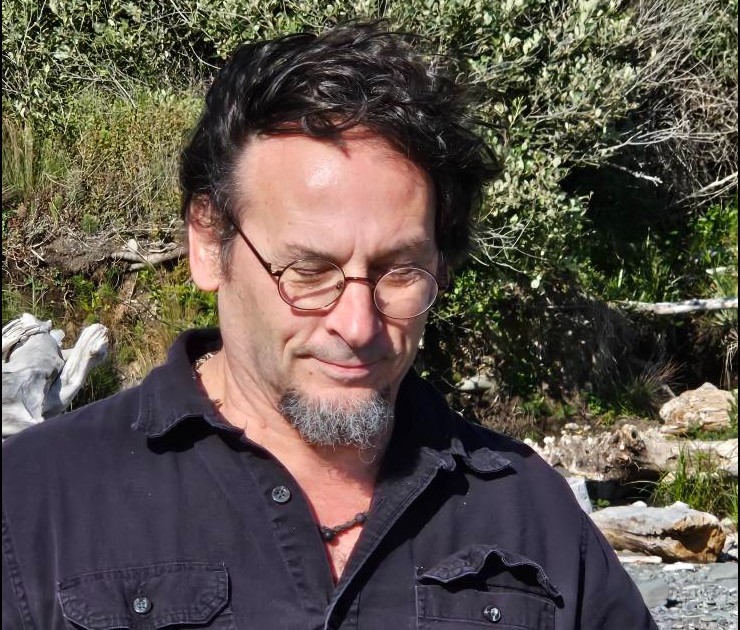
Michael Spring’s poetry, deeply ecological, was rooted in the physical world — in wind, water, and fire. A martial artist for over four decades, he often described his practice as a “movement of the imagination,” akin to Jung’s alchemical psychology. He lived on a permaculture farm, raised goats, built a cob house with a living roof, and sought balance between craft and nature. This is evident in his verse, where the natural world is not a backdrop but a presence. In “rock wall”, one of his final poems, he wrote: “my skull erodes / even as it forms / my heart is in the mouth / of another heart”
The poem, written months before his illness, carries both fragility and eternity — a recognition that the body and earth are inseparable. His eco-poetic sensibility aligned him with Gary Snyder, W. S. Merwin, Jane Hirshfield, Seamus Heaney, and Mary Oliver, yet his rhythm was distinctly Azorean-American: the pulse of saudade beating beneath cedar and salt air.
Few poets have embodied the Azorean spirit in English as naturally as Spring. In the interview with Accardi, he spoke of how his maternal bloodline traced to the Azores since the early 1700s, and how discovering that history gave him “a sense of self-identity and belonging”. His work demonstrates what Vamberto Freitas once called literatura de travessia — literature of crossing — where the poem is a vessel that sails between languages and lands.
In “approaching the Azores”, Spring captures that pilgrimage: “finally the gulls like fat moths / float from the basalt cliffs … I’m finally looking at Pico Island / and its mountain peak / rising out of the mists and clouds.” This is not the nostalgia of exile but the reverence of return — the poet’s communion with the volcanic roots of imagination. Spring’s bilingualism (through the translations of Maria João Marques) expanded his voice into the Lusophone world, connecting him with Portuguese writers such as Urbano Bettencourt, Antero de Quental, and Sophia de Mello Breyner Andresen, whom he admired deeply. His “Azorean Saudade”, dedicated to Vamberto Freitas, is both elegy and affirmation: “she is here, she will always be on this island where you stand, holding a blue hydrangea.” The blue hydrangea, symbol of Azorean summers, becomes the emblem of endurance — the color of remembrance that refuses extinction.
Michael’s journey to Lisbon in 2016, funded by a Luso-American fellowship from FLAD, was a turning point. There, he met Katherine Vaz, Frank X. Gaspar, Oona Patrick, Richard Zenith, and Denis Johnson. He called it “an amazing time,” a moment when “art, language, and belonging converged.” He spent mornings with um café e um pastel de nata, evenings listening to Fado in Alfama, and days walking the miradouros, especially that of Graça, dedicated to Sophia. After Lisbon, he traveled to São Miguel, Faial, and Pico, where he met his longtime friend and critic Vamberto Freitas, who had translated his first book, Blue Crow, with students at the University of the Azores. They lunched in the crater of Furnas, gazed at the twin lakes of Sete Cidades, and visited the bookstores and volcanic harbors of the Green Island. In Pico, he walked from Madalena to São Roque — a pilgrimage through ancestral silence and basalt.
These journeys imprinted his later poetry with a calm luminosity. The sea, the harbor, the otter, the fog — all became meditations on existence. He found in the Azores not only the landscape of his family but a mirror for his own spiritual geography.

The February 2025 edition of Filamentos from Bruma Publications at PBBI-Fresno State stands as an anthology of grief and gratitude. As the humble editor and director, I opened the issue with the words: “May his voice never be forgotten. He will live forever in the memory of those who cherished Michael as a friend, a comrade, and a poet.”
Among the tributes are poems by João Rasteiro, Katherine Vaz, Carlo Matos, Henrique Levy, Aníbal C. Pires, RoseAngelina Baptista and others. Rasteiro’s “O eco dentro do som” transforms Spring’s title into an afterlife of sound: “between two oceans the echo of your echoed trace.”
Katherine Vaz’s elegy, “Dear Michael,” written the day before Thanksgiving 2024, blends personal memory and metaphysical symbolism. She recalls reading his poem “Blue Wolf,” then, as if in magical realism, finding a gingerbread sculpture by “Michael Wolfe” in New York — a coincidence she interprets as his sign. She writes: “Don’t we all want to do that, even if they are not meant to last? To have a wild creature escape from us. To glimpse its flash of blue as it flees.” Her letter becomes a dialogue with the departed, embodying the tenderness that defines the Luso-American poetic kinship.
In his own way, Henrique Levy mourns through sacred imagery: “meu corpo é uma aldeia sem casas nem giestas” — “my body is a village without houses or meadows” — transforming Spring into a saint of solitude. And Aníbal C. Pires condenses the ache into minimalist verse: “I carry pieces / of time and places … / without words / only longing.” And RoseAngelina Baptista: “Migratory birds fly along the Space Coast,/ over great lagoons,/between barrier islands.” Together, these tributes and the others included in the 12th edition of Filamentos reveal a community bound not by geography but by memory — a diasporic brotherhood of poets who recognize themselves in the rhythm of waves and volcanic light.
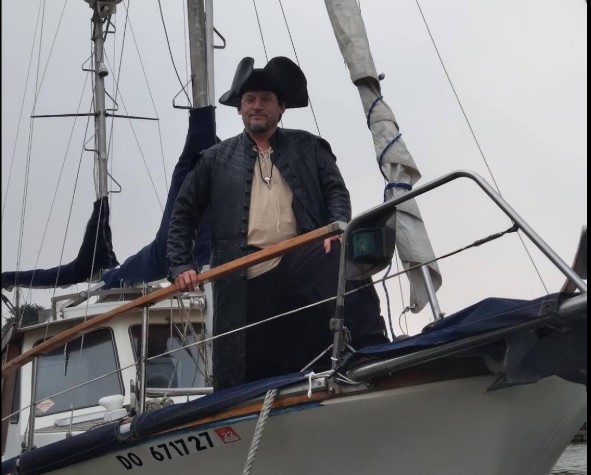
For Michael Spring, the sea was never distant. Even in Oregon, he lived an hour from the coast, often on his 33-foot Nauticat motor sailboat moored in Brookings, with his partner, the artist Jazmine Blu, “the captain.” There, he wrote, edited, and watched “otters and seals and blue herons” under a salt breeze. The sea taught him what Pessoa had called desassossego — the restlessness of being human, forever oscillating between the seen and the unseen. His fascination with Fado and Jazz — especially the collaborations of Carlos Paredes and Charlie Haden — reveals how he conceived poetry as music: improvisation within discipline, melody within solitude. “The Portuguese guitar,” he said, “transports me into another world, or further into this one.” In that sentence lies his aesthetic credo: poetry as immersion, not escape.

Michael Spring’s body of work — Blue Crow (2003), Mudsong (2005), Root of Lightning (2011), Unfolding the Field (2016), and Dentro do Som (2021) — constitutes a poetic ecology of connection. Critics praised him for uniting “earth and body wisdom” and for writing “medicine poems … sizzling and soothing our cluttered lives” . His verse often bridges animism and tenderness, grief and regeneration.
The “Blue Wolf” that Katherine Vaz heard howling in his lines is emblematic of his art: instinctive, untamed, luminous. He wrote of listening to the howl with the concentration of stitching a wound closed — a metaphor for the poet’s vocation: to heal through attention.
Michael Garcia Spring’s poetry occupies a crucial place in the genealogy of Luso-American writing — alongside Frank X. Gaspar, Lara Gularte, George Monteiro, Katherine Vaz, Alfred Lewis, Paula Neves, Carlos Matos, Marina Carreira, Sam Pereira, Amy Sayre Batista, Millicent Borges Accardi, José Luís da Silva, and others. Yet his voice also converses with Azorean predecessors — Pedro da Silveira, Natalia Correia, Álamo Oliveira, and Emanuel Félix — who saw in poetry a homeland without borders.
In an era of cultural dispersion, Spring reaffirmed that diaspora is not exile but expansion. His poems, crossing English and Portuguese, Oregon and Pico, present a model of belonging that is porous and inclusive. He reminds us that to be Azorean-American is to carry two winds: one from the Atlantic, one from the Pacific — both murmuring of return.
In the introduction to the Filamentos dedicated to Michael, I described him as “a clean soul, an extremely generous human, an excellent poet, and a dear friend.” Those who met him at Disquiet, at readings, or in quiet exchanges online attest to his humility and warmth. Poet Scott Edward Andersson, recalling their meeting at the Disquite Literary Residency, called him “my Azorean American poetry brother… we shared not just our heritage, but a deep love of our ancestral islands and poetry.”
To write about Michael Garcia Spring is to enter that brotherhood of sea and ink, where friendship becomes continuation and poetry, resurrection. His life — half on land, half on water — was a lesson in balance. His death leaves silence, but not absence. Like the otter in his poem, he pauses, noticing us from the mist, before disappearing into the tide.
In one of his last interviews, Spring said, “When I write, I draw deeply from the natural world… Being on the boat is relaxing. I like the smell of salt in the air.” That simplicity is his testament. He did not write for fame but for fidelity — to life, to heritage, to the fragile beauty of the earth.
His sound — dentro do som — continues in every poet who listens to waves as language, who sees in the volcanic stone the pulse of ancestry, and who, like him, believes that poetry can still be “a door in the river,” always open.
“There are endless vastnesses of sunny and snowy days without you, where the sea and the land hold the sound under the ecological weight of your vast absence.” — João Rasteiro, A Tribute to Michael Garcia Spring.
Let the Azorean diaspora in the United States and Canada take Michael Garcia Spring into its classrooms, parishes, Espírito Santo halls, university syllabi, book clubs, and family tables. Let his poems be read beside blue hydrangeas and dairy barns, on Pico’s dark stone and in California’s Central Valley, in New Bedford and Toronto alike. For his is the clarifying voice of truth in our community, the tide that braids memory to becoming.
If a people are to endure, they must keep a chorus of the living and the dead. Embrace Michael’s work as common patrimony and future map: teach it, translate it, stage it, sing it. In doing so, we guarantee that his compass—set to belonging—and his music—dentro do som—will keep guiding our children and our children’s children toward the generous horizon where islands and continents rhyme.
Diniz Borges, PBBI-Fresno State.
Sources:
- Millicent Borges Accardi, Interview with Michael Garcia Spring, Portuguese-American Journal (March 7, 2023)
- Filamentos, 12th edition (Feb. 2025), ed. Bruma Publications
- Dentro do Som / Inside the Sound (Companhia das Ilhas, 2021)

 Filamentos (artes e letras)