
Ships Without Direction
Amílcar Cabral (1924–1973)
Dispersed,
immersed,
alone on the Ocean . . .
Thirsty,
rocky,
bits of African notions,
from the black continent,
the abandoned daughters,
our island yachters,
navigate with sad countenance . . .
Like ships from long ago,
like ships
from old Portugal,
those whose entries
opened passage ways through the immense sea . . .
The ships
that ours discovered silently.
Into the wind, into the storm,
they navigate
Cape Verde are these island yachters,
the daughters
of the immensely prominent
and black continent . . . . . . . . . . . . . . . . . . . . . . .
They are ten caravels
in search of the Infinite . . .
They are ten caravels,
without sails,
Into the storm and into the wind,
they go . . .
they navigate somnolent
these island yachters,
the daughters
of the black continent . . . . . . . . . . . . . . . . . . . . . . .
—Where are you going ships of Hunger,
of Mornas,
of Dreams, and of Tragedy? . . .
—Where are you going? . . . . . . . . . . . . . . . . . . . . . . . . . .
Without direction or vision guiding it,
All alone,
dispersed,
immersed,
we go,
dreaming,
suffering,
in search of the Infinite! . . . . . . . . . . . . . . . . . . . . . . . . . .
[Mindelo, 1943]
Translation from Frederick C. Williams
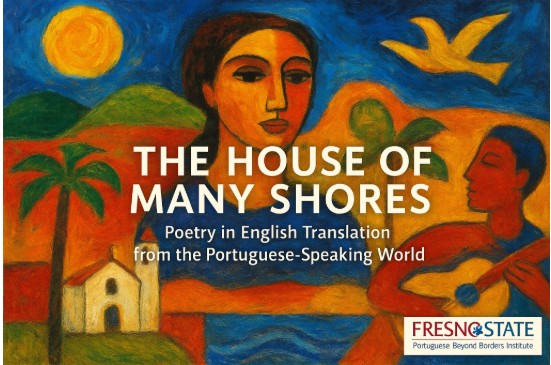
Some words build bridges, and some words build homes.
The House of Many Shores is such a dwelling — a place where the Portuguese language, scattered by winds of history and tides of migration, gathers under one roof. From Lisbon to Luanda, from Rio to Maputo, from the Atlantic islands to the shores of the Indian and Pacific Oceans, the Portuguese-speaking world carries a mosaic of voices: voices of longing and laughter, of exile and return, of memory and hope.
This series opens those doors to English-speaking readers, offering not just translations but acts of hospitality — poems that invite us to sit at the table of many lands, to hear the cadences of a language that has crossed oceans and centuries. In this house, every shore has its place, and every poem is a window to a different horizon.
Here, the sea does not divide; it connects. The language does not limit; it expands. And poetry, as always, reminds us that we belong to more than one place, more than one story, more than one world.
Vision
The House of Many Shores envisions a world where the poetry of the Portuguese-speaking universe — from Portugal to Brazil, from Africa to Asia, and across the diaspora — is heard, valued, and celebrated in English. By bridging continents through verse, the series aspires to create a shared cultural home where readers everywhere can experience the richness, diversity, and humanity of Lusophone voices.
Mission
The mission of The House of Many Shores is to gather, translate, and publish the poetic traditions of the Portuguese-speaking world in English, making them accessible to a global audience. This series:
- Preserves and amplifies the literary heritage of Lusophone communities.
- Builds bridges across cultures, continents, and generations through the universal language of poetry.
- Honors diversity, showcasing voices from Portugal, Brazil, Africa, Asia, and the diaspora.
- Inspires a sense of belonging, offering the Portuguese-speaking diaspora in North America and beyond a lyrical return to roots while inviting all readers into a shared poetic home.
We thank the Luso-American Education Foundation for its support of this project.
 Filamentos (artes e letras)