
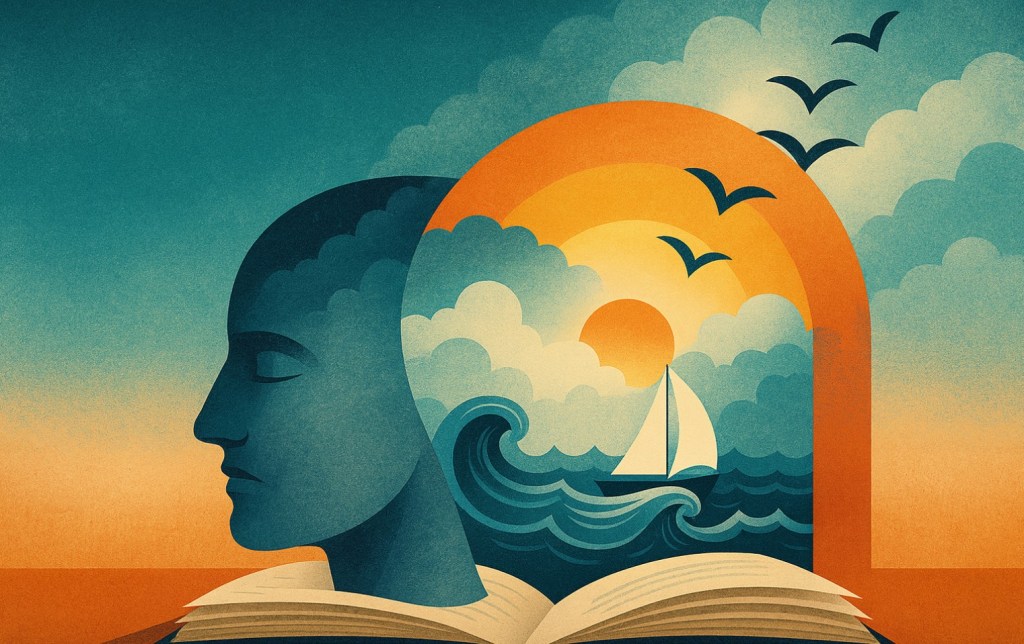
“Allegory comes when describing reality no longer serves us.”
— José Saramago
There are times when reality loses its pulse and language must invent a new heartbeat. That is when allegory arrives—quietly, like dawn reclaiming the shadows—and teaches us to see again. José Saramago lived in that interval between light and blindness, between the world as it is and the world as it could be if words dared to rebel. To read him is to be reminded that imagination is not an escape from reality, but a deeper entrance into it. It is fitting, then, that as we celebrate twenty-five years since Saramago received the Nobel Prize in Literature—the only Portuguese-language writer so far to do so—we return to his voice, not to canonize it, but to let it interrogate our own.
For me, Saramago has always been less a writer than a compass: one that points toward the moral north of language, where writing and being are inseparable. “I don’t just write,” he said, “I write who I am.” Few phrases better define the sacred labor of literature. And so, as we continue to honor the first and thus far only Portuguese writer to get a Nobel, I find myself once again turning to his words as parables through which to think about our Diaspora—its dreams and disillusions, its contradictions and small transcendences.
To declare oneself a reader of Saramago within the Portuguese Diaspora is, for some, an act of defiance. Some will see in it a provocation, or even a betrayal of their provincial certainties. Yet I have never asked permission to read freely, nor have I apologized for the writers who inhabit me. Reading, after all, is the most intimate form of citizenship: it binds us to the republic of conscience. Literature, unlike politics, does not ask for allegiance. It asks for depth, for empathy, for the capacity to imagine what the world might be if we truly saw it.
In that sense, literature has been a truer home, my truer home, much more than any flag or political party. It brings me joy when politics so often exhausts it. It opens the windows that ideology tries to close. Saramago’s confrontations—“words were not given to men to hide their thoughts”—are as urgent today as ever. And so, I write, as I have always written, refusing to hide my thoughts, knowing well that honesty is a kind of exile.
I have lived in California for more than half a century, within and alongside our Portuguese-American community – our Diaspora. It is a geography of belonging and estrangement, a landscape both physical and emotional. For years, I have studied, served, and questioned our Diaspora—its beauty, its limitations, its unfulfilled promise. I still recall a friend telling me, long ago: “Leave the community; it will consume you. You’ll never be successful.” But what, after all, is success? If success means surrendering one’s integrity for acceptance, then I prefer the solitude of those who persist in speaking truth.
Too often, our communities have been governed by vanity disguised as devotion, by mediocrity mistaken for service. “Personal selfishness, complacency, lack of generosity,” wrote Saramago, “the small cowardices of everyday life, all contribute to that pernicious blindness that consists of being in the world and not seeing the world.” I have witnessed that blindness in our Diaspora—leaders confusing applause with achievement, organizations confusing repetition with continuity. Many manage associations, clubs, even media outlets, as if they were personal fiefdoms. It is not governance; it is possession. And possession, like blindness, isolates.
We need fresh air, less sacristy mold, and more imagination. We need the courage to replace nostalgia with vision. Saramago reminds us: “If you can see, then see. If you can see, notice.” Too often, we have looked without noticing.
For years, I tried to nurture reflection within our organizations—to move beyond the merely ephemeral festivity and to think about what kind of community we were — and are — building. In one organization I belonged to and was on the board for over 15 years, I proposed retreats, seminars, and spaces to train leaders capable of dreaming beyond the horizon of tomorrow’s dinner-dance. I was told such ideas were “boring,” “unnecessary.” Reflection, it seems, is always tedious for those who fear mirrors. When I left, there was peace, they said. “Nothing was questioned. Everything ran smoothly.” So smoothly that the cultural heartbeat stopped. As Saramago warned: “Suddenly, the future became short.” Indeed, without thought, without renewal, our Diaspora shortens its own future every day.
We have sanctified nostalgia, confusing memories with paralysis. Our popular culture, as it is described, which once carried the perfume of survival, now risks becoming a museum of gestures. Meanwhile, our younger generations—educated, curious, multilingual—watch from a distance. Many visit our festas and, as one visits childhood home, with tenderness, but not with the intention of staying. Between the sanctuaries of the old and the silences of the young, our Diaspora drifts. Saramago foresaw it: “The best way to achieve universal exoneration is to conclude that, because everyone is guilty, no one is guilty.”
Yet I do not write from despair. I write from responsibility—the responsibility of those who still believe that constructive criticism is a form of caring. To question is not to destroy; it is to build with awareness. As Saramago observed, “Every day brings its joys and sorrows, and also its valuable lessons.” If pessimism is what remains when illusions are stripped away, then let us be noble pessimists—those who refuse to accept decay as destiny. “It is the pessimists,” Saramago said, “who change the world, for the optimists are always satisfied with everything.”
Our Diaspora will only endure if it learns to see itself not as a relic of emigration but as a living culture in translation — a culture capable of dialogue, innovation, and self-critique. The time has come to trade folklore for philosophy, celebration for contemplation, complacency for conscience.
“Our greatest tragedy,” wrote Saramago, “is not knowing what to do with the world.” Perhaps ours, on both sides of the Atlantic, is not knowing what to do with our Diaspora.
And yet, somewhere in the fog of the future, I imagine Saramago’s calm voice saying: “Do not despair. The sea is patient.” The Diaspora, too, is a sea — a vast, restless mirror of identities, always reshaping its shores. Between its tides of remembrance and renewal, there remains a quiet promise: that imagination can still carry us forward when institutions fail, that the written word can still find new homelands of the mind.
In that belief, I continue to write, as he did—not merely to describe, but to see. Not merely to remember, but to imagine. And in every word, to build, however humbly it may be, another bridge across the Atlantic mist.
*title inspired by one of José Saramago’s poems.
 Filamentos (artes e letras)