
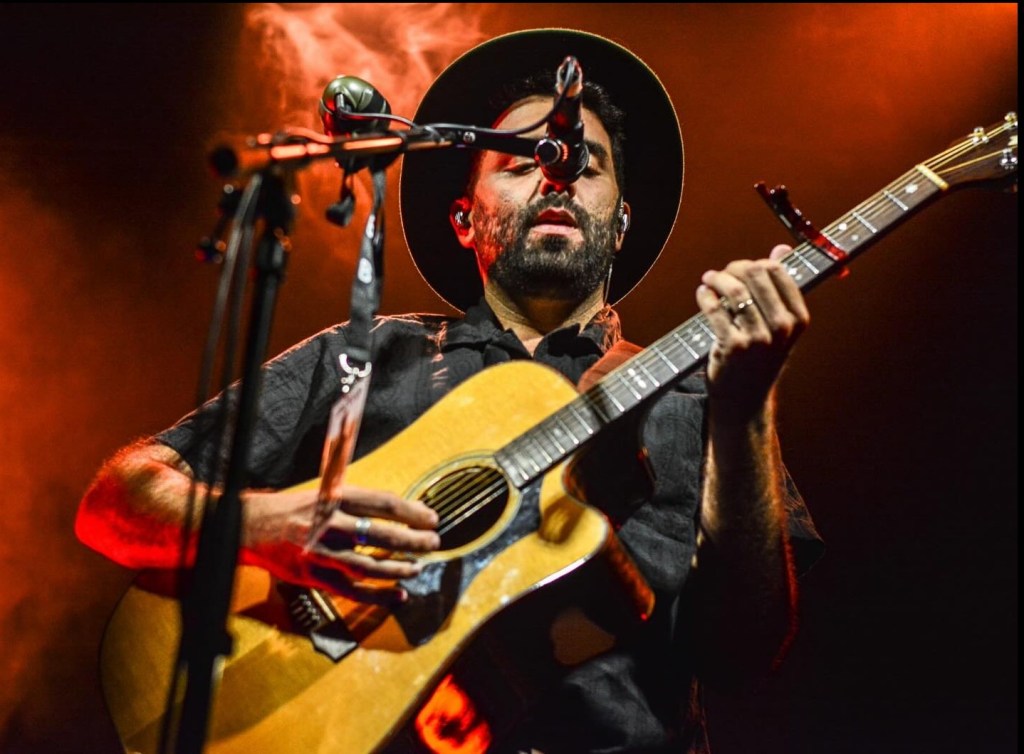
There are moments when reading becomes listening—when words on a page begin to echo like chords, and an interview becomes a song. As I read Cristóvam’s recent conversation with Diário Insular, which I translated for our literary platform Filamentos, I found myself once again immersed in the gentle urgency of his music. I played Desert of Fools softly as I translated, and the words seemed to flow with the rhythm of his voice. I realized then how often we in the diaspora see the Azores through the lens of nostalgia rather than through the lens of presence. We remember the islands as places left behind—beautiful, distant, mythical—but rarely do we recognize how vibrant, how young, how alive they are today. We forget that the Azores are not a museum of memory, but a living workshop of creativity—where musicians, poets, novelists, painters, and filmmakers are redefining what it means to come from the middle of the Atlantic.
Cristóvam is one of those luminous examples—a voice that belongs as much to the sea as to the century. His music carries both the clarity of wind and the weight of longing. From Terceira Island, he has built an artistic bridge between solitude and connection, between the intimacy of island life and the vastness of the world beyond it. His newest album, Desert of Fools, released this year, feels like a confession set to melody, a songbook of journeys and inner tides.
In his interview with Diário Insular, Cristóvam calls it his “most mature album yet,” explaining that it “combines 11 songs written throughout 2023 and 2024.” Recorded in Australia and produced by fellow singer-songwriter Tim Hart, Desert of Fools grew from both friendship and risk. “The title and concept,” he explains, “came from one of the songs on the album that shares the same name. This song reflects a duality that is very present in my life—the decision to make music professionally from the Azores. This choice brings with it the constant need to travel in order to work, and from this also comes the feeling of never being completely in one place.”
That feeling—of being between—is at the heart of both his art and the Azorean condition. “When I am in the Azores,” Cristóvam tells Diário Insular, “I always feel the urge to leave, because it is outside that my career takes place, but when I am away, I feel the desire to return, because it is in the Azores that my family, my friends, the sea, nature, and everything that defines me as an Azorean are.” He adds, beautifully, “I like to think of albums as time capsules that capture who I am at a given moment, and I feel that, in recent years, this duality has been an essential part of my life and my artistic identity.”
Listening to Desert of Fools confirms that truth. The songs shimmer with both clarity and ache, their tone shaped by distance yet rooted in belonging. It is an album about identity as movement, about home as both place and pulse.
Reflecting on his artistic journey, Cristóvam told Diário Insular: “Every day I learn something new, but it’s inevitable to look back at my first album, Hopes & Dreams, and realize how much I’ve matured since then, not only as an artist and composer, but also as a person.” He recalls that first work as a bold beginning—one where he “took on practically all the reins of production,” a process that taught him through trial and discovery. His second album, Songs on a Wire, produced remotely by Hart during the pandemic, was a turning point: “I felt that I had matured as a songwriter and developed a more critical eye on my own work. Over the years, I have always been very demanding of myself, and I believe that every song I have written and every album I have recorded has been another step on that path of growth.”
That path led, quite literally, across the world. In the same interview, Cristóvam recounts how his collaboration with Tim Hart began: “In 2017, I opened for two Australian artists in Portugal, Stu Larsen and Tim Hart. During those days, we talked a lot about producers, albums, and favorite artists, and we realized we had a lot of tastes in common.” From those few days grew two enduring friendships. “Two simple concerts gave rise to two great friendships,” he says. “A year later, Stu Larsen invited me to open his European tour, and Tim became a close friend, whom I talk to almost daily and with whom I ended up recording my last two albums.”
Recording Desert of Fools in Australia was a kind of pilgrimage. “The experience,” he tells Diário Insular, “was a dream come true. I took only the rough drafts of the songs with me and decided to finish them there, precisely so that this energy and context would be reflected in the sound and direction of the album. Working in person with Tim Hart was incredible, and I feel I learned a lot from the experience.”

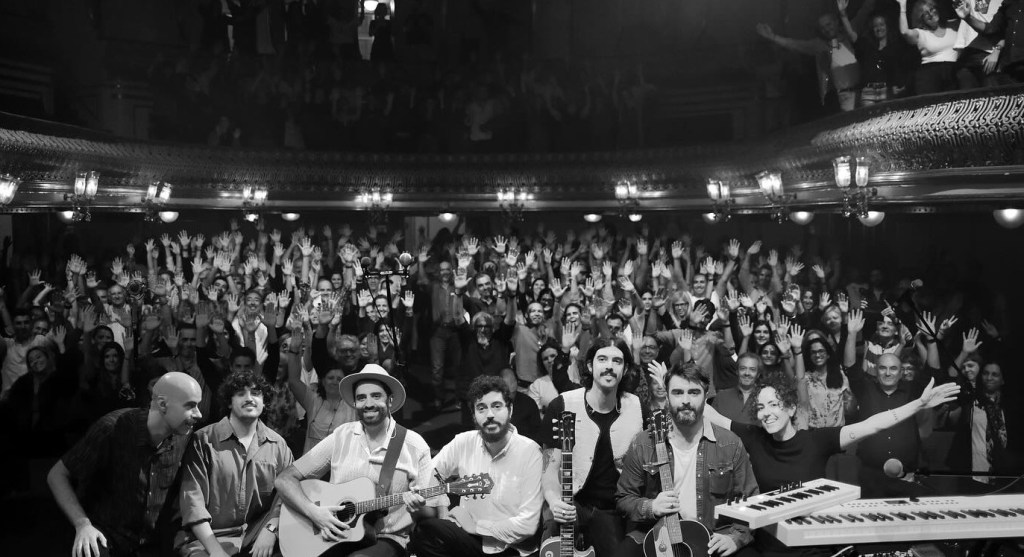
And yet, for all its global reach, Cristóvam’s music is still deeply local. His concerts at Teatro Angrense, nearly always sold out, have become something of a ritual. “Performing at home,” he says, “is always very special. No matter how many beautiful venues I’ve been lucky enough to play in, I always feel the affection of people here—it gives me a great sense of responsibility and the mission of continuing to deserve their support.”
That balance—between the island’s intimacy and the world’s expanse—is what makes Cristóvam such an important artist to bring to California. His music belongs in the same spaces where the Azorean diaspora planted its roots: the valleys of Tulare and Turlock, the orchards of San Jose, the coastal light of San Diego. A California tour would not only allow Azorean-descended youth to see that the islands are alive with creative fire, but also invite multicultural audiences to listen to the Atlantic in a new key.
For Cristóvam, as for the Azores, the journey outward is never a departure—it’s a continuation. His songs remind us that to travel is not to escape, but to understand. And as the Pacific wind carries new melodies westward, perhaps we too will learn to hear the modern Azores as they truly are: a constellation of voices, rooted in basalt, rising toward the world.
Cristóvam’s Desert of Fools is more than an album — it is a compass of song, a vessel of light crossing the ocean’s heart. Each melody is a current, each lyric a tide that carries both the solitude of the islands and the promise of their becoming. Between the cliffs of Terceira and the orchards of California, the same sea breathes — a living pulse of creation. And within that rhythm, the diaspora may listen anew, rediscovering not the echoes of an old homeland, but the new sounds of home: a home in constant creation and evolution, where music and memory intermingle, and where the Azores are not merely remembered but reborn — repeatedly — in every note that dares to cross the sea.
Photos from the artist’s Facebook Page from the album debut at Teatro Angrense in Angra do Heroísmo., Terceira island-Azores.


 Filamentos (artes e letras)