
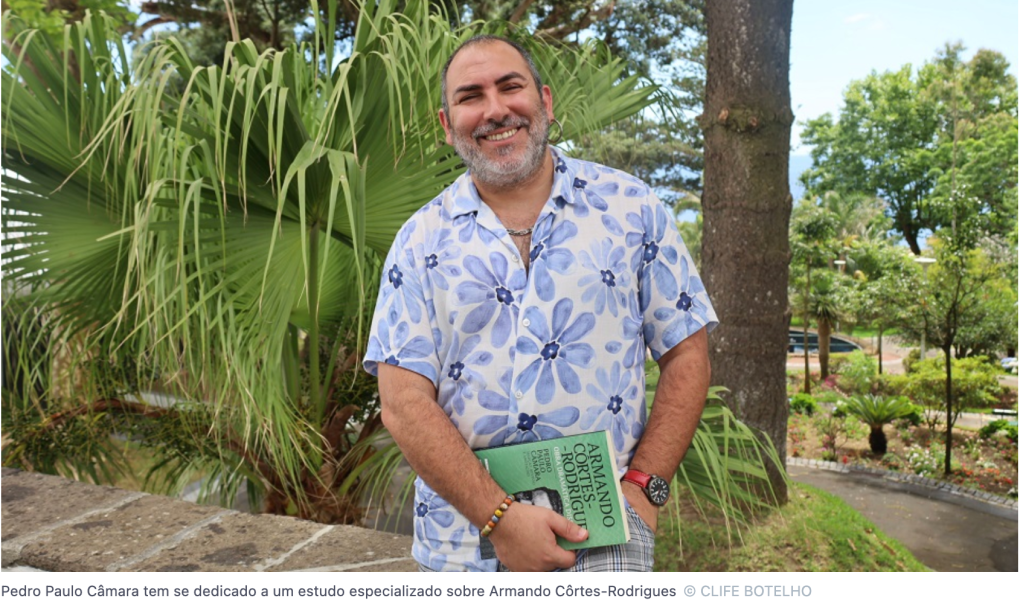
Teacher, researcher, and writer, Pedro Paulo Câmara is driven by a love of reading and a passion for writing. Born in the parish of Ginetes, in São Miguel, on August 9, 1980, he balances his professional life with a routine fueled by boundless energy.
Leaving Ginetes, Pedro Paulo Câmara came to meet us in the city of Lagoa. His availability reflects his commitment to preserving cultural heritage, where he is dedicated to rescuing the legacy of forgotten authors, such as Armando Côrtes-Rodrigues. The writer argues that it is a job to “do justice” to history and to ensure that memory is preserved.
He begins by revealing to Diário da Lagoa (DL) that his interest in reading and writing started in childhood, inspired by magazines his grandmother received at home, such as Reader’s Digest, and, above all, by a trunk of old papers he once found in the family attic. He deepened his love of writing during his teenage years and at university, but only published his first book at the age of 31, after a period he considered essential for his maturation. “There is no need to be hasty. Everything has its time,” he says.
Through his master’s thesis, Pedro Paulo Câmara devoted himself to a specialized study of Armando Côrtes-Rodrigues, a 20th-century writer who, according to him, was “definitely hidden.” The research resulted in the publication of the work Violante de Cysneiros: o outro lado do espelho de Côrtes-Rodrigues (Violante de Cysneiros: the other side of Côrtes-Rodrigues’ mirror).
Passion drives his intense routine, and he confesses to our newspaper that he sleeps very little because his brain is always generating new ideas. He usually organizes his thoughts during his 30-kilometer commute to work and on his way home, which he considers “highly therapeutic.”
Influenced by his dedication to scouting, he confesses: “I don’t have many fears and I like new challenges.”
DL: How do you introduce yourself when you are off the island?
When people ask me where I’m from, I always say I’m from the Azores before saying I’m from Portugal. I feel that this fuels people’s magic and curiosity. I am Azorean in body and soul, constantly evolving. I have within me the tranquility of the Sete Cidades lagoon and the energy of Ferraria.
DL: You published your first book at the age of 31. Is maturity crucial for a writer?
I don’t think there’s any need to rush things. Everything has its time. In my case, I needed a period of maturation, and I still do. I am an author in constant development. If you ask me if my first book is my best, of course it isn’t, but it was the most important. It gave me the courage to face the public and a possible “no” from a publisher.
DL: Part of your work focuses on researching Azorean authors. Why?
It’s a way of doing justice. The only way to survive death is to remain alive in the memory of others. Authors such as Armando Côrtes-Rodrigues were, in fact, lost. My job is to bring that legacy into the modern age. I wanted to take his literary production out of obscurity and reveal it to the public, as I did with Violante Cysneiros: Obra reunida (Violante Cysneiros: Collected Works), or, as happened recently with Armando Côrtes-Rodrigues, Obra Dramática Dispersa (Armando Côrtes-Rodrigues, Dispersed Dramatic Works), which brings together the author’s unpublished dramatic texts.
DL: We already know that you have an intense routine. Where does all this energy come from?
The driving force behind all this is passion. It’s the only thing that’s possible. I am deeply passionate about everything I do. The only way I can rest is by writing down the ideas that come to me at night, so they don’t keep running through my head.
DL: Nowadays, we are connected to new technologies. How does that affect who you are? I think everything should be put into perspective. In the 80s and 90s, not having technology didn’t affect me at all. Today, computers and cell phones are vital for teaching, producing books, staying in touch with the world, and conducting research. I use them as an ally. I promote my work through social media, which is also a good tool. I try not to be dependent, but it’s not always feasible. We often find ourselves mindlessly scrolling or lost in a sea of reels. I remember my first cell phone, my first computer, and my typewriter. The truth is that I only had a typewriter when I went to university and a computer in my second year. In my first high school assignments, we used tracing paper. Nowadays, for elementary school assignments, there are already three thousand different strategies, ranging from PowerPoint to Prezi. Many things have changed, but I liked living at that time without all this access. It made me develop important skills.
DL: And is that reflected in your writing, for example?
Yes, without a doubt. My writing reflects my way of seeing the world.
DL: Do you write with a pen or a keyboard?
I prefer to write with a pen, in a notebook, when it’s prose or poetry. For research, involving numerous PDFs and open bibliographies, I write on the keyboard.
DL: How do you see young people’s relationship with reading today?
A large part of my students have an almost natural aversion to reading and only read the works they are required to read and that are presented in the curriculum. I believe that the responsibility for encouraging reading lies not only with the school, but also with the family. Often, a student gives up reading because the required book doesn’t interest them, and they haven’t yet discovered a genre or author that sparks their love for reading.
DL: As long as there are readers, there is hope? What is your message to those who care about culture?
Yes, “as long as there are readers, there is hope.” Authors are working towards this, and I am one of them.
In Diário da Lagoa, Clibe Botelho-director
Eis a ligação para a entrevista em português
 Filamentos (artes e letras)