

The city of Lisbon awoke on October 5, 1910, to the sound of transformation.
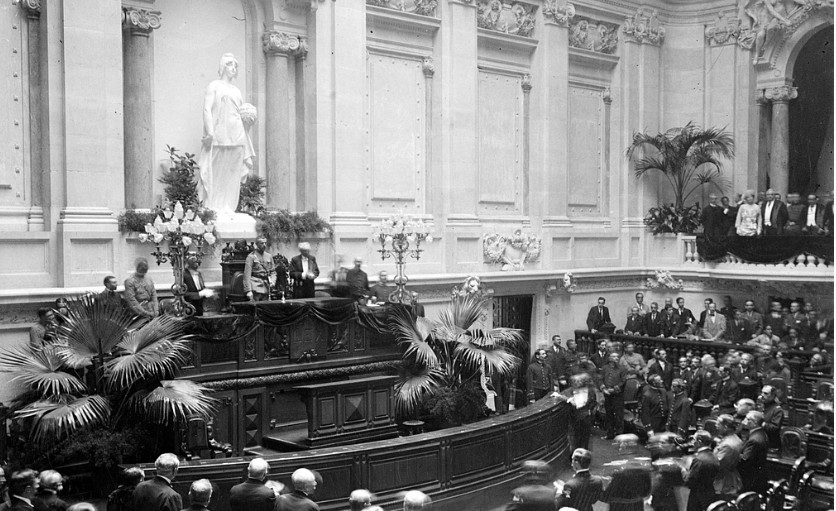
On the Praça do Município, a crowd surged, eyes fixed on the balcony from which history would soon lean forward and proclaim: “Proclama-se a República!” The green and red flag climbed slowly into a light that seemed to come from another century. Bells rang, but not for Mass; they rang for citizenship. And in that sound—metallic, defiant, exhilarating—the people of Portugal felt, if only for a moment, that history could be rewritten in their own tongue.
The First Portuguese Republic was born of exhaustion and idealism. The monarchy had become a fossil of empire, a gilded echo of vanished empires. The royal household was distant, debt-ridden, and surrounded by clerical privilege. The assassination of King Carlos I in 1908 revealed a country already trembling beneath the weight of itself. “Portugal was a nation dying of monarchy,” wrote the republican intellectual Teófilo Braga, who would become the first provisional president; “and only the Republic could restore its moral pulse” (Braga, A República Portuguesa).
In those first breathless months, Portugal’s new republic declared itself the dawn of reason. It dismantled the state’s alliance with the Church, abolished religious orders, secularized education, instituted civil marriage, and envisioned a lay nation governed by science, not superstition. Historian Douglas Wheeler called this moment “the boldest experiment in secular republicanism south of the Pyrenees” (Wheeler 143). The Republic sought to transform subjects into citizens, replacing kneeling with standing and faith with instruction. Nevertheless, like all dawns, it was short-lived.
The First Republic (1910–1926) was at once luminous and chaotic. It promised a rational, just society but was haunted by its own human frailty. Within sixteen years, Portugal experienced nine presidents, forty-five governments, and numerous insurrections. Still, the Republic’s progressive imagination was extraordinary for its time. It expanded education, promoted civic literacy, and affirmed the equality of citizens before the law—ideas that would later underpin the democratic constitutions of 1976 and the European Union’s Charter of Rights.
However, progress invites enemies. The Republic’s secular zeal alienated conservative peasants; its anticlerical measures enraged the rural Church; its political infighting exhausted the middle classes. Historian António José Telo called it “a Republic of light surrounded by a sea of shadows” (Telo 219). The idealism of Afonso Costa, who thundered that “the Church must be torn from the state as weeds from a garden” (Costa, qtd. in Saraiva 87), created as many martyrs as disciples.
Still, its moral ambition endures. In an era when women in much of Europe remained voiceless, the Portuguese Republic debated the issue of suffrage and educational equality. Feminist pioneers like Ana de Castro Osório and Carolina Beatriz Ângelo—the latter becoming the first woman to vote in Portugal in 1911—embodied the Republic’s daring redefinition of citizenship. Theirs was a Portugal intoxicated with modernity: railways, telegraphs, newspapers, the electricity of belief in the future. The Republic was a poem of brass and ink, a declaration that reason and justice could become national character.
However, the music faltered. The Great War drained the treasury and the soul; inflation rose, coups multiplied. By 1926, the republic had collapsed under fatigue, paving the way for the long authoritarian night of the Estado Novo under Salazar. If monarchy had suffocated Portugal’s past, dictatorship would suffocate its future.
Why revisit that morning of October 5, 1910, now—one hundred and fifteen years later—when democracies tremble once again? Because the questions that haunted the Republic then haunt us still:
Can progress survive polarization? Can reason survive resentment? Can democracy withstand the fatigue of its own citizens?
Today, both Portugal and the United States, countries separated by an ocean but joined by democratic aspiration, stand in uneasy reflection. The paradox is painful: the First Republic looked forward with audacity; our modern republics, though more stable and wealthier, often look backward in fear.
In the United States, political scientist Barbara F. Walter warns of “a pre–civil war level of division” where democratic erosion occurs not in coups but in “the slow normalization of hate and lies” (How Civil Wars Start 27). In Portugal, the rapid rise of the far-right party Chega—now the country’s second-largest parliamentary force—signals that the antibodies of 1974’s Carnation Revolution are weakening. As political analyst Luís Aguiar-Conraria observed, “Chega speaks the language of despair that the Republic once sought to cure” (Aguiar-Conraria, Público, 2025).
The danger lies not only in extremism but in complacency—in what the historian Timothy Snyder calls the “seduction of safety,” when citizens trade the burden of thought for the comfort of obedience (On Tyranny 43). In Portugal, segments of the center-right now “pay lip service” to Chega, flirting with its rhetoric of exclusion under the guise of pragmatism. In the United States, leading politicians normalize conspiracy and rage as legitimate political speech. The disease is the same: the corrosion of civic imagination.
The First Republic was born in a time of faith in progress. The twenty-first century, by contrast, is an age of fatigue and irony. Where Braga saw “a moral resurrection of the people,” we see algorithmic cynicism. Where Afonso Costa sought to liberate minds from clerical dogma, we now bind them with digital ones.
In 1911, the Republic’s new constitution enshrined universal male suffrage, abolished hereditary titles, and proclaimed education as “the highest duty of the state.” It was imperfect but aspirational. One can almost hear echoes of the Enlightenment in its cadence: “The sovereignty resides in the nation, and all powers derive from it.”
Contrast this with the rhetoric of our time. Across the Atlantic, American democracy—once considered the temple of republican virtue—is fractured by its own myths. George Packer has written that “the American republic is dying of loneliness, its citizens atomized, and its truths replaced by tribes” (The Atlantic, 2021).
What the First Portuguese Republic attempted, in its fragile way, was precisely the opposite: to forge a common truth through education and secularism, to replace superstition with civic knowledge. Its leaders, though often naive, understood that without shared narratives, no nation endures.
In both countries today, we confront a crisis of imagination. Facts are drowned by emotion; truth becomes elective. The Portuguese republicans feared clerical domination; we now face algorithmic domination. The pulpit has become the platform; sermons have become tweets.
Portugal’s political turbulence echoes a global pattern. The 2025 elections saw the governing Democratic Alliance win narrowly, while Chega surged to unprecedented influence, capturing disillusioned youth and rural voters. In speeches, party leader André Ventura invoked “a forgotten people” and accused elites of betrayal—a rhetoric chillingly like populist appeals in the U.S. and Europe. As The Atlantic Council observed, “Portugal’s rightward shift is not an anomaly but part of a continental current eroding the postwar consensus” (Atlantic Council, May 2025). The irony is cruel: the First Republic sought to emancipate citizens from tutelage; our modern democracies, by their own fatigue, risk reentering it.
Every republic, said Afonso Costa, must choose “between virtue and corruption, between education and ignorance.” The First Republic chose virtue but was unable to sustain it. Its leaders believed the people could be educated into citizenship, but their methods were too swift, their reforms too radical for a largely rural, illiterate society. Nevertheless, in failure, it left moral residue. Its secular schools, civic holidays, and belief in debate as a civic duty became the DNA of modern Portuguese democracy.
We might read the Republic as a parable: that democracy requires not only revolution but maintenance. The poet Sophia de Mello Breyner Andresen would later write, “A liberdade é o espaço do homem” (“Freedom is the space of mankind”). However, that space must be swept, repaired, and defended on a daily basis.
In the United States, constitutional scholar Cass Sunstein reminds us that democracies “die not by assassins but by apathy” (Can It Happen Here? 11). In Portugal, historian Raquel Varela warns that the “moral legitimacy of April [the Carnation Revolution] fades when social inequality deepens and extremism feeds on despair” (Varela, Diário de Notícias, 2024).
These warnings converge. Democracy cannot live on ritual alone. When its language becomes procedural instead of poetic—when citizenship is reduced to bureaucracy, its heart slows. The First Republic, despite its flaws, never lacked poetry. Its decrees were written with faith in the future tense. Today, we need that tense again.
It is worth recalling that the republican impulse was transatlantic from the start. The Portuguese revolutionaries read Rousseau and Jefferson, Voltaire and Lincoln. They saw in America’s 1776 a precedent for their 1910—a shared rebellion against dynastic fatalism.
However, 115 years later, the current flows in the opposite direction. Portugal, with its still-young democracy born in 1974, watches the United States struggle to defend institutions once envied by the world. The January 6, 2021, insurrection at the U.S. Capitol bore a tragic resemblance to the barricades of Lisbon—but reversed in meaning. Where the 1910s revolt sought to create a republic, 2021’s mob sought to dismantle one.
“History,” wrote Eduardo Lourenço, “is a mirror that often returns not our face but our wound” (O Labirinto da Saudade 76). To look into the mirror of 1910 today is to see both the beauty of belief and the peril of forgetting.
In Portugal, movements like Chega exploit the forgetting of nostalgia without history, patriotism without ethics. They mimic the Republic’s populist tones, “the voice of the people”—but drain them of moral substance. Their rhetoric is a hollow inversion of the ideals once proclaimed on Lisbon’s balcony. In the U.S., similar demagoguery appeals to grievance, baptizing resentment as “truth.” Across democracies, we witness a counter-enlightenment dressed in populist robes: a retreat from complexity toward the simplicity of rage. Thus, we return to the metaphor: the Republic as a lantern in the storm.
In 1910, that lantern burned with faith in humanity’s capacity to think, to educate, to debate, to become better. Its flame was literary as much as political: its heroes were professors, journalists, poets. Teófilo Braga believed literature itself was a moral instrument; “the Republic,” he wrote, “is not a form of government but a form of conscience.”
What would he see today? Screens that blind instead of illuminate, parties that invoke the people but fear their thoughts, and a public sphere where words are weaponized. Nevertheless, perhaps he would still hope.
Because the lesson of 1910 is not only that revolutions die, but that they leave embers. Every act of education, every poem that refuses despair, every civic conversation that resists cynicism, is a continuation of that Republic. In both Portugal and the United States, the challenge is not merely to restore civility but to restore moral imagination—the ability to see one another not as adversaries but as co-authors of a shared narrative. The Republic of 1910 imagined a secular faith in progress; our century must imagine a spiritual faith in democracy itself.
Lisbon again, but now in memory. The red and green flag flutters over the Praça do Município, and the bronze effigy of Teófilo Braga looks toward the Tagus, perhaps wondering whether the dream he helped ignite still burns. The city moves on—trams ring, tourists laugh, cafés hum—but beneath the cobblestones lies the tremor of that October morning. Every republic is provisional. Every democracy is a daily plebiscite on decency.
As the Portuguese poet Mário de Sá-Carneiro wrote in 1912, “Tudo é instável e tudo se renova” (“All is unstable, and all renews itself”). To renew democracy, we must believe again in renewal itself.
So let the lantern of October 5 be relit—not in marble monuments, but in classrooms, in conversations, in the courage to disagree without hate. Let the flame of reason, once kindled on the banks of the Tagus, travel across oceans of division and illuminate again the frail architecture of our own republics. For if the First Republic taught us anything, it is that progress is not a destination but a discipline, not a monument but a movement of conscience.
May that conscience, though battered by time, still rise like a banner in the Atlantic wind.
Works Cited
Aguiar-Conraria, Luís. “O perigo de banalizar o extremismo.” Público, 2 May 2025.
Atlantic Council. “Portugal’s Shift to the Right Is Accelerating—What Does That Mean for Its Future?” New Atlanticist, May 2025.
Braga, Teófilo. A República Portuguesa: Ensaios de Filosofia Política. Lisboa, 1911.
Costa, Afonso. Quoted in Saraiva, José Hermano. História Concisa de Portugal. Lisboa: Publicações Europa-América, 1993.
Lourenço, Eduardo. O Labirinto da Saudade: Psicanálise Mítica do Destino Português. Lisboa: Gradiva, 1978.
Packer, George. “The Four Americas.” The Atlantic, July 2021.
Snyder, Timothy. On Tyranny: Twenty Lessons from the Twentieth Century. New York: Tim Duggan Books, 2017.
Sunstein, Cass R., ed. Can It Happen Here? Authoritarianism in America. New York: HarperCollins, 2018.
Telo, António José. Portugal Contemporâneo: Do Liberalismo ao Estado Novo. Lisboa: Presença, 1990.
Varela, Raquel. “A desmemória de Abril.” Diário de Notícias, 22 Apr. 2024.
Walter, Barbara F. How Civil Wars Start and How to Stop Them. New York: Crown, 2022.
Wheeler, Douglas L. Republican Portugal: A Political History 1910–1926. Madison: University of Wisconsin Press, 1978.
 Filamentos (artes e letras)