
IT IS THE HOLY SPIRIT THAT ARRIVES TO BLESS YOU!
May 2023. We live in the time of Pentecost, the festive celebration of praise and love for the Divine Holy Spirit. On Sunday, May 28, across all nine islands of the Azores and throughout all the communities of the Azorean diaspora, a unison cry crossed borders and geographies: “Long live the Lord Holy Spirit!”
The celebrations of the Divine Holy Spirit begin in the lands of Santa Catarina. The festive atmosphere takes hold of Florianópolis from Pentecost Sunday until September 28, when the festivities conclude. The opening of the Ciclo do Divino on May 13 marks the start of the celebration. The raising of the Holy Spirit’s flag, the blessing of the crowns and the small Holy Spirit breads, and the procession of communities from Florianópolis and neighboring municipalities through the streets of the historic center convey the joy and respect of our people for a tradition that represents the sense of belonging to a cultural heritage of 275 years.
The bustle is immense in the fourteen localities where the festival is held with great cultural and religious expression: in downtown Florianópolis, Ribeirão da Ilha, Monte Verde, Trindade, Rio Tavares, Prainha, Pântano do Sul, Lagoa da Conceição, Barra da Lagoa, Campeche, Rio Vermelho, Santo Antônio de Lisboa, Canasvieiras, and Estreito. At the Chapel of the Holy Spirit, the official opening of the festivities took place on Thursday, May 25, with words from the Provedor Paulo do Vale Pereira and from the Festival Couple, Marcello and Judite Petrelli, who emphasized in their speeches the historical and social importance of the Brotherhood (Irmandade) and highlighted the program of the 247th Divine Festival and the 250th anniversary of IDES. Praiseworthy is the path of generations of Brothers who keep alive the ideals and commitments made in the past in the name of the Holy Spirit. The media are generous in covering the traditional festivity, reporting on a legacy built since the arrival of the first Azoreans.
A glance at the past reveals countless records in the Desterro press, such as in the May 23, 1858 edition of the newspaper Santelmo, which announced the novenas of the Holy Spirit and the upcoming festival promoted by IDES. Editor J. J. Lopes described in the editorial the grandeur and pomp of the event: “And it could not be otherwise, because the Emperor, besides being a man of ample means, has good taste; he is proud and anything but stingy; therefore, we will have flies by the string and mosquitoes by the wire.”
The English traveler, Pastor Charles Stewart, in May 1853, was astonished at the Holy Spirit Festival in Desterro: the enthusiasm of the faithful singing the novena, the arrival of the red flag with the white dove, the singing of the foliões, the raffles of gifts, the loud band, the fireworks, the opening of the Empire and the coronation of the Boy Emperor, and the Brotherhood dressed in red silk cloaks. In his detailed account, included in his work Brazil and La Plata (New York, 1853), he comments with irony: “Under the blasphemous title of Emperor of the Holy Spirit, he presides in burlesque majesty over this feast and is treated with special honor by all the people during his time on the throne.” (Gerlach, 2010, p. 216).
I could continue citing newspapers from Desterro and today, authors such as Virgílio Várzea, Cruz e Sousa, Lacerda Coutinho, Horácio Nunes Pires, Bento Águido Vieira, Henrique Fontes, Osvaldo Cabral, who dedicated themselves in their narratives to the traditions of the Holy Spirit, a legacy carried across the seas and one that remains more alive here than ever. From the 20th and 21st centuries, we find this secular tradition in the novels of Othon d’Eça, the novel Marcelino by Godofredo Neto, the columns of Moacir Benvenutti, Aldírio Simões, Juliana Wosgraus, and the unsurpassed chronicles of Sérgio da Costa Ramos, who, like the Flag of the Holy Spirit, always moves forward as a true herald of this centuries-old devotion and of our Azorean cultural identity.
Years ago, in my arduous and passionate pursuit of the cultural heritage of our 18th-century Azoreans and, especially, of the Holy Spirit Festivals (in fact, I still dream of attending the great Holy Spirit Festivals of New England, about which I have heard so much since the time of the late Heitor Sousa, its founder), I wrote an email to the Azorean writer, colleague, and dear friend Onésimo Teotónio Almeida with a series of considerations and questions. With patience greater than Job’s, he replied: “Lélia, you have there a good example, the festival of the Holy Spirit, to confirm that culture is carried, consciously or unconsciously, in people’s habits and customs, and that adults, when emigrating, already have them structured and internalized. They carry all of this under their skin.”
I need to add nothing more and return to the present, to the Holy Spirit Festival held in the parish of Ribeirão da Ilha, Monte Verde, and the central region of the capital, from May 25 to 28. The program recalled from the past differs little from the Holy Spirit Festival of Florianópolis in 2023, celebrating the 250th anniversary of the Brotherhood of the Holy Spirit/IDES, founded on June 10, 1773, and the first Holy Spirit Festival, held in 1776, the oldest in Santa Catarina. It was only in 1806 that the first festival with a coronation took place, with the Azorean Captain Manoel Francisco da Costa being crowned.
Entering the Chapel of the Holy Spirit on Pentecost Sunday, May 28, 2023, beautifully decorated with flowers, flags, banners, and the ornaments of the Holy Spirit, to the sound of the popular song A Bandeira do Divino by Ivan Lins, I was overcome with great emotion. I could not hold back the tears that blurred my vision. As I walked in the IDES procession, I remembered the Festival of May 26, 1996, when my husband, Sebastião Ivan Nunes, and I were the Festival Couple of that year, taking on the commitment to revive the popular festivities, bringing back the stalls and bands to Getúlio Vargas Square, which had not happened for thirteen years. Since 1983, the Brotherhood, in its mission of safeguarding devotion and the festival of the patron, had maintained the terms of its Commitment: the celebration of religious acts, the procession and coronation, the distribution of the promise breads, and the small breads of the Holy Spirit’s gifts. The participation of the people of Florianópolis in the traditional festival was surprising, representing a significant part of our social and cultural memory.
Sérgio da Costa Ramos, in his column in Diário Catarinense, May 28, 1996 edition, in the delightful chronicle Barraquinha do Divino, expressed his satisfaction with the revived tradition: “This whole festival has just been revived, which is worthy of sincere rejoicing. The ‘barraquinhas’ of the Divine, a variation of the ‘raffle of gifts’ of which tradition speaks to us, have also been resurrected. Hallelujah. The ‘barraquinhas’ of the Divine, there in Getúlio Vargas Square, next to the Little Church of the Holy Spirit, are part of my dearest and most treasured potpourri of childhood and youth memories. (…)”
The transformations resulting from the festival’s dynamism, increasing urbanization, inevitable cultural change, and adaptation to modern times have not caused substantial alterations in the way the Holy Spirit is celebrated. Each year, the dove of the Divine Holy Spirit pours out its gifts and blessings upon our good people. Such a vibrant and grand cultural tradition as an identity marker is protected and recognized as Intangible Cultural Heritage of Santa Catarina and, at the municipal level, in some cities of Santa Catarina, such as Florianópolis, São José, Jaguaruna, and Paulo Lopes. On Santa Catarina Island and along our coast, we uncover worldviews in spatial compositions illuminated by the strength of faith and celebrations in praise of the Divine Holy Spirit, the ID of our cultural identity. Beliefs and devotion persist in the kissing of the dove atop its mast, in the cutting of its ribbons kept in the hope of receiving the Holy Spirit’s grace and the blessing of its gifts. Beliefs that have traversed time and generations, surviving in the same spirit of sharing and faith. The Divine Festival of 2023 of IDES arrived with the attire of modern times, and the dove of the Holy Spirit in the contemporary art of the artist Luciano Martins highlights the renewal of faith, love, and hope. Once again, the community responded to the invitation of IDES and the Festival Couple. Its participation in the Divine Festival – The Family Festival was immense, strengthening the tradition and recognizing the importance of the Brotherhood of the Holy Spirit, a model institution whose mission is the holistic education of the human being, working in the care and development of children and adolescents. It develops four major programs, divided by age and socio-pedagogical activities: São Vicente de Paulo Home (children from 0 to 6 years old whose rights have been violated); Girassol Early Childhood Education Center; EducArte; and Apprentice Training – learning, professional qualification, and integration into the labor market. IDES directly assists an average of 800 children and adolescents daily.
At the solemn mass of Pentecost Sunday, during the coronation of the Boy Emperor, witnessed by the community of Florianópolis and IDES, the Festival Couple, Marcello and Judite Petrelli, were moved as they felt the force of our Azorean history in the renewal of Queen Saint Isabel’s promise, made 702 years ago in Alenquer. A promise that is fulfilled and gains strength in the geography of the Azorean world with each new coronation of the Holy Spirit. It is the rekindling of layers of a past in the Azorean Islands of our time travelers, or the illumination of the present and the future I envision on the liquid horizon made of sea and dreams.
So, in this radiant May of 2023, how about singing in an infinite choir of voices?
Let the flag pass, let the flag enter
It is the Holy Spirit, arriving, arriving to bless you.
Santa Catarina Island, May 30, 2023
Translated by Diniz Borges
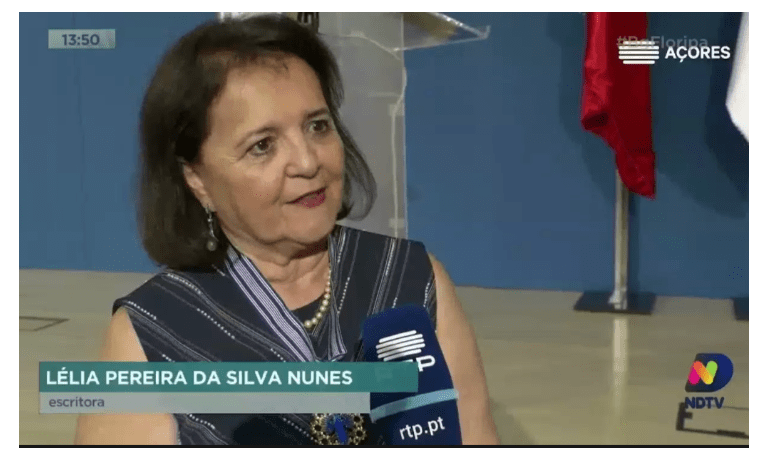
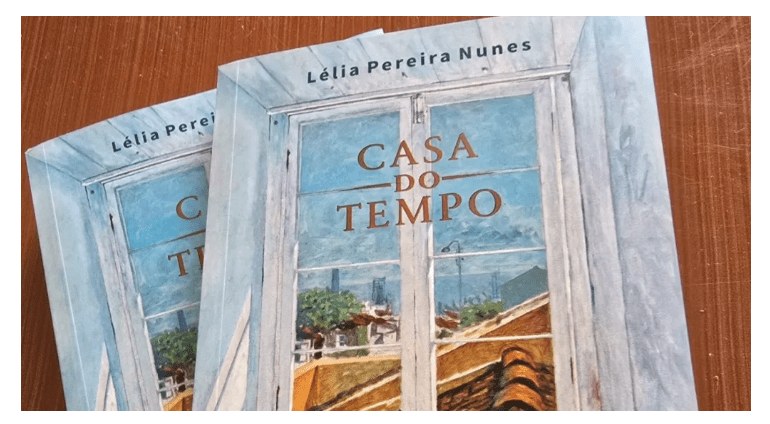
Filamentos is pleased to publish a chapter from Lélia Pereira Nunes’ new book, Casa do Tempo, every few weeks. We are delighted to publish these translations as part of our vision/mission statement: to be a voice for the Global Azorean Diaspora. Brazil has, for many centuries, been an important aspect of the Azorean Diaspora. It is time that we all know each other, regardless of where we live. We thank Lélia Pereira Nunes for the opportunity to translate her important work.
 Filamentos (artes e letras)