

República (A) – Newspaper
A daily newspaper in Ponta Delgada, entitled A República. Diário da Manhã began circulation on April 4, 1911, continuing a previous project of the same name that had started in 1910.
Carlos J. Borges was its chief editor until July 1911, when Miguel S. Alvim took over that role. Until January 1912, C. d’Oliveira was the editor; Jacinto S. Cardoso took over thereafter. From June 1912 to an unspecified date, Mira Saraiva served as administrator until H. Vasconcelos assumed the administration. In June 1914, Francisco Luís Tavares took over the management of the newspaper, with the name Alvim disappearing, but Jacinto Cardoso remaining as editor. In May 1919, following Francisco Tavares’ election as deputy, Carlos C. Rodrigues temporarily assumed the role of director. In October of the same year, J. Cândido Teixeira’s name appeared in that position.
Owned by the company that published the newspaper A República, it was printed and typeset in its own printing house at Rua da Fonte Velha, no. 49, the same address as its editorial and administrative offices.
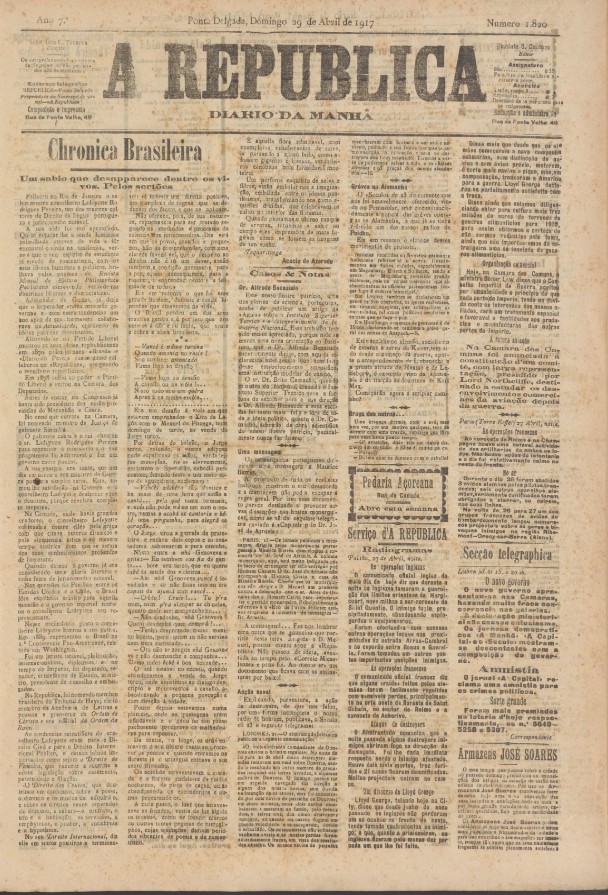
In terms of graphics, the newspaper underwent only one major aesthetic and structural change in October 1919, when it “completely recast its typographic material, presenting […] a magnificent appearance, enhanced by the creation of new sections and the remodeling of the old ones.”
In its presentation, it was described as a newspaper “completely recast, printed in its own workshops, with a new editorial team” and, compared to its predecessor, it stated that “our daily newspaper has almost nothing in common with the bi-weekly newspaper that was published there”. Founded just six months after the establishment of the republican regime, it appeared “out of necessity of the environment and the moment,” solely for the “republicanization of this district.” Its objective was “to serve with loyalty and sacrifice […] the cause of the Fatherland and the Republic,” always accompanying the “growth of Portuguese democracy” and the “legitimate interests of this beautiful land of São Miguel.”
Many topics were covered in its pages. The implementation of the republican regime on the island of São Miguel, the Law of Separation, considered the ideal weapon to combat clericalism (“manifestation of international banditry”), the popular demonstrations in São Miguel in favor of the Republic and against the Clergy (“vivo protesto contra o maior inimigo da nossa independência ? the clerical reaction”), the unfolding of World War I, describing submarine attacks on the coast of the island of São Miguel, for example, or commenting on the fact that the newspaper’s typographers had been called up for preparatory military training…
In fact, its pages reveal the evolution of republican parties and ideals, a vicissitude that affected the newspaper’s own stance. In April 1916, when celebrating its sixth year of existence, A República drew attention to the fact that “when the parties differed and the work accomplished was not such as to obtain the solidarity of all republicans, having exhausted all means of conforming to our conscience, we marked our place alongside the Republican Union.”
A República ended with issue 2,688, dated April 4, 1920. The reason for this end was due to “circumstances of a general and particular nature,” with its editor stating that he had a “vehement desire” to take refuge “in the theoretical field of principles, where all their moral beauty stands out, a growing inhibition of the will to appreciate the political facts that unfold.” At the time of its farewell, the newspaper expressed “an indecisive feeling of disappointment and liberation” after nine years of “struggle and faith, lived day by day in the communion of an ideal,” in the firm belief that “republicanism and democracy are an imperative requirement of our spirit and our moral formation.”
by Ana C. Moscatel Pereira
Bibl. A Republica (1911-1920), Ponta Delgada.
 Filamentos (artes e letras)