
“Humanism, Freedom, and the Unfinished Future”
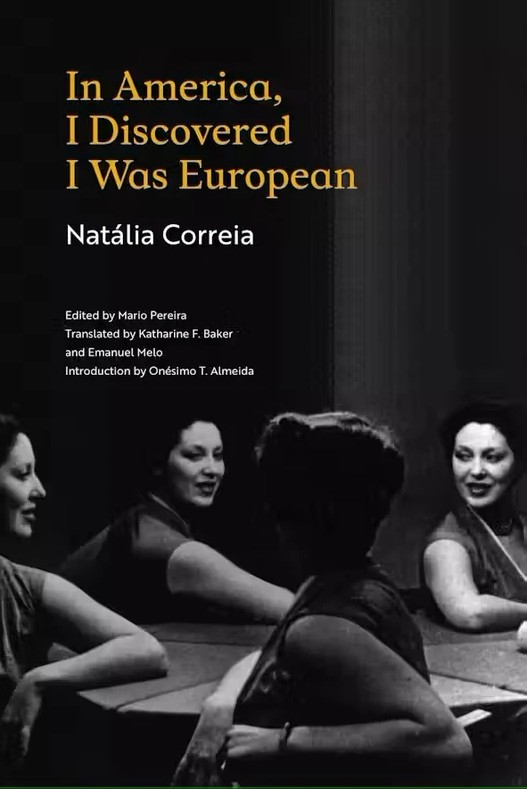
Publication of In America, I Discovered I Was European by Natália Correia
It was said with reason that Natália Correia lived one of the most productive and flamboyant lives in the history of Portuguese culture. In America, I Discovered I Was European is Correia’s account of her first visit at the age of twenty-six to the United States in June 1950. It was a historic month, bracketed by Senator Margaret Chase Smith’s denunciation of McCarthyism and the outbreak of the Korean conflict. Correia visited Boston, coastal Maine, New Bedford, MA, New York City, and Washington, DC. She mingled with intellectual and political figures, visited art museums, frequented nightclubs, watched Russian films, spoke on Portuguese-language radio, met with small town locals in Maine and with Luso-Americans in New Bedford, and attended soirées in Manhattan. In these pages we see the attractions and contradictions of 1950s America, the land of opportunity for so many immigrants, from a fresh perspective, through the experiences, discoveries, perceptive observations and critical reflections of a life-long enfant terrible.
Natália Correia was born in 1923 on São Miguel, Azores, but moved to Lisbon at age eleven. After briefly attending university, she embarked upon a literary career, writing poetry, fiction, plays, criticism, and journalism. A political activist and defender of women’s rights, the charismatic and combative Correia challenged preconceptions and defied conventions. She composed the lyrics to the regional anthem of the Azores. In the 1960s she spent two years under house arrest for resisting Portugal’s dictatorship. In 1971 she and two friends established Lisbon’s Bar Botequim as a venue for music and intellectual and political conversation. She was first elected to Portugal’s Parliament in 1980. One of the most prominent voices of Portuguese literature and culture in the second half of the twentieth century, she died in Lisbon in 1993.
Mario Pereira is Executive Editor of Tagus Press in the Center for Portuguese Studies and Culture at the University of Massachusetts Dartmouth. Katharine F. Baker attended the University of California-Berkeley, University of Maryland, and University of Pittsburgh. She has translated books by Álamo Oliveira, Gabriela Silva, Eduardo Mayone Dias, Vasco Pereira da Costa, Adelaide Freitas, and Joel Neto. She contributes to Gávea-Brown, Filamentos, and The Portuguese Tribune. Emanuel Melo immigrated to Canada at age nine from the Azores. His writing has been published in anthologies of Luso-Canadian writers, in Cleaver Magazine, Gávea-Brown, and Filamentos; other writings are on his website. Onésimo T. Almeida is Professor Emeritus of Portuguese and Brazilian Studies at Brown University.
Published with the support of the Government of the Azores, In America, I Discovered I Was European is volume 5 of the Bellis Azorica Series, edited by Onésimo T. Almeida (Brown University) and Mario Pereira (UMass Dartmouth), and a co-publication with Gávea-Brown Publications in the Department of Portuguese and Brazilian Studies at Brown University.
To purchase In America, I Discovered I Was European, please visit the University of Massachusetts Press website.
From the Center for Portuguese Studies and Culture at UMASS Dartmouth
Vision
To uphold and amplify the legacy of Natália Correia as a beacon of humanism, creativity, and freedom of thought. Through the Cátedra Natália Correia, we envision Fresno State as a transatlantic bridge where her voice continues to inspire critical reflection, cultural innovation, and the defense of democracy, justice, and imagination across generations and borders.
Mission
The mission of the Cátedra Natália Correia is to preserve, study, and disseminate the life and work of Natália Correia as a writer, thinker, and cultural activist. Rooted in her belief in the transformative power of literature and art, we are committed to:
- Literature & Culture: Promoting reading, translation, and study of her writings and the broader Portuguese literary tradition.
- Education & Research: Supporting scholarship, conferences, and academic initiatives that deepen understanding of her humanistic vision.
- Freedom & Humanism: Championing values of liberty, equality, and social justice central to her work.
- Community & Diaspora: Engaging the Portuguese-American and Portuguese-Canadian communities in the United States and beyond, ensuring her words resonate with new audiences.
- Publication & Innovation: Encouraging creative projects, artistic collaborations, and publications that reinterpret her work for contemporary times.
We thank the Luso-American Education Foundation for its support.
 Filamentos (artes e letras)