
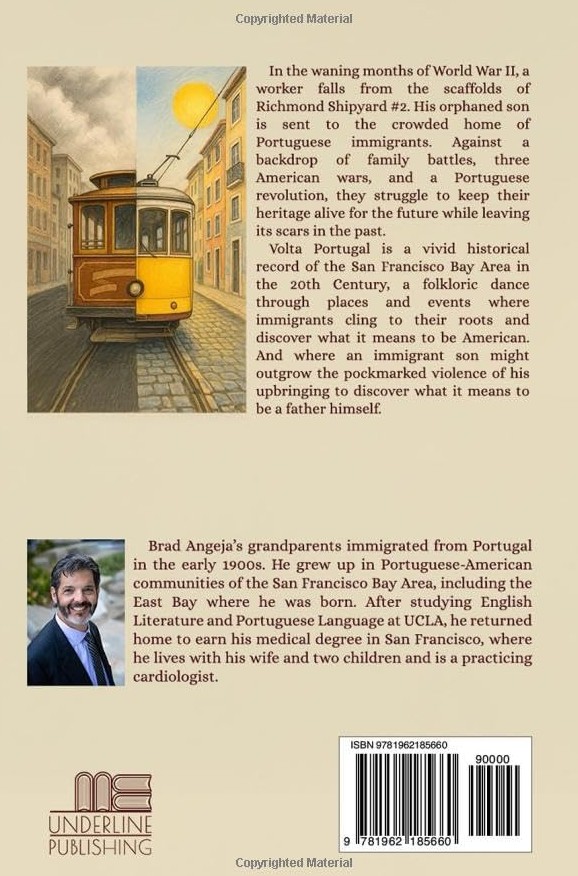
Volta Portugal: Memory, Identity, and the Portuguese Soul in California by Brad Angeja

The past of Portuguese-Americans in California does not stand in marble monuments or inscribed plaques; it breathes in the steam of sopas cooked in community cauldrons, in kitchens heavy with the scent of linguiça and bay leaves, in the clang of steel from shipyards where sparks once lit the night sky. It drifts in the rhythm of the chamarrita danced in crowded halls, in the voices of children who prayed in Portuguese but recited their lessons in English, in the crowns and capes of festas shimmering like borrowed sunlight. It is a past carried in spices, in songs, in sweat, in whispered prayers—a past both fragile and indestructible. Brad Angeja’s Volta Portugal gathers these fragments. It holds them to the light, weaving fact with folklore, memory with invention, until the story becomes not only a novel but an archive of feeling, a lantern raised against the shadows of forgetting. Its very title—Volta, a return, a circling back—captures the essence of diaspora: memory that refuses to vanish, circling like the tide between Portugal and California, stitching love, loss, and belonging into the fabric of a people.
Brad Angeja gives folklore its rightful weight. The Holy Ghost festas emerge not as quaint remnants, but as the glue that holds community identity together. The communal cooking, the crowns and capes of the queens, the rhythm of the chamarrita—these are not nostalgic decorations, but a living declaration that a people could thrive and hold on to their dignity in a new land. The scenes of sopas simmering in enormous cauldrons, men and women laboring through the night to feed hundreds, in some towns thousands, reveal tradition as both ritual and survival. In Volta Portugal, folklore is not ornamental; it is the heartbeat of a diaspora asserting its presence.
At its center, the novel is about families carrying roots into a new soil. The Martins embody both resilience and fracture, love and burden. The author portrays how the community extended family bonds to newcomers, taking in orphans and neighbors’ children as if they were their own. This continuity of Portuguese custom becomes the measure of belonging. Yet belonging is never simple. Children feel torn between homes, siblings compete for affection, and the pressures of survival expose both tenderness and tension. In this way, the family becomes the perfect metaphor for diaspora itself—fragile, conflicted, but sustained by love and necessity.
One of the novel’s most remarkable strengths is its use of dialogue. Every character, from the patriarch to the occasional neighbor, is given a voice that feels authentic. This chorus of voices—sometimes clashing, sometimes affectionate—creates a sense of genuineness and immediacy. Dialogue carries humor, grief, discipline, and yearning, allowing the reader to hear the accents of Portugal mingling with the slang of California. Literature lives in these voices, for they do not flatten into stereotypes but speak in their own cadences. The reader is drawn into the lived world of the characters, not as observers but as listeners. This is the hallmark of immigrant writing: a polyphony that mirrors the multiplicity of lives.
Volta Portugal weaves love in its many forms: friendship, romance, kinship, and communal bonds. Love is hesitant and tender, shaped by the weight of tradition and the eyes of the community. Romantic gestures are never detached from cultural rituals; they unfold in processions, in shared dances, in small acts of empathy between children of different backgrounds. In Angeja’s hands, love is not merely personal but becomes a vehicle for cultural continuity, for healing grief, for binding together fractured communities, for constructing identity in a multicultural world.
The backdrop of the Richmond Shipyards grounds the novel in history. Portuguese immigrants, Dust Bowl migrants, and African Americans built Liberty ships side by side, indispensable to the war effort yet often treated as expendable labor. The precariousness of this work echoes the broader immigrant condition: vital yet vulnerable, celebrated yet scapegoated. When Portuguese children are taunted at school for Salazar’s dictatorship back home, it reminds us that identity is never purely chosen—it is entangled in politics, prejudice, and the gaze of others. The author uses the Bay Area itself—its shipyards, neighborhoods, festas—as a living character that both embraces and excludes.
Brad Angeja’s characters resonate with figures across immigrant literature. The stern patriarch Abe carries echoes of Steinbeck’s men hardened by work and duty, while Glória’s quiet strength recalls Willa Cather’s resilient women. The coming-of-age struggles of Luis mirror, in a Portuguese key, the conflicts of Holden Caulfield or the children of Pietro di Donato’s Christ in Concrete. Roy, the outsider boy who folded into the Martins’ household, belongs to the same lineage as the displaced children in Sandra Benítez’s Bitter Grounds or Cristina García’s Dreaming in Cuban. The novel’s fidelity to the immigrant voice links it to Amy Tan’s The Joy Luck Club, Julia Alvarez’s How the García Girls Lost Their Accents, and even Victor Villaseñor’s Rain of Gold. Each of these works captures how immigrant families navigate love, loss, and survival while carrying ancestral memory into new terrain. Volta brings the Portuguese-American experience into this larger literary conversation.
The author appropriately frames his work as fiction rooted in fact, but memory is its deepest wellspring. Volta Portugal seeks not only to tell a story but to preserve a collective inheritance that might otherwise fade. The novel honors those who left Portugal (mostly Azoreans) for California with little more than faith and labor, who built lives in the shipyards, factories, and dairies of California. It is an act of remembrance and testimony, blending invention with lived truths, much like the oral traditions it evokes.
Volta Portugal is more than a novel—it is a vessel of saudade, carrying across decades the pulse of migration, faith, and resilience. It reminds us that diaspora is not rupture but weaving: threads of Portugal stitched into the soil of California, the Atlantic echoing in the Bay. Its dialogues preserve voices that might otherwise fall silent, its stories testify to a people who gave shape to a corner of America. For readers of Portuguese ancestry, the book is a mirror and a summons. To read it is to remember the kitchens where our grandparents stirred sopas, the festas where crowns and capes shimmered, the fields and shipyards where calloused hands built bright futures. It is to discover that within this story lies a fragment of our own family’s tale.
In the end, Volta Portugal is not only the tale of an immigrant community—it is the song of California itself. It is a book where the Atlantic meets the Pacific, where the salt of Azorean seas mingles with the dust of Central Valley fields, where carnations pressed into rifles in Lisbon bloom again in Bay Area backyards. Brad Angeja’s novel reminds us that identity is never a single note but a chorus, never a straight line but a weaving of roots that entangle, break, and sprout anew. In its pages, we hear the echoes of Steinbeck’s fields, Tan’s kitchens, Alvarez’s exiles, García’s dreamers, Villaseñor’s strivers—all refracted through the cadence of Portuguese saudade. To read Volta Portugal is to step into a California that is not only Portuguese, not only American, but a landscape of converging journeys—where every immigrant’s memory, every family’s sacrifice, every whispered prayer becomes part of the larger tapestry of belonging. It is a reminder that California itself is a volta: a circling back, a return to the truth that we are all woven from stories carried across oceans, stitched into the soil of a shared home.
Diniz Borges
 Filamentos (artes e letras)