A LUSO-SPANISH ARCHIPELAGO
The salty wave that caresses and drowns the widowed basalt of Ponta Delgada is the same that embraces and scorches the nuptial sand of Las Palmas. Anchored and christened by the Iberian wedding of Funchal.
The Azores, Madeira, and the Canary Islands have been courting for centuries!
It is indeed a time of union.
First, the geographical union of Macaronesian neighbors.
Then, the historical union of peninsular complicity.
Now, the cultural union of poetic motivation.
Four centuries later, with Saudades da Terra (Longing for the Land) of the three archipelagos, the historian Gaspar Frutuoso from São Miguel seems to have inspired the Madeiran poet João Carlos Abreu to embrace the Fortunate Islands in words. An embrace in the form of a book, entitled Abraço Atlântico (Atlantic Embrace), was published in Funchal in 2020. With it, we embark on this return journey of João Gonçalves Zarco and Tristão Vaz, of Gonçalo Velho Cabral and Diogo de Silves.
Unanchored by geography, navigated by history, brought together by culture.
The Azores, Madeira, and the Canary Islands coexist in the Atlantic condominium of Macaronesia, with Cape Verde. They are as close and as far from their seafaring brothers as they are from the continental cradle.
Ponta Delgada is 1,151 kilometers from Funchal and 978 kilometers from Lisbon.
Funchal is 1,450 kilometers from Lisbon and 544 kilometers from Las Palmas.
Las Palmas is 1,738 kilometers from Madrid and 1,450 kilometers from Ponta Delgada.
Unlike Madeira and the Azores, which were discovered and settled by Portuguese Iberians in the first half of the 15th century, the Canary Islands were occupied by North African Guanches before the European arrival at the end of the same century.
However, the conquest and colonization by the Castilians was shared and disputed by the Portuguese. It is even said that settlers from Madeira arrived in the Canary Islands and that the Portuguese captured freed Guanches for slave labor in the sugar cane fields of Madeira.
The Canary Islands were Old Europe’s main gateway to the New World. They were a trading stop on the ocean route to tropical America.
On the return journey, the Azores assumed a strategic position. A sheltered stopover for Atlantic navigation.
Between the two, there was also Madeira. A convenient stopover for supplying wine to the crews.
Thus, commercial contacts between the three archipelagos were born. Madeira, wine, and sugar. From the Canary Islands, fruit and fabrics. From the Azores, wheat. These flowed into the cultural complicities of a common sea.
In architecture, the traditional wine presses of Madeira and the Canary Islands or the typical haystacks of the Canary Islands and the Azores.
In agriculture, the farming tools of Madeira and the Canary Islands, or the bell collars of the oxen yokes of the Canary Islands and the Azores.
In crafts, the embroidery and lace of Madeira and the Canary Islands, and the traditional costumes of Vila de La Orotava and Madeira, or La Palma and the Azores.
In folklore, the Malaguena of the Canary Islands and the Charamba of the Azores.
In fauna, the Serinus canaria or canary, is exclusive and common to the three archipelagos.
The culture that unites us is greater than the sea that separates us and the calendar that distinguishes us.
The Azores, Madeira, and the Canary Islands are as linked in space and time as they are enamored by literary empathy.
In the luminous shadow of José de Anchieta (Tenerife, 1534), Antero de Quental (Ponta Delgada, 1842), and Herberto Helder (Funchal, 1930), the International Poetry Encounters—held in Ponta Delgada (2017, 2019, and 2024), Porto Santo (2018 and 2022) and Las Palmas (2021), and planned for Las Palmas (2025) and Porto Santo (2026) by the insular and Iberian soul of João Carlos Abreu – are now paving the way forward for each and every one.
Our Portuguese-Spanish “archipelago” now has 18 islands in the life of Poetry: Corvo, El Hierro, Faial, Flores, Fuerteventura, Graciosa, Gran Canaria, La Gomera, La Palma, Lanzarote, Madeira, Pico, Porto Santo, Santa Maria, São Jorge, São Miguel, Tenerife, and Terceira.
May you also have it in the poetry of Life.
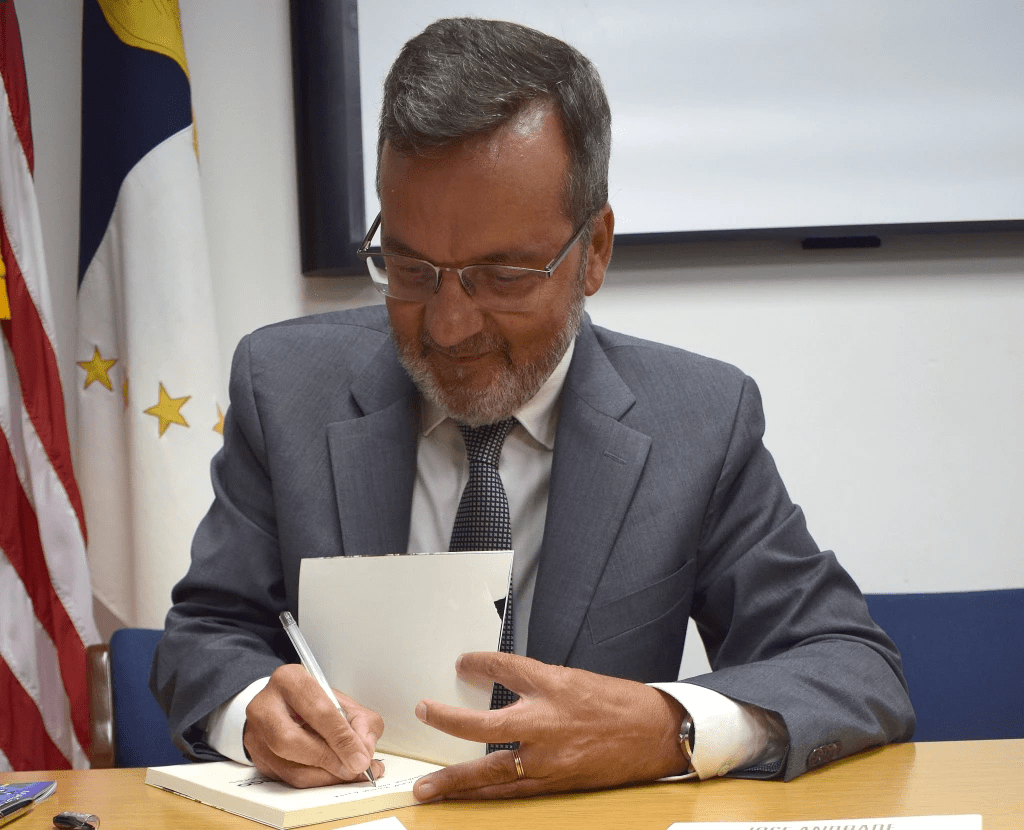
José Andrade is the current Director of the Azorean Communities for the Government of the Azores.
Translated by Diniz Borges
We thank the Luso-American Education Foundation for its support.
 Filamentos (artes e letras)