
IN THE BEGINNING THERE WAS THE BOOK
The book is like a river. It has its source and its mouth. And just as the river blends into the ocean’s vastness, the book merges into the mass of universal knowledge. Its source is the author. Its mouth is the reader. But this journey would not be possible without the publisher and the bookseller, sometimes obscure but no less important figures in the book’s march toward its universal destiny.
However, it is not without reason that alarm bells are ringing today. Technological omens, including McLuhan’s global village, predict, if not the liquidation of the book by the hypnosis of audio-visual media, at least the significant reduction of its space. Woe betide us if this is the case. Because audiovisual, no matter how highly cultural it may be, and it will hardly ever be, doesn’t allow for the retention of the word, the turning back that writing provides, indispensable elements for reflection, the exercise of memory, and the awakening of subjectivity that is increasingly depleted by the tyranny of massification.
Dignifying the book and promoting its expansion is the work of those committed to safeguarding the individualizing values that can resist the imbecilization of humanity sterilized by the egalitarianism of technological quantification.
When Gutenberg invented the printing press, some saw this means of democratizing knowledge as the fanciful work of a pact with the devil. And even Lope de Vega denounced the danger of vandalizing by quantity what should be the inheritance of quality. However, ironically, today, due to the changing times and wills, it is in this noble product of the printing press that the virtues of defending the qualitative against globalist technology, which depersonalizes and disidentifies individuals, reside. Congrats, then, to those on this island who confirm the tradition of bibliophilia that has illustrated it so much and provided it with yet another instrument of culture. This is the very condition for strengthening the Azorean personality and its invulnerability to the usury of a centralizing state, which, in its narcissism, condemns itself to sink in the fatal waters of self-contemplation, tragically oblivious to indefectible realities such as this: Azoreanness.
Natália Correia
Translated by Diniz Borges
(From a presentation she made at the opening of a bookstore in the Azores)
Thanks to Dr. Carlos Melo Bento for the original text in Portuguese.
The series envisions Natália Correia as a world writer, a voice whose work transcends geography and language. Through translation, it will establish her as a central figure not only of Portuguese literature but of universal literature, accessible to readers of all backgrounds. Rooted in the Cátedra Natália Correia at the Portuguese Beyond Borders Institute, California State University, Fresno, this project is guided by the belief that literature is both cultural memory and social capital — a bridge between Portugal, the diaspora, and the global community of readers.
- Translate and publish Natália Correia’s poetry, prose, and creative writings systematically into English, creating the first sustained body of her work in translation.
- Connect diaspora communities in North America to one of their greatest literary and feminist figures, strengthening cultural pride and identity.
- Introduce American and Canadian readers to a bold, universal author whose themes — freedom, feminism, justice, creativity, and human dignity — speak urgently to our own age.
- Preserve, amplify, and institutionalize Natália’s legacy as poet, essayist, novelist, and cultural icon through the Cátedra Natália Correia at the Portuguese Beyond Borders Institute, Fresno State, ensuring that her work reaches both academic and community audiences.
- Foster dialogue between Portugal and its diaspora by using literature as a shared space of memory, imagination, and critical thought.
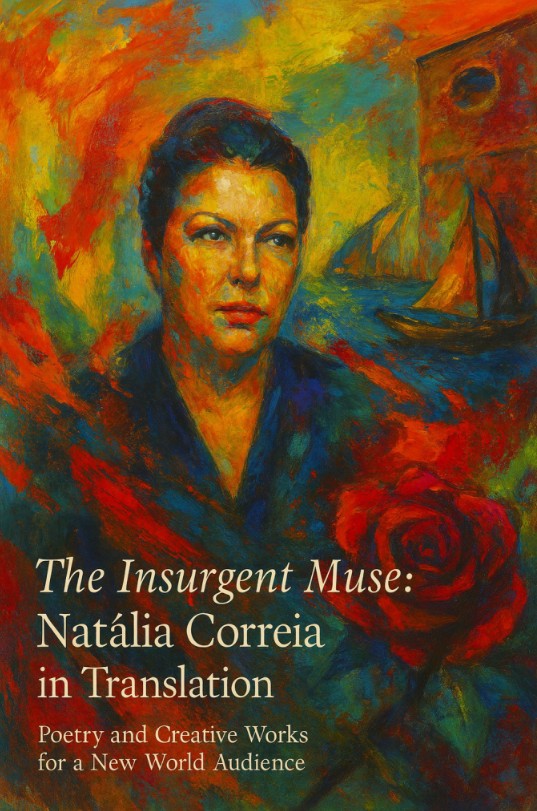
Natália Correia (1923–1993) was one of Portugal’s most incandescent voices — poet, novelist, playwright, essayist, and fearless advocate for freedom and women’s rights. Her words shook dictatorships, inspired generations, and continue to burn with relevance today.
The Insurgent Muse: Natália Correia in Translation is the first sustained project to bring her creative universe into English. Conceived under the auspices of the Cátedra Natália Correia at the Portuguese Beyond Borders Institute (PBBI), California State University, Fresno, this series brings together her lyrical poetry, her essays of resistance, her daring erotic writings, and her visionary humanism.
This project is more than translation — it is cultural bridge-building. It offers the Portuguese diaspora in North America a luminous return to one of their greatest voices, while introducing American and Canadian readers to a writer whose work belongs among the greats of world literature. In her lines, we find not only the soul of Portugal but also the universal call of a writer who believed that poetry was a force for liberty, equality, and imagination.
This project is sponsored by the Luso-American Education Foundation.

 Filamentos (artes e letras)