

The painting exhibition “Between Land and Sea” opens tomorrow and will be on display at the Altares Museum Center until October 26. Is this your first exhibition? What does this milestone mean to you, and what are your expectations?
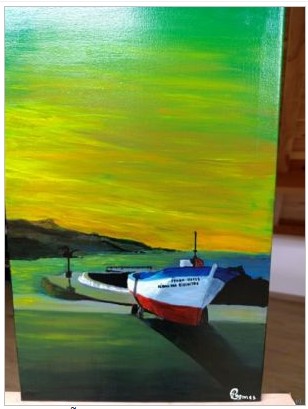
Yes, this is my first exhibition, and it’s part of Dar Cena – 8th Northwest Theater Exhibition. I’ve always seen painting as an intimate form of expression, almost like a personal diary made up of colors and brushstrokes. Now that we can share this journey with the public, it is both a challenge and a great joy. The exhibition “Between Land and Sea” is born of my deep connection to the Azorean territory, where the horizon never ends, where on one side is the bravery of the land and on the other the vastness of the ocean. I hope that visitors can feel directed to these places and recognize something from their own experience or discover a new perspective on the landscape that surrounds us.
How did your love of painting come about? What was your path?
My love of painting developed early on, during my childhood and adolescence. I liked to draw and paint, but I never really got into it. It was only more recently, as an adult, that I picked up the brushes again as an escape from the stresses of everyday life. It was a rediscovery, an almost natural return to something that was already part of me. Since then, painting has become not only a refuge, but also a way of giving more balance and meaning to my routine.
How has the public reacted to your work?
So far, I’ve mainly been sharing with my friends and acquaintances on social media. The reactions have been overwhelmingly positive and motivating, always accompanied by words of encouragement that give me the confidence to continue. This initial sharing was essential for me to gain the courage to take this bigger step and present the works to the public in an exhibition. Now I’m really looking forward to seeing what the reaction of the wider public will be like.
You paint mainly landscapes. What makes you choose this theme?
For me, the landscape is much more than an aesthetic motif; it’s a space of memory and identity. Each place holds stories, silences, and atmospheres that inspire me to paint. In the Azores, nature is irresistible; you only have to look at the rough sea, the texture of the volcanic rocks, or the light that changes every moment to feel the ambition to capture that moment. The landscape allows me to work with both attentive vision and personal interpretation, and in this balance, I find a language that is my own.
The Azores are always present in your art. Are they the ideal place for those who like to be inspired by nature?
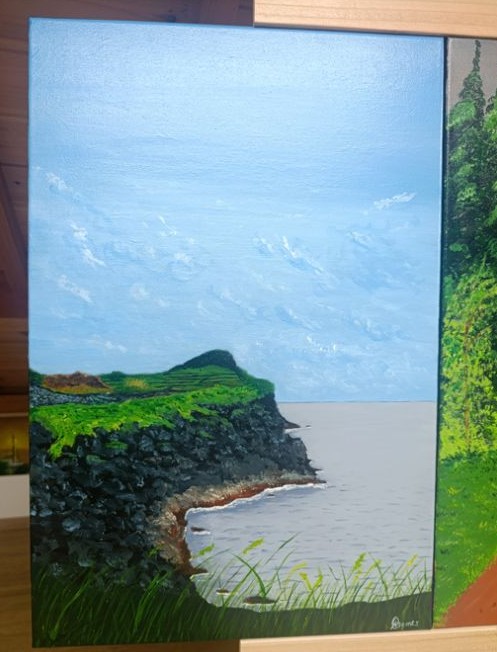
Absolutely. Living in the Azores means being constantly surrounded by visual and sensory stimuli. The intensity of the colors, the unpredictability of the climate, and the constant proximity between sea and land create a unique setting. It’s a privilege to be inspired every day by an environment that never repeats itself and, at the same time, conveys a sense of belonging. Each island has its own identity, and this multiplies the creative possibilities. I don’t think there could be a more fertile place to develop a painting linked to nature.
You also draw as an urban sketcher. Is that a different experience? What’s special about it?
Yes, it’s quite a different experience from studio painting. Urbansketching is an exercise in direct and immediate observation, sitting in a street, a square, or in front of a building, and recording what I see in the moment. There’s no time for hesitation; you have to quickly capture the essence of the scene. This spontaneous nature gives the drawing a unique character and, at the same time, forces me to take a closer look at everyday details that often go unnoticed. While landscape painting connects me above all with nature and silence, urban sketching brings me closer to people, urban life, and movement. They are complementary practices that enrich the artistic vision.
In Diário Insular, José Lourenço-director

We thank the Luso-American Education Foundation for its support.

 Filamentos (artes e letras)